
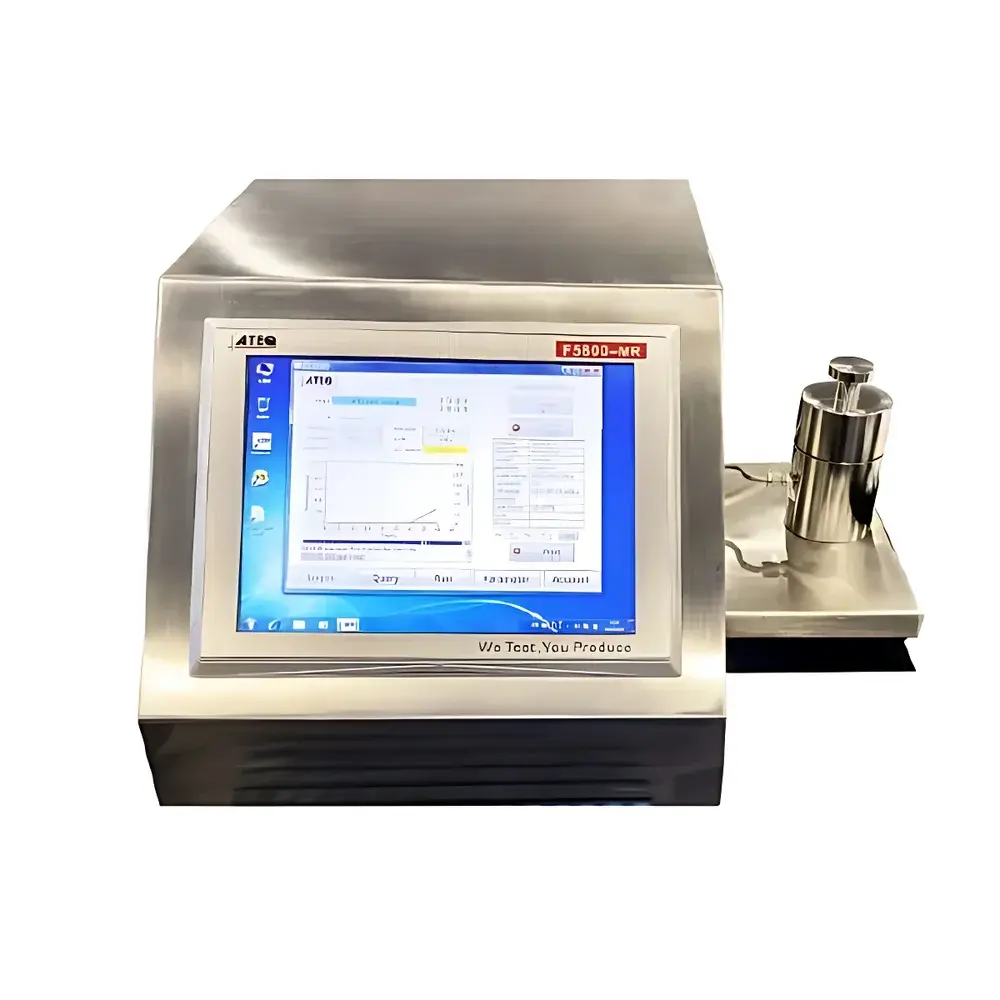
ATEQ F5800-MR Vacuum Decay Container Closure Integrity Tester
| Brand | ATEQ |
|---|---|
| Model | F5800-MR |
| Origin | France |
| Measurement Principle | Vacuum Decay |
| Compliance | ASTM F2338-09, FDA 21 CFR Part 11 (data integrity), ISO 8573-1 (air quality) |
| Test Volume | <7 mL |
| Sensitivity | ≥0.02 cc/min (equivalent to ~1.5 µm equivalent leak diameter) |
| Operating Temperature | 10–45 °C |
| Power Supply | 100–240 VAC, 50 W |
| Dimensions (W×H×D) | 450 × 150 × 356 mm |
| Weight | 20 kg |
| Display | Color touchscreen HMI |
| Pressure Sensors | Dual high-stability absolute pressure sensors |
| Data Traceability | Audit trail, electronic signatures, method versioning |
| Validation Support | IQ/OQ/PQ documentation package, 3Q validation-ready |
Overview
The ATEQ F5800-MR Vacuum Decay Container Closure Integrity Tester is an engineered solution for non-destructive, quantitative assessment of container closure integrity (CCI) in sterile pharmaceutical packaging. Based on the vacuum decay test principle—measuring minute pressure changes within a sealed test chamber under controlled vacuum conditions—the system detects leaks by quantifying the rate of pressure rise over time. This thermodynamically grounded method relies on gas law relationships (ideal gas behavior under low-pressure, isothermal conditions) and eliminates reliance on tracer gases or destructive sampling. Designed specifically for regulatory compliance in GMP environments, the F5800-MR implements ASTM F2338-09 as its foundational test protocol—a consensus standard formally recognized by the U.S. Food and Drug Administration (FDA) and the Center for Devices and Radiological Health (CDRH). Its sub-7 mL test cavity volume minimizes compressibility effects and enhances signal-to-noise ratio, enabling reliable detection down to 0.02 cc/min (equivalent to a ~1.5 µm laser-drilled reference orifice under defined test conditions).
Key Features
- Dual high-resolution absolute pressure sensors for differential drift compensation and enhanced measurement stability
- Compact test chamber architecture (<7 mL internal volume) optimized for rapid equilibration and minimal thermal lag
- Integrated color touchscreen HMI with intuitive workflow navigation, real-time pressure curve visualization, and cycle status logging
- Full audit trail capability compliant with FDA 21 CFR Part 11 requirements—including user authentication, electronic signatures, and immutable record retention
- Pre-validated test methods with documented uncertainty budgets and repeatability data per ICH Q2(R2) guidance
- Modular chamber design supporting custom fixtures for vials (2–30 mL), syringes, cartridges, ampoules, and blow-fill-seal (BFS) containers
- Onboard diagnostics for vacuum pump health, sensor calibration status, and environmental parameter monitoring (temperature, ambient pressure)
Sample Compatibility & Compliance
The F5800-MR accommodates a broad range of primary packaging formats common in aseptic manufacturing, including glass and polymer-based vials (e.g., 2R–20R), pre-filled syringes (1–3 mL), cartridges (e.g., 3–10 mL), ampoules, and BFS containers. It supports products containing liquids, lyophilized powders, suspensions, and semi-solids—provided headspace gas composition remains stable during test duration. All test configurations adhere strictly to ASTM F2338-09 procedural requirements, including chamber evacuation rate control, stabilization timing, test duration definition, and pass/fail threshold calculation methodology. The instrument meets ISO 8573-1 Class 4 compressed air purity specifications for test gas supply and operates within validated temperature and humidity envelopes per EU Annex 1 and USP . Full 3Q (IQ/OQ/PQ) documentation packages—including installation protocols, operational boundary testing, and performance qualification using NIST-traceable leak standards—are provided to support regulatory submissions and routine requalification.
Software & Data Management
ATEQ’s proprietary CCI software suite provides method development, execution, and reporting functionality aligned with ALCOA+ data integrity principles. Each test run generates a timestamped, digitally signed record containing raw sensor data (pressure vs. time), calculated leak rate, environmental metadata, operator ID, and equipment configuration snapshot. Data export is supported in CSV and PDF formats, with optional integration into LIMS or MES via OPC UA or RESTful API interfaces. Software includes built-in tools for method optimization—such as stabilization time profiling, pressure ramp rate adjustment, and statistical process control (SPC) charting for trend analysis across batches. All software updates undergo formal change control and are accompanied by impact assessments for GxP-relevant functions.
Applications
- Final container release testing for parenteral drug products prior to distribution
- Process validation support for stoppering, capping, and sealing operations
- Stability study monitoring of CCI over shelf life under accelerated and real-time storage conditions
- Root cause investigation of sterility failures through comparative leak mapping across production lots
- Qualification of alternative closures (e.g., rubber stoppers, elastomeric seals) and container materials (e.g., cyclic olefin copolymer vials)
- Support for Quality Risk Management (ICH Q9) and lifecycle-based CCI control strategies per USP
FAQ
What regulatory standards does the F5800-MR comply with?
ASTM F2338-09 is fully implemented; data handling conforms to FDA 21 CFR Part 11 and EU Annex 11 requirements for electronic records and signatures.
Can the system be integrated into an automated production line?
While primarily designed for offline lab use, the F5800-MR supports discrete batch testing with barcode-triggered method selection and can interface with PLCs via digital I/O or Ethernet/IP for semi-automated workflows.
Is method transfer between laboratories supported?
Yes—method portability is ensured through standardized parameter sets, traceable calibration procedures, and cross-site verification protocols included in the validation package.
Does the instrument require periodic recalibration?
Pressure sensors are factory-calibrated with NIST-traceable references; annual verification against certified leak standards is recommended and supported by ATEQ’s service network.
How is environmental variability (e.g., ambient temperature fluctuations) compensated?
The system monitors chamber temperature in real time and applies physics-based compensation algorithms to pressure decay calculations, minimizing thermal drift artifacts.



