
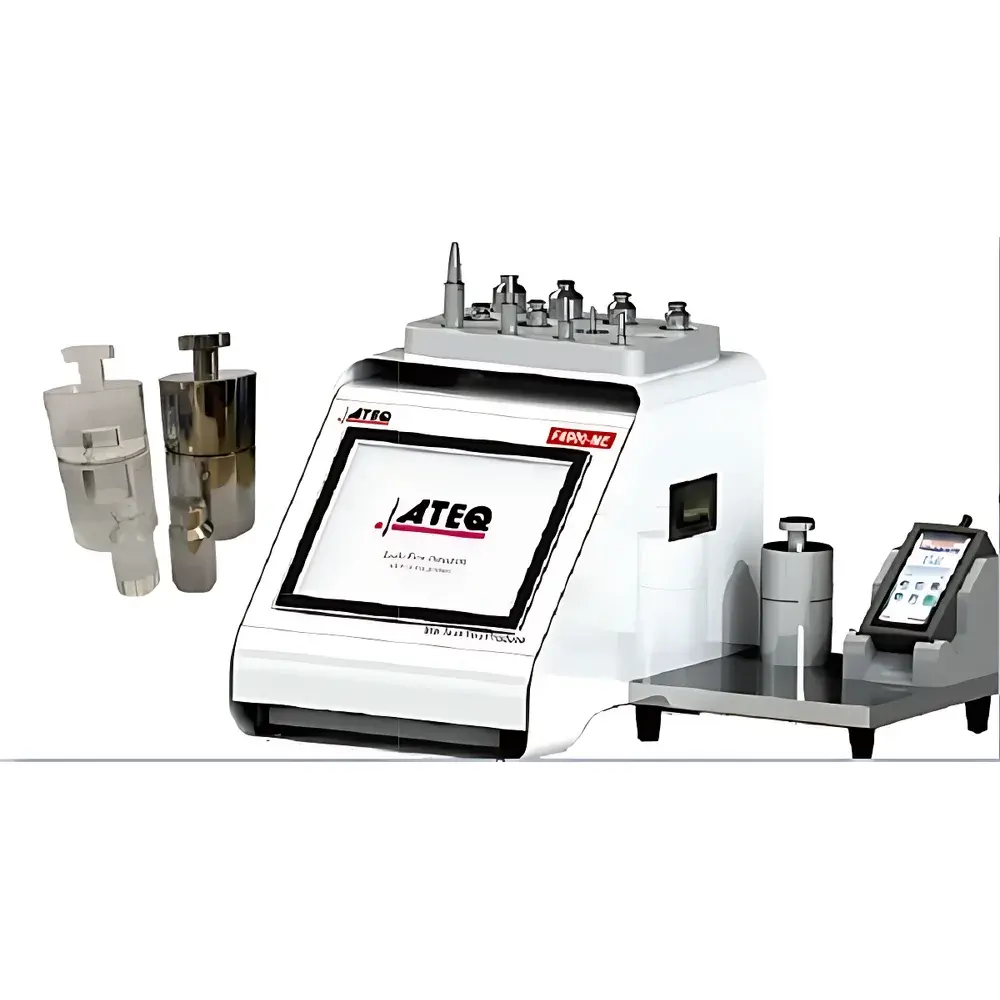
ATEQ F6900-EC Desktop Vacuum Decay Leak Tester
| Brand | ATEQ |
|---|---|
| Model | F6900-EC |
| Origin | France |
| Type | Vacuum Decay Leak Detection System |
| Compliance | ASTM F2338-09 |
| Internal Volume | Minimized Dead Volume |
| Power Supply | 100–240 VAC, 50 W |
| Drive Air Pressure | 400–600 kPa |
| Test Air Pressure | +1–2 bar above test pressure |
| Air Quality | ISO 8573-1 Class 4 or better |
| Operating Temperature | 10–45 °C |
| Storage Temperature | 0–60 °C |
| HMI | Color TFT Display with Intuitive Menu Navigation |
| Optional Accessories | Micro-flowmeter, Custom Vial Test Chamber, Certified Leak Standards |
Overview
The ATEQ F6900-EC Desktop Vacuum Decay Leak Tester is an engineered solution for quantitative, non-destructive leak detection in sealed packaging and components across regulated and industrial environments. Based on the vacuum decay principle—where a test specimen is evacuated to a defined sub-atmospheric pressure, isolated, and monitored for pressure rise over time—the system delivers high-resolution, repeatable quantification of leak rates without product contact or internal modification. Unlike tracer-gas or bubble-emission methods, vacuum decay operates independently of gas species, making it ideal for sterile barrier systems (SBS), pharmaceutical blister packs, pre-filled syringes, IV bags, and automotive fluid reservoirs where residual moisture, headspace composition, or material permeability may interfere with alternative techniques. The F6900-EC implements a dual-sensor, dual-cycle architecture: one sensor monitors chamber pressure during evacuation and stabilization; the second tracks ultra-fine pressure drift during the isolation phase—enabling robust compensation for thermal transients and system compliance effects. Its minimized internal volume (< 2.5 mL) reduces compressibility error and accelerates cycle times, supporting throughput up to 6–8 tests per minute under typical conditions.
Key Features
- Dual high-stability piezoresistive pressure sensors (±0.05% FS accuracy) for independent chamber and reference monitoring
- Patented electro-pneumatic valve manifold with microsecond actuation timing, eliminating hysteresis and flow-induced artifacts
- Ultra-low dead-volume test cavity optimized for small-format containers (e.g., 1–50 mL vials, blister cards, pouches)
- Real-time pressure vs. time curve visualization on integrated 7-inch color TFT display with touch-enabled navigation
- Pre-configured test protocols aligned with ASTM F2338-09, including “Standard Test Method for Nondestructive Detection of Leaks in Packages by Vacuum Decay”
- Automatic temperature drift correction via internal thermal sensor and adaptive baseline modeling
- Integrated self-diagnostics and calibration status tracking compliant with ISO/IEC 17025 laboratory requirements
Sample Compatibility & Compliance
The F6900-EC accommodates rigid, semi-rigid, and flexible packaging formats without requiring fixture reconfiguration. Standard configurations support vials (2–50 mL), ampoules, syringes, blister cards (Alu-Alu, Alu-PVC), pouches (Tyvek®/PE, foil-laminates), and medical device housings. Optional custom chambers—including stainless-steel vial adapters and low-permeability elastomer seals—are available for GMP-compliant validation studies. Regulatory alignment includes full traceability to ASTM F2338-09, ISO 11607-2 (Packaging for terminally sterilized medical devices), and USP (Package Integrity Evaluation). Data integrity meets FDA 21 CFR Part 11 requirements through electronic signature support, audit trail logging (user actions, parameter changes, pass/fail decisions), and immutable result archives.
Software & Data Management
ATEQ’s proprietary LeakWare™ software (v4.2+) enables remote configuration, method development, and statistical process control (SPC) integration. All test data—including raw pressure curves, derivative plots, leak rate calculations (in Pa·s⁻¹ or cc/min He equivalent), and environmental metadata—are exported in CSV, PDF, or XML formats compatible with LIMS and MES platforms. The system supports IQ/OQ documentation packages, including protocol templates for installation qualification (IQ), operational qualification (OQ), and performance qualification (PQ) per Annex 15 and EU GMP guidelines. Audit trails record timestamped entries for every user interaction, parameter adjustment, and calibration event—retained for ≥36 months with optional cloud backup.
Applications
- Pharmaceutical: Sterility assurance testing of lyophilized vials, pre-filled syringes, and combination products per USP
- Medical Devices: Validation of sterile barrier integrity for catheters, implants, and diagnostic cartridges
- Automotive: Functional leak verification of brake fluid reservoirs, fuel caps, and EV battery enclosures
- Consumer Health: QC screening of inhaler canisters, nasal spray pumps, and transdermal patch packaging
- Food & Beverage: Shelf-life stability assessment of retort pouches and modified atmosphere packaging (MAP)
FAQ
What leak rate sensitivity does the F6900-EC achieve under standard conditions?
Typical detection limit is 1 × 10⁻⁴ mbar·L/s (≈ 1 × 10⁻⁵ cc/s He equivalent) for 10-mL rigid containers tested at 80 kPa vacuum, 30-second hold time, and 10-second measurement interval.
Can the system be integrated into a production line?
Yes—via Ethernet/IP or Modbus TCP interfaces; optional PLC-ready I/O modules support e-stop, start trigger, and pass/fail discrete outputs for inline deployment.
Is operator training required for method development?
Basic operation requires <30 minutes; advanced method optimization (e.g., pressure ramp profiling, multi-stage decay analysis) is supported by ATEQ-certified application engineers onsite or remotely.
How often must the system be calibrated?
Annual calibration is recommended; internal zero and span checks are performed automatically at startup and may be scheduled daily or per shift.
Does the instrument meet cleanroom compatibility requirements?
The F6900-EC housing meets ISO 14644-1 Class 5 (Class 100) particulate limits when operated with ISO 8573-1 Class 4 compressed air; optional stainless-steel enclosure upgrade available for Class 10 environments.



