
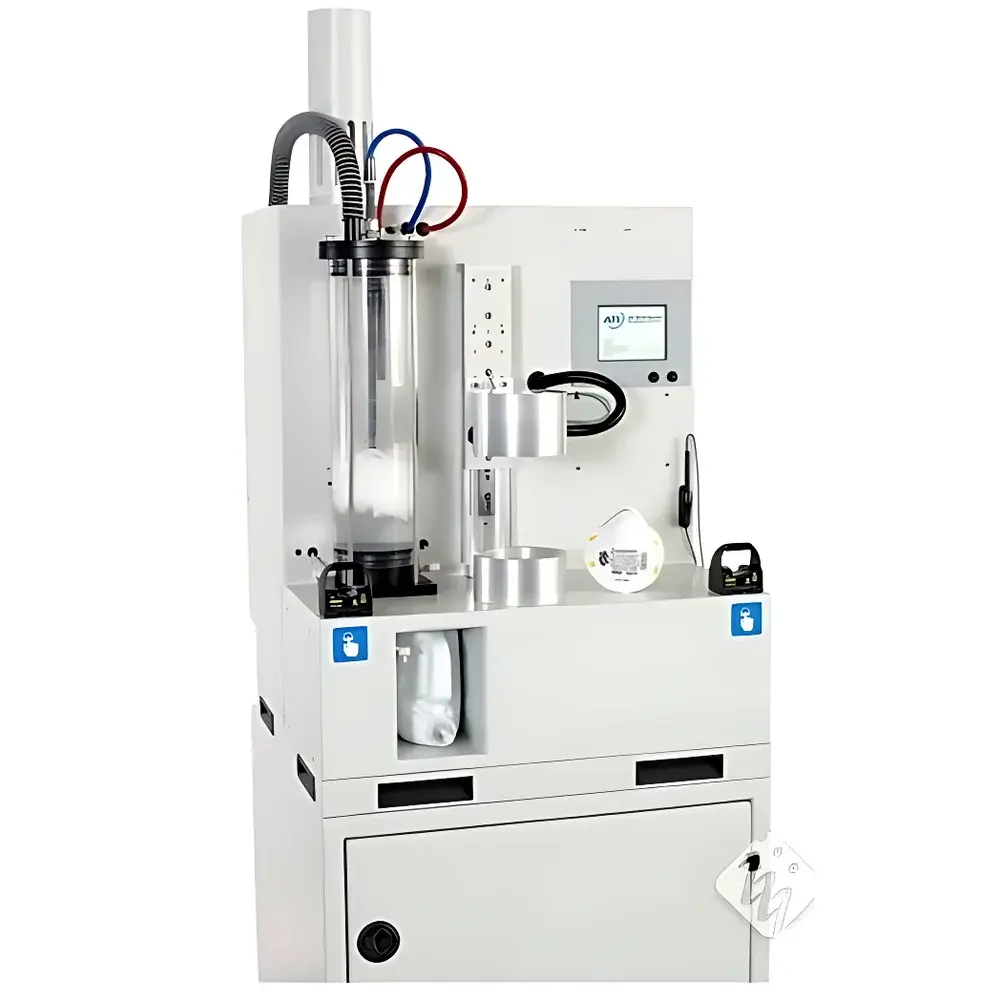
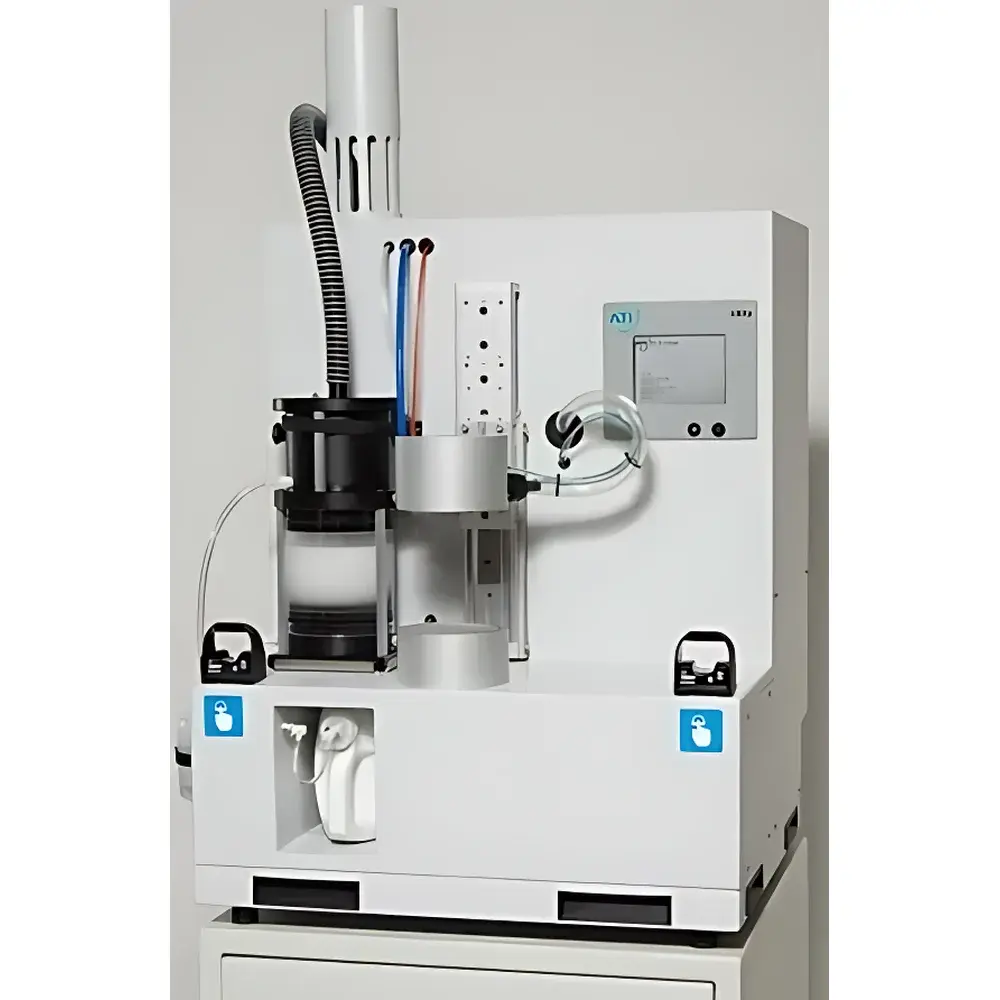
ATI 100X Automated Filter Efficiency Tester
| Brand | ATI |
|---|---|
| Origin | USA |
| Model | 100X |
| Compliance | NIOSH 42 CFR Part 84, GB 2626–2019, GB 19083, EN 13274-7:2019, ASTM F3502-21, ISO 23328, YY 0469 |
| Aerosol Types | NaCl (salt) or DOP/PAO/paraffin oil |
| Flow Range | 10–170 L/min |
| Filtration Efficiency Range | up to 99.9995% |
| Sampling | 100% isokinetic aerosol sampling |
| Aerosol Reservoir | 3.8 L (1 gal) integrated patented replenishment system |
| Test Area | 100 cm² standard flat-media fixture |
| Configuration Options | Manual, Automatic (PLC-integrated), Hybrid |
Overview
The ATI 100X Automated Filter Efficiency Tester is a precision-engineered instrument designed for quantitative evaluation of filtration performance across medical, industrial hygiene, and personal protective equipment (PPE) applications. It operates on the principle of real-time, 100% isokinetic aerosol sampling combined with photometric or particle-counting detection—enabling trace-level resolution of penetration through filter media, respirator facepieces, and cartridge-based systems. The system generates monodisperse or polydisperse challenge aerosols (NaCl for salt-based testing; DOP, PAO, or paraffin oil for oil-based protocols) under tightly controlled flow conditions, ensuring metrological traceability and repeatability required for regulatory conformance. Its architecture supports both R&D validation and high-throughput production QC environments, delivering data that directly align with pass/fail criteria defined in globally harmonized standards.
Key Features
- 100% isokinetic aerosol sampling architecture eliminates spatial bias and minimizes particle loss, enhancing measurement fidelity for ultra-high-efficiency filters (e.g., HEPA, ULPA, electret media).
- Three selectable flow rates (10–170 L/min), with EN 13274-7:2019-compliant high-flow option enabling simultaneous multi-unit testing or PAPR filter characterization.
- Patented 3.8 L (1 gallon) integrated aerosol solution reservoir with auto-replenishment—eliminates manual refills during extended test sequences and stabilizes aerosol concentration and size distribution over time, especially critical for NaCl-based dynamic salt challenges.
- Modular configuration options: Manual (human-triggered via ergonomic photo-actuator, ideal for lab-scale validation), Automatic (RS-232/Ethernet-enabled PLC integration for inline 100% inspection in automated manufacturing lines), and Hybrid (dual-mode operation supporting both local fixture use and remote PLC-driven deployment).
- High-accuracy differential pressure monitoring across test specimens, synchronized with aerosol generation and detection subsystems for comprehensive resistance–efficiency correlation analysis.
- Acoustically optimized enclosure (<65 dB(A)) suitable for shared QC laboratories and regulated R&D facilities without requiring dedicated noise-isolation infrastructure.
Sample Compatibility & Compliance
The 100X accommodates flat-sheet filter media (HEPA, ULPA, electret, melt-blown nonwovens), rigid cartridges, half/full-face respirators (N95, KN95, FFP2/FFP3, P100), surgical masks, and powered air-purifying respirator (PAPR) filters. It satisfies full test method alignment with ISO 23328 (anesthesia/respiratory circuit filters), ASTM F3502-21 (performance specification for barrier face coverings), YY 0469 (Chinese surgical mask standard), GB/T 32610 (daily protective masks), and GB 19083 (medical protective masks). For certification workflows, the platform supports audit-ready documentation per GLP/GMP principles and facilitates 21 CFR Part 11–compliant electronic records when paired with validated software configurations.
Software & Data Management
The 100X operates with ATI’s proprietary firmware suite, delivering real-time efficiency calculation (penetration = downstream / upstream × 100%), pressure drop logging, and statistical summary reporting (mean, SD, CV%) per test sequence. Export formats include CSV and PDF, compatible with LIMS integration and internal QA databases. All test parameters—including aerosol type, flow rate, test duration, and operator ID—are timestamped and immutably logged. Optional software modules provide trend analysis across batches, SPC charting (X-bar/R), and automated report generation aligned with CNAS, CMA, or FDA submission templates.
Applications
- Validation of electret-charged melt-blown polypropylene media used in N95 respirators and surgical masks.
- Batch release testing of industrial cartridge filters against NIOSH 42 CFR Part 84 subpart K (e.g., P100 oil resistance) and EN 143/EN 149 requirements.
- Developmental screening of novel nanofiber or electrospun filter architectures under variable humidity and loading conditions.
- Regulatory submission support for LA certification (China), CE marking (EU), and FDA 510(k) or De Novo pathways.
- Root-cause analysis of filter degradation following simulated aging (thermal, mechanical, or aerosol loading cycles).
FAQ
Does the 100X support both salt and oil aerosol testing in a single unit?
Yes—the 100X is available in dedicated NaCl or oil-aerosol variants (DOP/PAO/paraffin); dual-aerosol capability requires factory configuration and separate aerosol generation modules.
Can the 100X be integrated into an existing automated production line?
Yes—its automatic configuration includes native RS-232, Modbus TCP, and Ethernet/IP interfaces for seamless PLC handshake and status feedback (pass/fail, efficiency %, ΔP, error codes).
Is the 100 cm² test area fixed, or are custom fixtures available?
The standard fixture is 100 cm² for flat media; optional fixtures for 3M 8210-style respirators, half-face forms, and cylindrical cartridges are available upon request.
How does the 100X ensure long-term stability of NaCl aerosol concentration during extended runs?
Its patented reservoir design maintains constant solution level and feed pressure, minimizing concentration drift caused by evaporation or crystallization—critical for meeting GB 2626–2019 and EN 13274-7:2019 repeatability thresholds.
What calibration standards does the 100X reference for photometric detection?
Photometric mode uses NIST-traceable polystyrene latex (PSL) spheres at 0.3 µm and 0.6 µm for optical density verification; particle-counting mode supports ISO 21501-4 compliant calibration using certified reference aerosols.







