
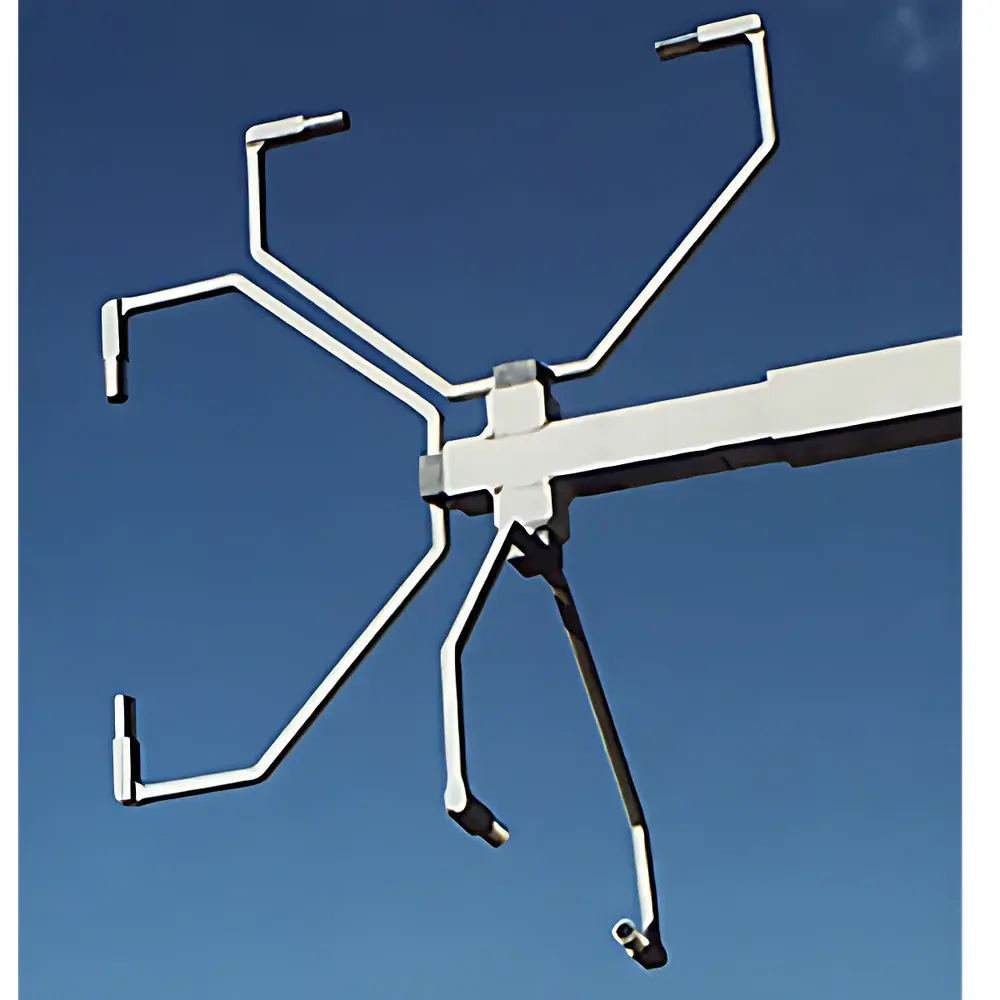
ATI TriSonica 3D Ultrasonic Anemometer
| Brand | ATI |
|---|---|
| Origin | USA |
| Instrument Type | Ultrasonic Anemometer |
| Measurement Principle | Orthogonal Acoustic Time-of-Flight |
| Axes | 3D (U, V, W) |
| Wind Speed Range | ±65 m/s (model-dependent) |
| Temperature Range | −50 °C to +70 °C (extended to +250 °C) |
| Accuracy | Wind Speed ±0.01 m/s, Orthogonality ±0.1°, Sonic Temperature ±0.05 °C |
| Resolution | Wind Speed 0.001–0.01 m/s (configurable), Wind Direction 0.1°, Temperature 0.01 °C |
| Output | RS-232C/RS-422 serial (ASCII, UART), programmable baud rate (4800–460,800 bps), data rate 1/3600 Hz to 200 Hz |
| Power | 9–32 VDC, <100 mA |
| IP Rating | Fully sealed for outdoor deployment |
| Probe Dimensions (V-model) | 17.8 × 17.8 × 17.8 cm |
| Weight | <1.0 kg |
| Compliance | Designed for GLP-aligned atmospheric research, compatible with eddy covariance systems per ASTM D5116 and ISO 16000-28 |
Overview
The ATI TriSonica 3D Ultrasonic Anemometer is a precision-engineered, microprocessor-controlled atmospheric sensor designed for high-fidelity, three-dimensional wind vector and sonic temperature measurement in demanding environmental and boundary-layer research applications. Unlike mechanical cup or vane anemometers, it employs orthogonal acoustic time-of-flight (TOF) principles—measuring the differential transit time of ultrasonic pulses along three mutually perpendicular paths (U, V, W). This architecture enables direct, real-time computation of instantaneous horizontal and vertical wind components without interpolation or geometric assumption. Critically, the W-component (vertical velocity) is not derived from horizontal measurements but acquired as a native, factory-calibrated axis with orthogonality traceable to ±0.1°. The system integrates piezoelectric transducers within a rugged, fully sealed probe housing, eliminating moving parts and ensuring long-term stability under continuous unattended operation—even in harsh field conditions including rain, snow, and extreme thermal cycling (−50 °C to +250 °C). All signal conditioning, TOF calculation, coordinate transformation, and data formatting occur onboard the probe mast electronics, minimizing cable-induced noise and latency.
Key Features
- True orthogonal 3D measurement architecture—no computational inference of vertical velocity
- Onboard microprocessor handling all acquisition, calibration, and output formatting
- Programmable data sampling rates from 1 sample per hour to 200 Hz for turbulence-resolving applications
- Selectable filtering modes: arithmetic mean averaging or median filtering to suppress transient outliers
- Configurable output formats—including wind speed/direction, U/V/W components, sonic temperature, speed of sound, and raw transit times
- Integrated leveling and vibration monitoring for post-deployment quality assurance
- Low-power DC operation (9–32 VDC, <100 mA), suitable for solar-battery remote stations
- RS-232C/RS-422 serial interface with ASCII decimal output; compatible with industry-standard dataloggers and SCADA systems
- Optional humidity input for enhanced sonic temperature correction per ITU-R P.835 and WMO guidelines
- Probe-level flow distortion compensation algorithms, adjustable by user based on mounting configuration
Sample Compatibility & Compliance
The TriSonica series supports multiple probe configurations—including V (10 cm path, optimized for low-wind forest canopy), Sx (15 cm, planar horizontal alignment), K (15 cm, BL-layer optimized), and A (15 cm, high-dynamic-range non-orthogonal variant)—each validated against NIST-traceable wind tunnel calibrations. All models comply with the physical measurement requirements of eddy covariance flux systems as defined in the FLUXNET protocol and referenced in ISO 16000-28 (Indoor air — Part 28: Determination of air exchange rate). The instrument’s sonic temperature output satisfies the thermodynamic consistency criteria outlined in the American Meteorological Society (AMS) Eddy Covariance Handbook. While not certified to FDA 21 CFR Part 11, its onboard audit trail logging (timestamped calibration events, power-up diagnostics, and firmware version reporting) supports GLP-compliant atmospheric monitoring workflows. The sealed, corrosion-resistant enclosure meets IEC 60529 IP66 specifications for outdoor exposure.
Software & Data Management
Data output is natively formatted as ASCII decimal strings over asynchronous serial communication, enabling plug-and-play integration with Campbell Scientific CR-series loggers, LI-COR EddyPro®, and open-source platforms such as PyFlux and R-flux. The device supports remote command execution via serial protocol—including internal self-calibration initiation, zero-wind offset verification, and dynamic range reconfiguration. User-defined parameters—including averaging interval, output variables, baud rate, and filtering mode—are stored in non-volatile memory and persist across power cycles. Optional firmware updates are delivered via secure UART handshake and include cryptographic signature validation. Raw transit-time logs can be archived for post-processing using custom MATLAB or Python toolchains compliant with the AmeriFlux Level 1–2 processing standards.
Applications
This anemometer serves as a primary sensor in micrometeorological flux towers for quantifying turbulent exchange of momentum, sensible heat, latent heat, CO₂, and CH₄ across terrestrial and aquatic ecosystems. Its high-frequency response (up to 200 Hz) and sub-centimeter spatial resolution make it suitable for canopy-scale turbulence studies, urban boundary layer profiling, wind farm wake characterization, and validation of large-eddy simulation (LES) models. In industrial settings, it monitors ventilation efficiency in cleanrooms and stack emissions compliance per EPA Method 9. It is also deployed in unmanned aerial systems (UAS) when configured with the TriSonica Mini variant, supporting low-altitude atmospheric profiling with synchronized pressure, humidity, and inertial measurement.
FAQ
How does the TriSonica differ from conventional ultrasonic anemometers?
It implements true orthogonal acoustic paths with independent W-axis transduction—eliminating reliance on tilt correction or horizontal-derived vertical estimates.
Can it operate in freezing rain or high-humidity environments?
Yes—the transducers are hermetically sealed, and optional heater modules (available upon request) prevent ice accumulation on active surfaces.
Is factory recalibration required annually?
No—its absolute measurement principle eliminates drift-related recalibration; however, biannual verification against zero-wind and known-speed references is recommended for GLP traceability.
Does it support time-synchronized triggering with co-located gas analyzers?
Yes—programmable TTL trigger output allows hardware-level synchronization with Picarro, Los Gatos, or Campbell Scientific GHG analyzers.
What mounting hardware is supplied?
Standard mounting uses a 3.175 cm (1.25″) square mast adapter; custom brackets for tripod, tower, or UAV integration are available under engineering services agreement.
Related Products







