
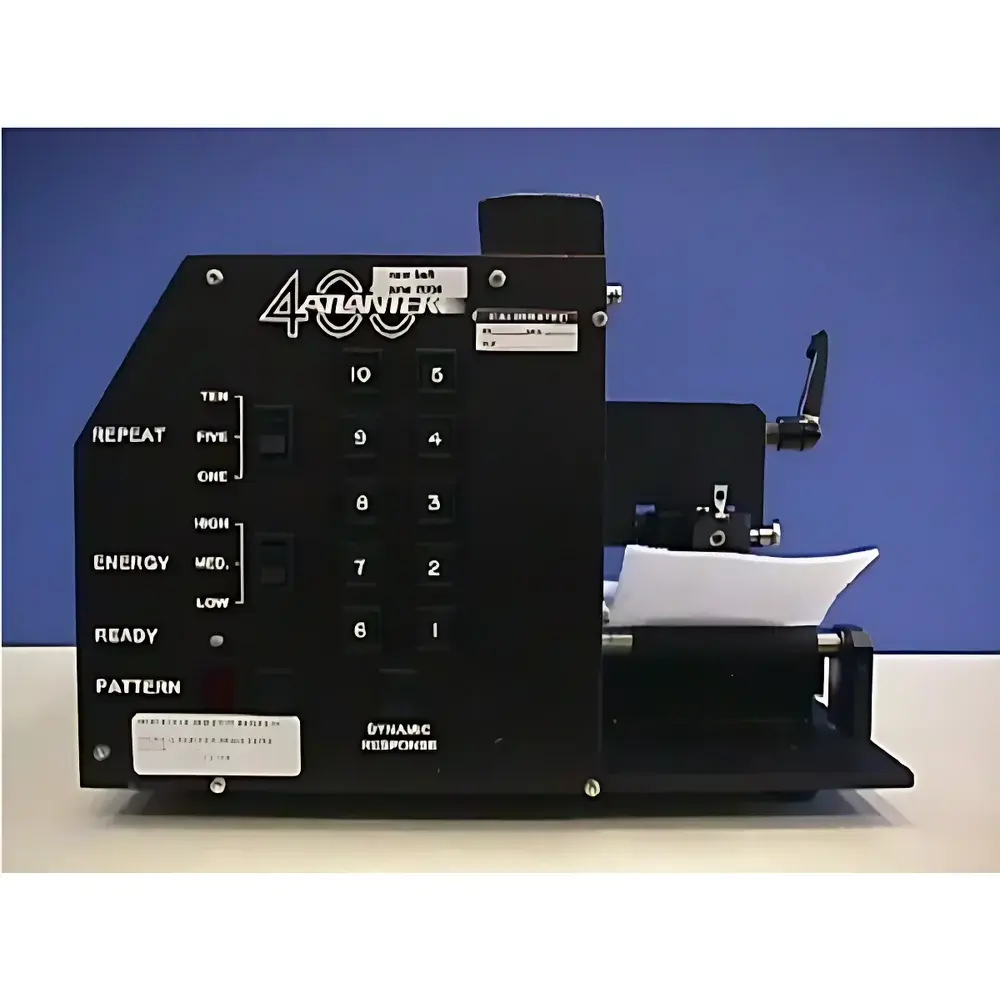
ATLANTEK Model 400 Dynamic Thermal Reaction Analyzer
| Brand | ATLANTEK |
|---|---|
| Origin | USA |
| Manufacturer Type | Authorized Distributor |
| Product Origin | Imported |
| Model | Model 400 |
| Pricing | Available Upon Request |
| Printing Method | Direct Thermal Printing |
| Print Resolution | 300 dpi |
| Print Width | 53 mm |
| Sample Width Capacity | 100 mm |
| Print Head Technology | Thin-Film Resistive (Corner-Type) |
| Print Speed Options | 10 in/s (programmable at three discrete settings) |
| Adjustable Parameters | Print Head Pressure, Print Head Position |
| Interface | RS-232 Serial |
| Power Supply | 115 V / 60 Hz or 220 V / 50 Hz |
| Test Patterns | Checkerboard, Solid Fill, UPC-A Barcode, User-Defined Patterns |
| Test Modes | Dynamic Reaction Sequence (10 energy steps), Full-sequence or single-step execution, repeat counts per step: 1×, 5×, or 10× |
Overview
The ATLANTEK Model 400 Dynamic Thermal Reaction Analyzer is an engineered precision instrument designed for the quantitative evaluation of thermal response characteristics in direct thermal materials—primarily thermal papers, labels, and imaging substrates. It operates on the principle of controlled, reproducible thermal stimulation using a calibrated thin-film resistive print head, simulating real-world thermal printing conditions under defined mechanical, electrical, and temporal parameters. Unlike static density measurement tools, the Model 400 enables dynamic assessment: it applies sequential, user-defined thermal energy pulses across a single sample strip while varying print head pressure, linear speed, and instantaneous power delivery—thereby generating a spatially resolved optical density gradient that correlates directly with material sensitivity, latency, and thermal decay kinetics. This capability supports root-cause analysis of batch-to-batch variability, formulation optimization, and accelerated aging studies in accordance with industry-standard thermal stability protocols.
Key Features
- Thin-film corner-type thermal print head with precise resistance calibration and uniform heat distribution across 53 mm active width
- Three programmable linear print speeds (all referenced to 10 inches/second nominal), enabling controlled dwell-time modulation without altering energy-per-pulse
- 10-step dynamic energy ramping sequence—each step independently configurable for pulse duration and voltage level—to map thermal response thresholds
- Mechanically adjustable print head pressure and lateral position, accommodating substrate thickness variations from 70 µm to 250 µm
- RS-232 serial interface compliant with standard SCPI command sets, supporting integration into automated QC workflows and LIMS environments
- Preloaded test pattern library including ISO/IEC-compliant UPC-A barcodes, high-contrast checkerboard arrays, solid-area fills, and customizable user-defined patterns (via ASCII-based pattern upload)
- Repeat-mode functionality: each of the 10 energy steps may be executed once, five times, or ten times consecutively—enabling statistical assessment of repeatability and fatigue behavior
Sample Compatibility & Compliance
The Model 400 accommodates standard thermal media rolls or cut sheets up to 100 mm wide and 0.3 mm thick. Its open-throat design allows rapid loading of coated paper, polymer films, and composite label stocks. The instrument conforms to ASTM F2298–22 (“Standard Practice for Evaluating Thermal Print Quality”) and supports traceable calibration against NIST-traceable optical density standards (e.g., Stouffer Step Wedge T-21). All mechanical adjustments are lockable with metric-threaded fasteners; pressure calibration is verified using certified load cells (±0.5% full scale). Electrical safety complies with UL 61010-1 and IEC 61010-1 for laboratory equipment. Data integrity meets FDA 21 CFR Part 11 requirements when operated with validated third-party software enabling electronic signatures and audit trails.
Software & Data Management
While the Model 400 operates as a standalone hardware platform via front-panel controls, its RS-232 interface supports bidirectional communication with external acquisition systems. Users may log timestamped test parameters—including applied voltage, pulse width, head temperature (via integrated thermistor), and mechanical settings—alongside post-test densitometric readings obtained via external spectrodensitometers (e.g., X-Rite i1Pro3 or Techkon SpectroDens). ATLANTEK provides a reference Python API library and CSV export templates compatible with JMP, Minitab, and MATLAB for multivariate regression analysis of thermal response curves. Audit logs record operator ID, session start/stop time, parameter changes, and firmware revision—supporting GLP/GMP documentation requirements.
Applications
- Quality assurance of thermal paper coatings during roll-to-roll manufacturing (e.g., leuco dye–developer–sensitizer systems)
- Formulation screening for thermal sensitivity, darkening rate, and image stability under accelerated thermal stress
- Validation of thermal print head compatibility across OEM printer platforms
- Failure analysis of image fading, ghosting, or non-uniform development in field-deployed thermal labels
- Development of thermal recording media for medical device labeling, logistics tags, and point-of-sale receipts requiring ISO/IEC 15416-compliant barcode readability
- Supporting ISO 2470-1 (paper brightness) and ISO 5636-3 (air permeance) correlation studies where thermal response interacts with substrate porosity and coating rheology
FAQ
What standards does the Model 400 support for thermal print quality validation?
It aligns with ASTM F2298–22, ISO/IEC 15416 (for barcode test patterns), and provides traceable inputs for internal SOPs aligned with ISO 9001 clause 7.6.
Can the Model 400 operate without a connected computer?
Yes—the instrument features a fully functional front panel with membrane switches and LED indicators for all core functions, including pattern selection, energy step navigation, and repeat-count configuration.
Is print head replacement user-serviceable?
Print heads are field-replaceable modules with keyed connectors and alignment pins; replacement requires no recalibration but must be performed using ATLANTEK-certified parts to maintain thermal uniformity specifications.
How is optical density measured after printing?
The Model 400 performs thermal stimulation only; optical density quantification requires integration with a calibrated reflection densitometer or spectrophotometer—typically positioned downstream in a custom test bench or inline inspection station.
Does the instrument support variable-temperature environmental control?
No—ambient operation only (15–30 °C, <70% RH). For elevated-temperature testing, users integrate the Model 400 into climate-controlled enclosures with feedthrough-rated cabling and thermal shielding per ASTM D618 guidelines.



