
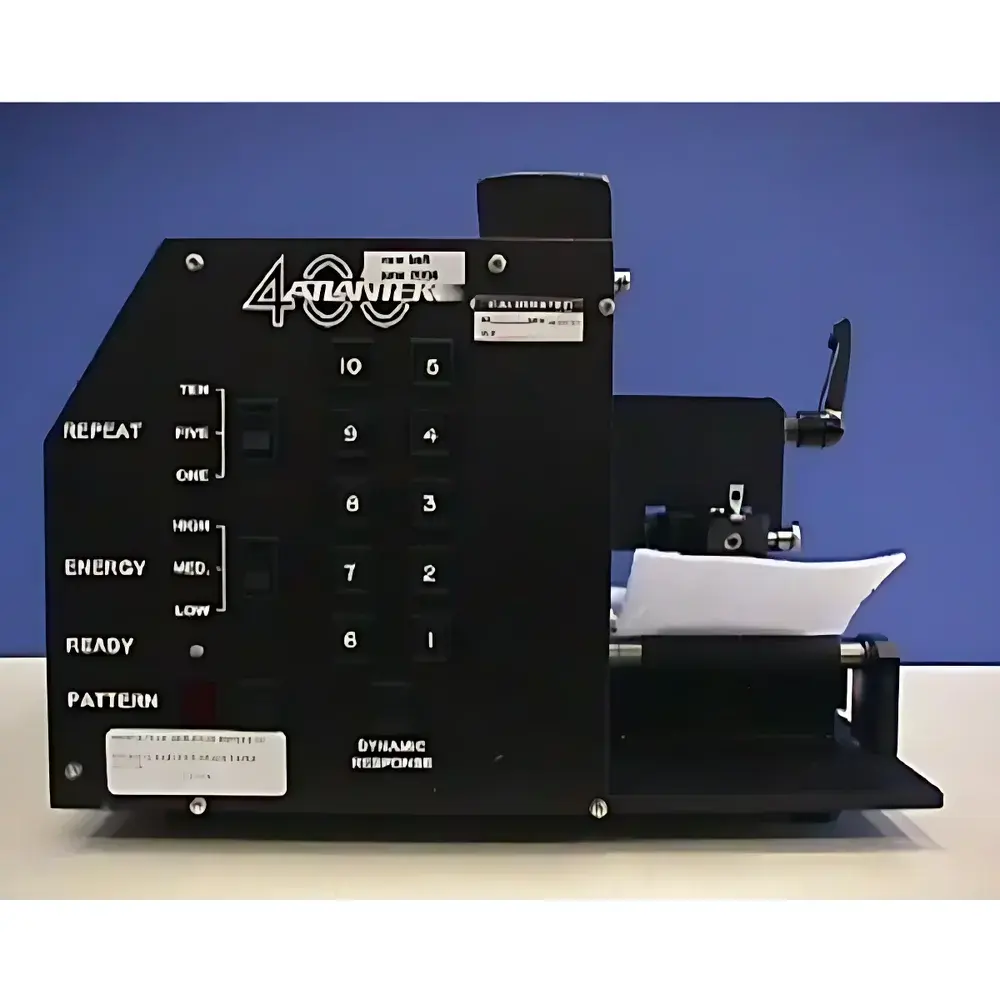
ATLANTEK Model 400 Dynamic Thermal Response Analyzer
| Brand | ATLANTEK |
|---|---|
| Origin | USA |
| Manufacturer Type | Authorized Distributor |
| Origin Category | Imported |
| Model | Model 400 |
| Pricing | Available Upon Request |
| Printing Method | Direct Thermal |
| Print Resolution | 300 dpi |
| Print Width | 53 mm |
| Sample Width | 100 mm |
| Printhead Architecture | Thin-Film, Corner-Type |
| Print Speed | Programmable at 10 in/s (254 mm/s) |
| Adjustable Parameters | Printhead Pressure, Printhead Position |
| Interface | RS-232 Serial |
| Power Supply | 115 V / 60 Hz or 220 V / 50 Hz |
| Test Patterns | Checkerboard, Solid Fill, UPC-A Barcode, User-Defined Patterns |
| Test Modes | Dynamic Reaction Sequence (10 programmable energy steps), Single-Step Execution, Repetition Options (1×, 5×, 10× per step) |
Overview
The ATLANTEK Model 400 Dynamic Thermal Response Analyzer is a precision-engineered benchtop instrument designed for quantitative evaluation of thermal response characteristics in direct thermal media—primarily thermal papers, labels, and receipt substrates. It operates on the principle of controlled, reproducible thermal activation: a calibrated thin-film corner-type printhead delivers precisely defined thermal energy pulses to the sample surface under adjustable mechanical pressure and linear velocity. The resulting thermally induced color development (typically via leuco dye–developer systems) is assessed through post-print optical density (OD) measurement using standardized reflectance photometry. Unlike static thermal testers, the Model 400 enables dynamic parametric variation—simultaneously modulating printhead pressure, dwell time (via speed control), and thermal pulse amplitude (via energy setting)—to replicate real-world printer operating conditions and isolate dominant kinetic and thermodynamic drivers of image formation, fade resistance, and gray-scale linearity.
Key Features
- Fourth-generation architecture optimized for repeatability and operator ergonomics, with intuitive front-panel controls and tactile feedback switches.
- Programmable thermal energy delivery across 10 discrete steps, enabling systematic characterization of threshold response, saturation behavior, and thermal overdrive effects.
- Three fixed print speeds (all at 10 in/s nominal; verified per ASTM F2279-22 for thermal printer simulation fidelity) ensure consistent dwell-time control during dynamic testing sequences.
- Mechanically adjustable printhead pressure and lateral positioning accommodate variations in substrate caliper, surface roughness, and coating uniformity—critical for cross-lot validation and supplier qualification.
- Native support for industry-standard test patterns including checkerboard (for edge acuity and dot gain analysis), solid fill (for maximum density and uniformity assessment), UPC-A barcode (for decode reliability and bar-edge definition), and user-defined vector-based patterns via serial command protocol.
- RS-232 interface enables integration into automated QA workflows and supports external data logging, script-driven batch testing, and traceable parameter recall per GLP/GMP requirements.
Sample Compatibility & Compliance
The Model 400 accepts thermal media up to 100 mm wide and 0.1–0.3 mm thick, including coated thermal papers, synthetic thermal films, and pressure-sensitive thermal label stocks. Its 53 mm active print width ensures compatibility with standard laboratory-scale sample strips while maintaining representative coverage for statistical OD sampling. All operational parameters—including energy calibration, speed verification, and pressure range—are traceable to NIST-traceable thermal standards and documented in the instrument’s factory calibration certificate. The system complies with ASTM F2279 (Standard Test Method for Thermal Print Quality of Thermal Paper), ISO 2470-1 (Paper brightness and whiteness), and supports audit-ready documentation for FDA 21 CFR Part 11–aligned environments when paired with compliant data acquisition software.
Software & Data Management
While the Model 400 operates autonomously via its embedded microcontroller, its RS-232 port permits bidirectional communication with host PCs running custom or vendor-supplied terminal applications. Users may export timestamped test logs—including energy step ID, pattern selection, repetition count, and pass/fail flags—to CSV or XML formats for integration into LIMS or statistical process control (SPC) platforms. Firmware updates preserve backward compatibility and include enhanced error-checking routines for printhead temperature stability monitoring and open-circuit detection. Audit trails record all parameter changes, user logins (when configured with external authentication), and calibration events—meeting minimum ALCOA+ (Attributable, Legible, Contemporaneous, Original, Accurate, Complete, Consistent, Enduring, Available) data integrity criteria.
Applications
- Raw material qualification: Screening incoming thermal coatings, developers, and dye systems for batch-to-batch consistency in activation energy and response slope.
- Process optimization: Correlating calendering pressure, drying temperature, and coating weight with thermal sensitivity profiles across production lines.
- Fade and aging studies: Accelerated thermal stress testing by repeated high-energy printing followed by ISO 11799-compliant archival storage and periodic OD re-measurement.
- Printer OEM validation: Verifying thermal media performance under simulated ESC/POS and line-printer duty cycles prior to field deployment.
- Regulatory submissions: Generating repeatable, instrument-logged thermal response curves required for EU REACH Annex XIV dossiers or US EPA TSCA pre-manufacture notices involving novel thermal developers.
FAQ
Does the Model 400 include an integrated densitometer?
No—the Model 400 is a dedicated thermal stimulus generator. Optical density measurement requires a separate, NIST-calibrated reflection densitometer (e.g., X-Rite 500 series or Techkon SpectroDens) aligned per ISO 5-3:2009.
Can test pattern geometry be modified beyond the four built-in options?
Yes—user-defined patterns can be uploaded via ASCII hex command sequences over RS-232, supporting monochrome bitmaps up to 400 × 400 pixels at 300 dpi resolution.
Is printhead temperature actively regulated during testing?
The thin-film printhead incorporates embedded thermistors for real-time temperature feedback; however, closed-loop thermal regulation is not implemented. Ambient temperature stabilization (±1 °C) is recommended per ASTM D6422-20.
What maintenance is required for long-term accuracy?
Annual verification of energy calibration against reference thermal films and mechanical recalibration of pressure actuation springs are recommended. Printhead cleaning with 99.9% isopropyl alcohol and lint-free swabs is performed after every 500 test cycles.
Does ATLANTEK provide application support for method development?
Yes—qualified applications engineers offer remote protocol design assistance, including DOE matrix construction for multi-variable thermal response modeling and SOP drafting aligned with ISO/IEC 17025 requirements.





