
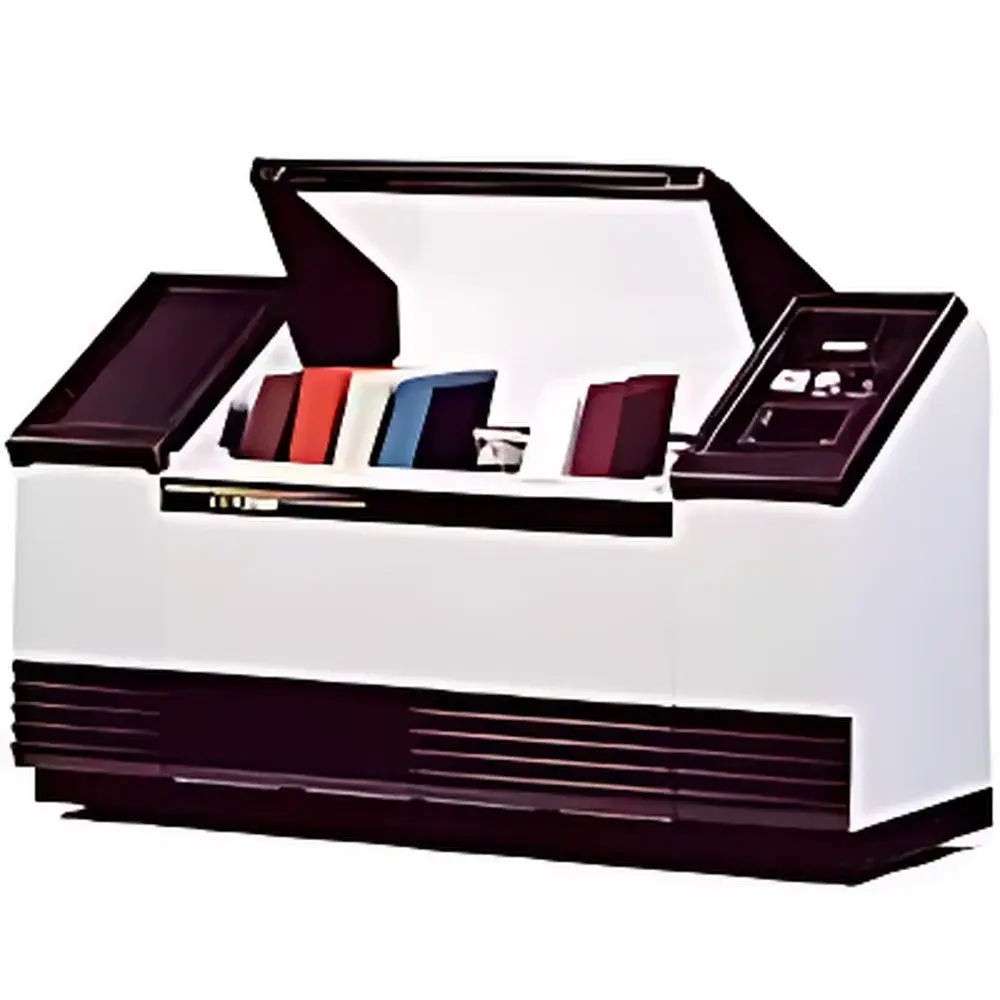
Atlas CCX Advanced Cyclic Corrosion Test Chamber
| Brand | ATLAS |
|---|---|
| Origin | USA |
| Model | CCX |
| Temperature Range | Up to 71°C (standard), optional up to 90°C |
| Chamber Capacities | 565 L (CCX2000) to 3115 L (CCX11000) |
| Compliance | SAE J2334, Ford BI-123-01, Ford APGE, GM9540P, GMW14872, ASTM B117, ISO 9227, DIN 50021 |
| Control System | PLC-based with programmable multi-step cycling |
| Humidity Generation | Heated foam tower with pressure-regulated air bleed |
| Exposure Zone Construction | Fiberglass-reinforced polymer (FRP) with gel-coated interior |
| Solution Reservoir | 227 L (60 gal) standard |
| Heating | Titanium rod heaters in exposure zone |
| Lid Design | Ridge-roof configuration to prevent condensate drip |
| Sealing | Dual magnetic gasket on transparent lid |
| Optional Features | SO₂ injection, Prohesion™ mode, non-condensing humidity control |
Overview
The Atlas CCX Advanced Cyclic Corrosion Test Chamber is an engineered solution for accelerated, multi-phase environmental durability assessment of coatings, metals, composites, and assembled components. Based on the principles of controlled cyclic exposure—alternating between salt spray, high-humidity condensation, drying, and optional corrosive gas phases—the CCX replicates real-world atmospheric degradation mechanisms with high reproducibility. Unlike static salt fog chambers governed solely by ASTM B117, the CCX implements dynamic, time-sequenced protocols aligned with automotive OEM specifications (e.g., GMW14872, Ford BI-123-01) and international standards including ISO 11997 and SAE J2334. Its modular architecture supports both laboratory validation and production-line quality assurance, delivering data relevant to service life prediction, material qualification, and failure mode analysis under complex electrochemical stress conditions.
Key Features
- Fiberglass-reinforced polymer (FRP) test chamber with gel-coated exposure zone for chemical resistance and thermal stability
- Large-capacity solution reservoir (227 L / 60 gal) with titanium rod heating elements ensuring uniform temperature distribution and corrosion-resistant longevity
- Ridge-roof lid design eliminates condensate drip onto test specimens—critical for maintaining surface integrity during humidity and drying transitions
- Heated foam tower humidification system with integrated air-pressure regulation and real-time pressure monitoring via analog gauge or digital sensor (depending on control tier)
- Dual-magnetic gasket sealing on transparent viewing lid (polycarbonate or polypropylene for larger models) enables visual inspection without cycle interruption
- Programmable exposure-zone temperature range: 10–71°C standard; optional high-temp upgrade extends to 90°C for accelerated aging protocols
- Modular control platform: Base model features PLC-based interface with five preloaded test methods and storage for 15 multi-step profiles (up to 18 steps each); advanced configuration includes Windows-compatible notebook controller with graphical UI, 50-profile memory, and step-wise data logging
Sample Compatibility & Compliance
The CCX accommodates diverse sample geometries—from small coupons and fasteners to full-scale automotive subassemblies—across five standard chamber sizes (CCX2000 to CCX11000). Each model maintains strict adherence to regulatory and industry-specific compliance frameworks: ASTM B117 (neutral salt spray), ISO 9227 (accelerated corrosion testing), DIN 50021 (cyclic salt mist), and OEM-specific CCT protocols. Its validated performance meets GLP and GMP documentation requirements when paired with audit-trail-enabled software options compliant with FDA 21 CFR Part 11. The system supports integration into enterprise LIMS environments through standardized OPC UA or Modbus TCP interfaces, enabling traceable test execution and electronic record retention.
Software & Data Management
Standard CCX controllers include timestamped event logging and cycle-stage tracking. The advanced notebook-based system provides real-time graphical visualization of chamber parameters—including exposure-zone temperature, relative humidity, solution pH (with optional probe), and foam tower pressure—across all active steps. All test configurations are saved with user-defined naming conventions and metadata (operator ID, sample batch, revision date). Export functionality supports CSV and PDF report generation, with embedded calibration certificates and instrument identification tags. Data integrity safeguards include write-protected archives, password-protected method editing, and configurable audit trails meeting ISO/IEC 17025 and ICH E6(R3) requirements for regulated testing laboratories.
Applications
- Aerospace: Qualification of primer systems, fastener coatings, and composite substrate protection against marine and de-icing salt exposure
- Automotive: Validation of Zn-Ni plating, e-coat systems, and multi-layer paint architectures per GMW14872 and Ford APGE
- Electronics: Corrosion resistance evaluation of printed circuit board finishes, conformal coatings, and connector housings
- Defense & Government: MIL-STD-810H Method 509.6 (corrosion) and NATO AEP-55 compliance verification
- Academic & Industrial Research: Mechanistic studies of pitting initiation, crevice corrosion kinetics, and inhibitor efficacy under simulated field conditions
- Coatings Development: Rapid screening of waterborne acrylics, epoxy hybrids, and self-healing polymer systems across variable chloride/humidity/dry cycles
FAQ
What standards does the CCX support out-of-the-box?
The CCX natively executes ASTM B117, ISO 9227, SAE J2334, Ford BI-123-01, GM9540P, and GMW14872. Additional protocols—including Prohesion™, SO₂-injected cycles, and non-condensing humidity phases—require optional hardware modules and corresponding software licenses.
Can the CCX be integrated into a centralized lab automation network?
Yes. All CCX models support RS-232, Ethernet, and optional USB-to-serial interfaces. With the advanced control package, OPC UA server functionality enables seamless connection to SCADA, MES, or LIMS platforms for remote monitoring and automated report dispatch.
Is calibration traceability provided with the system?
Each CCX ships with NIST-traceable calibration certificates for temperature, humidity, and solution concentration sensors. Annual recalibration services are available through ATLAS-certified field engineers, with documented uncertainty budgets per ISO/IEC 17025.
What maintenance intervals are recommended for long-term reliability?
Daily visual inspection of solution levels and nozzle integrity; weekly cleaning of foam tower diffusers and drain lines; quarterly verification of gasket compression and heater resistance; annual full-system calibration and FRP surface integrity assessment. Preventive maintenance kits and service contracts are available directly from ATLAS.
Does the CCX support unattended weekend operation?
Yes. The system’s robust PLC architecture and redundant safety interlocks—including overtemperature cutoff, low-solution-level shutoff, and lid-open detection—enable fully autonomous multi-day testing. Cycle continuity is preserved across power interruptions when configured with an uninterruptible power supply (UPS).



