
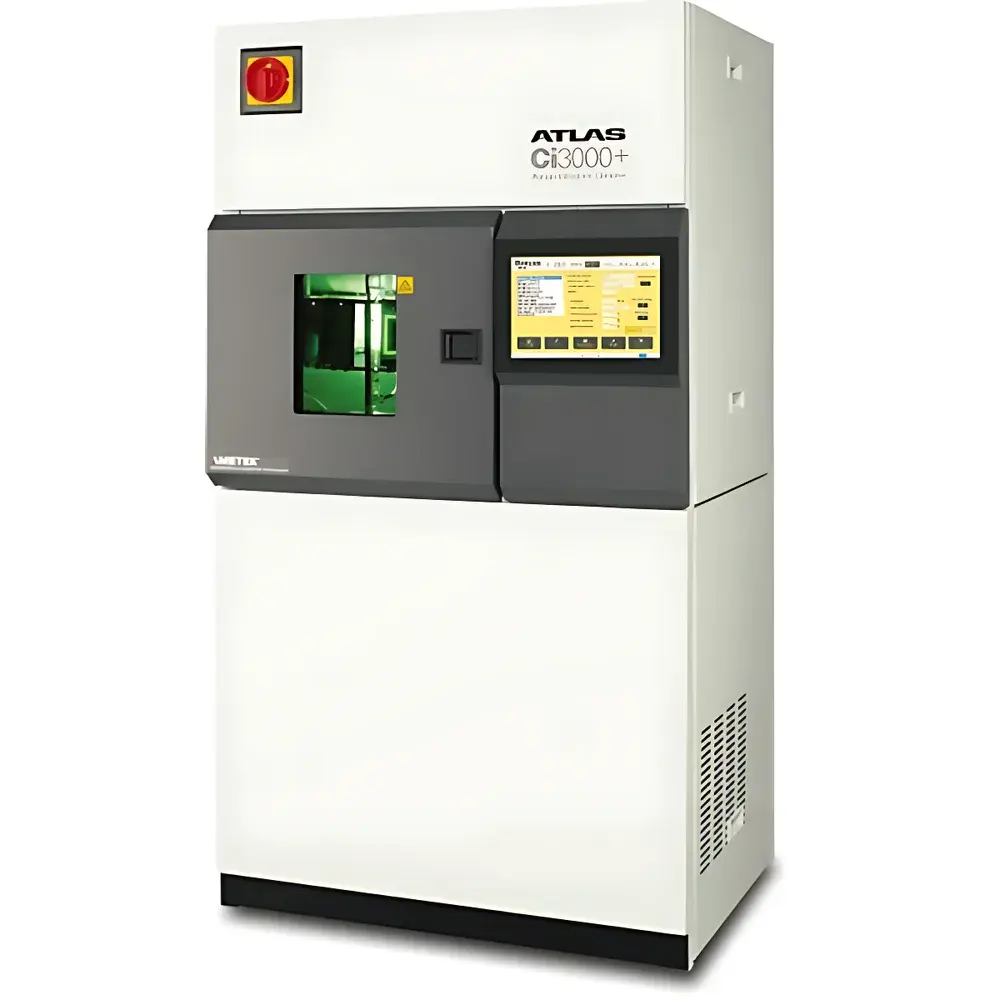
Atlas Ci3000+ Xenon Arc Weathering Test Chamber
| Brand | ATLAS |
|---|---|
| Origin | USA |
| Model | Ci3000+ |
| Lamp Power | 4500 W water-cooled xenon arc |
| Total Exposure Area | 2,188 cm² (339 in²) |
| Control Panel | 12-inch TFT full-color touchscreen |
| Predefined test methods | 14 (Weather-Ometer), 6 (Fade-Ometer) |
| Custom program slots | 12 |
Overview
The Atlas Ci3000+ Xenon Arc Weathering Test Chamber is an internationally recognized, research-grade instrument engineered for accelerated simulation of solar radiation, temperature, and humidity exposure conditions—enabling precise prediction of material degradation mechanisms in polymers, coatings, textiles, automotive interiors, and aerospace composites. Based on the fundamental principle of xenon arc irradiation, the Ci3000+ replicates the full solar spectrum (290–800 nm) with spectral power distribution closely matching natural sunlight, especially in the critical UV and visible regions. Its water-cooled 4500 W xenon lamp, combined with advanced optical filtering (including daylight, window-glass, and extended UV configurations), ensures traceable, repeatable, and spectrally accurate irradiance delivery across the entire 2,188 cm² exposure area. Unlike simpler UV fluorescent or QUV-based systems, the Ci3000+ provides true broadband solar simulation—including infrared thermal loading—making it the benchmark platform for ISO 4892-2, ASTM G155, AATCC TM16, and automotive OEM specifications such as SAE J2527 and GMW14124.
Key Features
- 12-inch full-color TFT touchscreen interface with intuitive navigation, real-time parameter visualization, and diagnostic alerts
- Independent, direct-setpoint control of black panel temperature (BPT), black standard temperature (BST), relative humidity (RH), and chamber air temperature—each with closed-loop feedback and high-resolution PID regulation
- Smart Damper™ adaptive airflow modulation system minimizes intra-chamber gradients and compensates for ambient lab fluctuations in temperature and humidity
- VibraSonic™ ultrasonic humidification delivers fine, uniform mist without mineral residue or nozzle clogging—critical for long-term RH stability and textile testing compliance
- XenoCal™ in-situ irradiance calibration system enables NIST-traceable, position-matched irradiance verification directly at the sample plane—eliminating reliance on lamp-hour estimation or external reference cells
- SmartLight Monitor™ continuously validates lamp alignment, filter integrity, and sensor functionality—ensuring spectral fidelity throughout each test cycle
- Dual blackboard temperature sensing (BPT and BST) with dedicated thermocouples per standard, supporting simultaneous monitoring per ASTM D7869 and ISO 11341 requirements
- Multi-wavelength irradiance monitoring options: 300–400 nm (broadband UV), 340 nm (narrowband UV-A), or 420 nm (visible cut-on)—all with grating-based optics and dual-filter housing for spectral purity
- CS-7 and LiquiAirSmart™ independent cooling architectures—supporting both top-mounted and wall-mounted lamp configurations for optimal thermal management and service accessibility
Sample Compatibility & Compliance
The Ci3000+ accommodates diverse specimen geometries through configurable 2-tier sample racks (60 positions total), including flat-panel holders, 3D automotive trim fixtures, and textile frame kits compliant with AATCC TM16 and ISO 105-B02. Optional auxiliary filter housings enable specialized spectral cuts required for interior automotive testing (e.g., SAAB, Volvo, BMW specifications). All hardware and firmware comply with CE, UL 61010-1, CSA C22.2 No. 61010-1, and EN 61000 electromagnetic compatibility standards. The system supports GLP/GMP-aligned operation via WXView™ data logging—recording timestamps, setpoints, actual values, alarm events, and calibration history with user-defined audit trails. Full traceability to ISO/IEC 17025-accredited calibration laboratories is maintained for irradiance, temperature, and humidity channels.
Software & Data Management
WXView™ is a Windows-based, FDA 21 CFR Part 11–ready data acquisition and reporting suite. It captures all operational parameters at user-configurable intervals (as low as 1 second), stores encrypted raw datasets locally or on network drives, and generates PDF/CSV reports with embedded metadata (operator ID, method name, calibration certificate IDs, environmental logs). Custom report templates can be built for internal QA documentation or regulatory submissions. Remote monitoring and control are enabled via secure Ethernet connection; USB export (including included flash drive) allows offline data transfer without network dependency. Firmware updates are delivered via signed packages with version-controlled rollback capability.
Applications
The Ci3000+ serves as the primary weathering validation tool across regulated and industrial sectors: polymer formulation R&D (PP, PE, PC, TPU); automotive OEM component qualification (dashboards, seat fabrics, headliners); architectural coating durability assessment (acrylics, fluoropolymers); aerospace composite UV resistance certification (per ASTM D4329, MIL-STD-810H); textile colorfastness grading (AATCC, ISO, GB/T); and photostability testing of medical device packaging per ISO 11607-1. Its reproducibility—validated across inter-laboratory round-robin studies—makes it suitable for specification conformance, supplier qualification, and failure analysis root-cause investigations.
FAQ
What standards does the Ci3000+ support out-of-the-box?
ASTM G155, ISO 4892-2, ISO 11341, AATCC TM16 (Options 1–4), ISO 105-B02, SAE J2527/J2412, GMW14124, Ford APG2201, Volkswagen PV3929, and many more—via preloaded methods and configurable filter/lamp/humidity profiles.
Can irradiance be calibrated at the sample surface—not just at the lamp?
Yes. XenoCal™ performs in-situ, plane-of-sample irradiance measurement and adjustment, eliminating positional error and ensuring compliance with ISO 4892-2 Annex B and ASTM G155 Section 7.4.
Is remote monitoring and data export supported?
Yes. WXView™ enables real-time Ethernet-based supervision, scheduled automated backups, and encrypted USB export—including full audit logs and calibration certificates.
How does the system ensure thermal uniformity across large sample arrays?
Via Smart Damper™ dynamic airflow control, dual-zone BPT/BST sensing, and precision-engineered rotating drum geometry—validated to ±0.5 °C spatial uniformity per ISO 4892-2 Clause 6.3.
Does the Ci3000+ meet regulatory requirements for pharmaceutical or medical device testing?
While not a Class III medical device itself, its WXView™ software architecture complies with 21 CFR Part 11 electronic records/signatures requirements, and its calibration traceability supports ISO 11607-1 and ICH Q1B photostability protocols when deployed under validated SOPs.



