
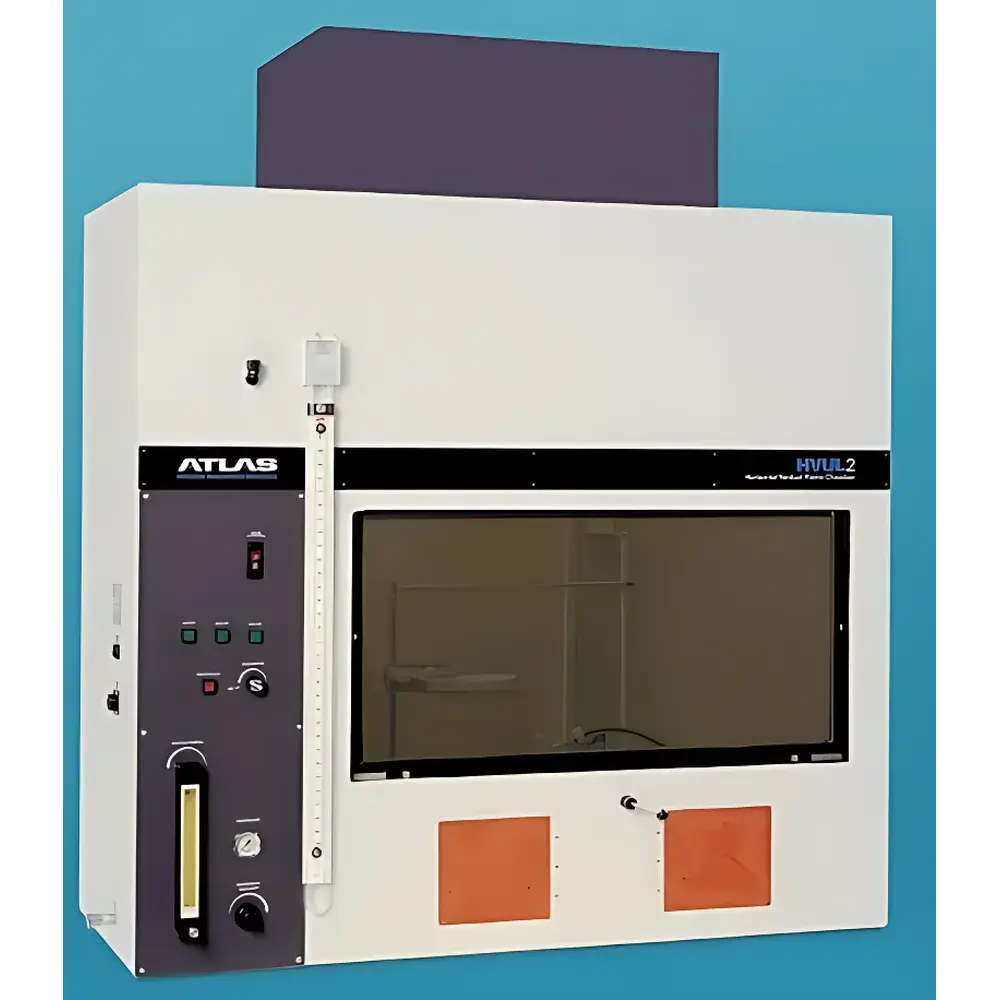
ATLAS M233HVU Horizontal and Vertical Combustion Test Chamber
| Brand | ATLAS |
|---|---|
| Origin | USA |
| Model | M233HVU |
| Chamber Volume | >0.75 m³ |
| Construction | Stainless Steel with Matte Black Interior |
| Viewing Window | Sliding Safety Glass (Large-Area, Unobstructed) |
| Gas Control System | Electromagnetic Solenoid Valve, Adjustable Pressure Regulator, Air Flowmeter, Gas Flow Meter |
| Timing System | Three Independent Digital Timers (0.1 s Resolution), Remote Start/Reset Functionality |
| Exhaust | Variable-Speed Exhaust Fan with Throttle Valve |
| Compliance Accessories | ASTM D5207 Burn Verification Kit |
| Sample Holder | Fully Adjustable Mechanical Fixture |
| Internal Illumination | Integrated LED Lighting |
| Inlet Port | Manual Iris-Type Sealed Access Port |
| Safety Features | Interlocked Door Monitoring, Flame-Resistant Sealing Gasket, Thermal Insulation Layer |
Overview
The ATLAS M233HVU Horizontal and Vertical Combustion Test Chamber is a precision-engineered instrument designed to evaluate the flammability behavior of polymeric materials—particularly plastics used in electronic enclosures, wiring harnesses, and printed circuit board components—under standardized horizontal (HB) and vertical (V-0, V-1, V-2) burning conditions per UL 94, IEC 60695-11-10, and ASTM D3801. The chamber operates on the principle of controlled flame impingement followed by quantitative assessment of afterflame time, afterglow time, and drip ignition behavior. Its fully sealed, >0.75 m³ stainless steel enclosure ensures consistent thermal mass, minimal air turbulence, and repeatable combustion dynamics—critical for achieving inter-laboratory reproducibility required in regulatory submissions and product safety certification workflows.
Key Features
- Robust 304 stainless steel construction with matte black interior finish to minimize optical reflection and enhance flame visibility during real-time observation.
- Large-dimension sliding safety glass viewing window (≥300 × 400 mm), mechanically interlocked to prevent operation during door opening and certified to ANSI Z87.1 impact resistance standards.
- Three independent digital timers with 0.1-second resolution, mounted on rear chamber walls and accessible via remote push-button interface—eliminating operator proximity during ignition phase and reducing human timing bias.
- Electronically actuated electromagnetic gas valve synchronized with pressure-regulated propane or methane supply, enabling precise stoichiometric flame generation per UL 94 Annex A calibration protocols.
- Fully adjustable sample holder assembly accommodating specimens up to 125 × 13.0 × 12.5 mm (L × W × H), with micrometer-level tilt angle control for HB testing and vertical clamping rigidity for V-series evaluations.
- Variable-speed exhaust fan with integrated throttle valve and differential pressure monitoring to maintain stable draft conditions (±2.5 Pa) across test cycles—essential for compliance with ISO 5659-2 draft control requirements.
Sample Compatibility & Compliance
The M233HVU supports rigid and semi-rigid thermoplastic and thermoset specimens used in consumer electronics, automotive interiors, and industrial control housings. It accommodates standard UL 94 specimen geometries (including 1.5 mm, 3.0 mm, and 6.0 mm thickness variants) and enables direct correlation with pass/fail criteria defined in UL 94 Ed.7 (2022), IEC 60695-11-10:2021, and GB/T 2408–2008. The included ASTM D5207 Burn Verification Kit provides traceable reference materials and procedural validation steps to verify burner flame height (20 ± 1 mm), tip temperature (1000 ± 50 °C), and ignition timing repeatability prior to each test series—fulfilling GLP audit requirements for method verification documentation.
Software & Data Management
While the M233HVU operates as a hardware-controlled standalone system, its timer outputs and gas valve status signals are compatible with optional analog/digital I/O modules (e.g., National Instruments USB-6009) for integration into LIMS or ELN platforms. Timestamped test logs—including start time, flame application duration, afterflame/afterglow intervals, and operator ID—can be exported via RS-232 or USB-C interface in CSV format. All timing events comply with FDA 21 CFR Part 11 electronic record integrity guidelines when paired with validated timestamping firmware and user-access-controlled audit trails.
Applications
- UL 94 HB, V-0, V-1, and V-2 classification testing for plastic resins supplied to OEMs in computing, telecommunications, and medical device manufacturing.
- Pre-compliance screening of flame-retardant formulations during polymer compounding R&D.
- Root-cause analysis of unexpected dripping or flaming droplet propagation in halogen-free FR systems.
- Supporting ISO 9773 (unmounted specimen) and ISO 9772 (flexible material) derivative assessments through custom fixture adaptation.
- Training laboratories requiring high-fidelity visual observation capability for technician competency assessment under ASTM E2057.
FAQ
Does the M233HVU meet UL 94 certification requirements for third-party testing labs?
Yes—the chamber’s dimensional tolerances, burner geometry, airflow control, and timing accuracy have been verified against UL’s Equipment Acceptance Criteria (EAC) for UL 94 testing apparatus. Certificate of Conformance (CoC) and factory calibration report are provided with each unit.
Can the chamber be used for oxygen index (LOI) testing per ASTM D2863?
No—the M233HVU is not configured for controlled oxygen/nitrogen atmosphere delivery or buoyancy-compensated specimen support; dedicated LOI analyzers (e.g., ATLAS M235OI) are recommended.
Is remote software control available for automated test sequencing?
Not natively; however, optional PLC-based sequencer modules (ATLAS SPC-M233) enable programmable ignition delay, multi-cycle repetition, and interlock synchronization with external environmental chambers.
What maintenance intervals are recommended for gas system components?
Electromagnetic valves and flowmeters require biannual verification using NIST-traceable pressure and flow standards; burner nozzles should be inspected and cleaned after every 50 test cycles per ASTM D5207 Section 7.2.



