
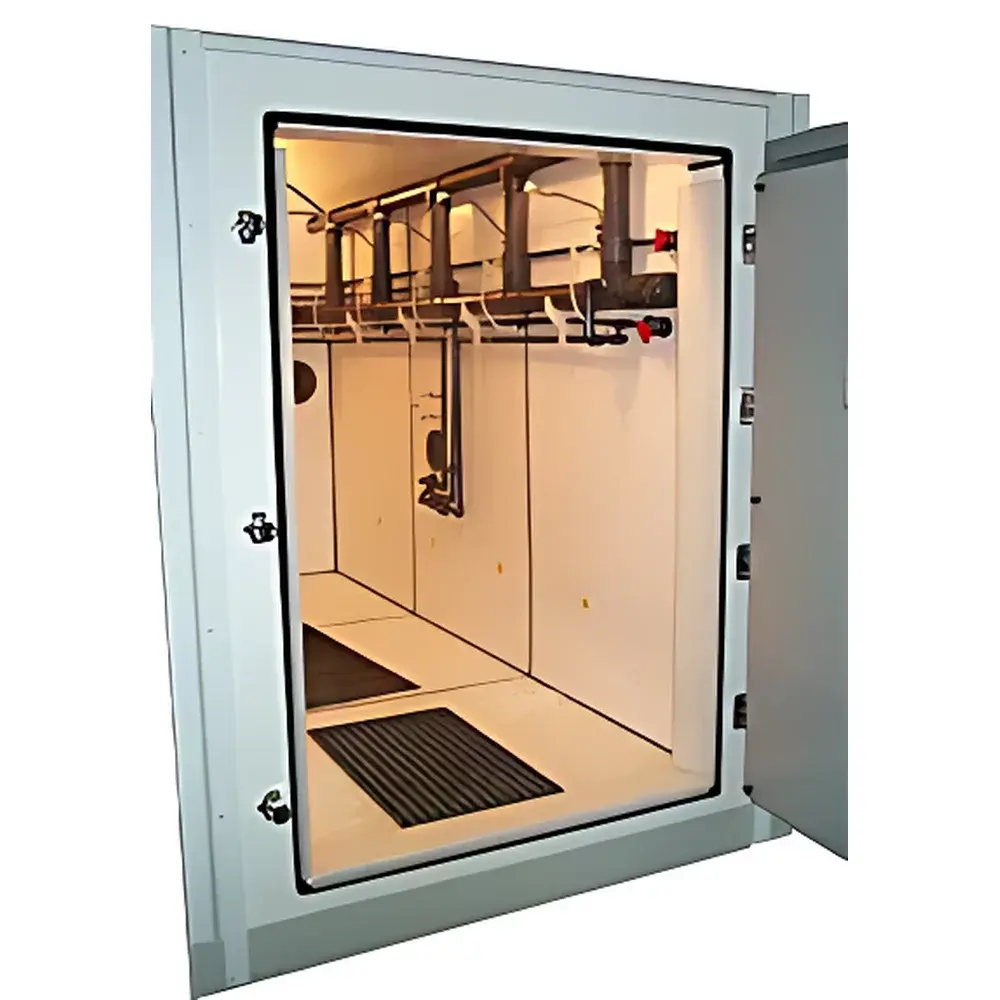
Atlas SF Walk-In Series Salt Spray Test Chamber
| Brand | ATLAS |
|---|---|
| Origin | USA |
| Model | SF Walk-In Series |
| Internal Dimensions (L×W×H) | 1.83×1.83×2.13 m (SF7000) / 2.44×1.83×2.13 m (SF9500) / 3.05×1.83×2.13 m (SF12000) |
| External Dimensions (L×W×H) | 2.13×2.13×2.74 m (SF7000) / 2.74×2.13×2.74 m (SF9500) / 3.35×2.13×2.74 m (SF12000) |
| Test Volume | 7,136–11,893 L |
| Temperature Range | Ambient to 49 °C (120 °F) |
| Construction | PVC-lined interior with sloped fiberglass or low-carbon steel chamber walls |
| Standard Features | Tempered Plexiglas® observation window, internal safety interlock door, elevated floor with rubber/plastic matting, external-mounted controls and lighting, digital temperature controller with display |
Overview
The Atlas SF Walk-In Series Salt Spray Test Chamber is an engineered environmental test system designed for rigorous corrosion evaluation of large-scale industrial components under standardized accelerated aging conditions. Based on the ASTM B117 and ISO 9227 salt fog test methodologies, the chamber generates a continuous, highly controlled saline aerosol environment—produced by atomizing a 5% NaCl solution via compressed air—while maintaining precise temperature uniformity across the exposure zone. Unlike benchtop units, the SF series accommodates full-assembly testing of structurally complex, oversized specimens that cannot be disassembled without compromising functional integrity or material interface behavior. Its walk-in architecture supports long-duration cyclic testing protocols—including combined salt spray, humidity, drying, and condensation phases—as defined in ASTM G85 Annexes A1–A5 and ISO 14993. The chamber’s robust construction ensures thermal stability, chemical resistance, and operational repeatability over extended test cycles, making it suitable for qualification testing in automotive, aerospace, defense, renewable energy, and heavy equipment manufacturing sectors.
Key Features
- Walk-in configuration with multiple standard internal footprints: SF7000 (1.83 × 1.83 × 2.13 m), SF9500 (2.44 × 1.83 × 2.13 m), and SF12000 (3.05 × 1.83 × 2.13 m), all customizable to client specifications
- PVC-lined interior chamber walls and ceiling with uniform thickness and seamless seams to resist chloride-induced degradation
- Sloped roof design prevents condensate drip onto test specimens—critical for eliminating localized false corrosion artifacts
- Elevated stainless-steel or reinforced polymer floor with integrated drainage and non-slip rubber/plastic matting for operator safety and fluid containment
- Tempered Plexiglas® observation window with internal safety interlock—ensures visual monitoring without compromising chamber integrity or personnel safety
- Digital microprocessor-based temperature controller with real-time display, ±0.5 °C accuracy, and ambient-to-49 °C operating range
- Externally mounted control panel with illuminated interior lighting, emergency stop, and power isolation switches compliant with UL 508A and IEC 61000-6-2
Sample Compatibility & Compliance
The SF Walk-In Chamber accommodates full-system validation of assembled products where material compatibility, joint integrity, and galvanic coupling effects are mission-critical. Validated use cases include automotive body-in-white assemblies, HVAC compressors, solar photovoltaic mounting structures, marine propulsion housings, military vehicle electronics enclosures, and architectural fenestration systems (windows, doors, curtain walls). All models comply with core international corrosion testing standards including ASTM B117, ISO 9227, JIS Z2371, and DIN 50021. Optional configurations support multi-phase testing per ASTM G85 (e.g., cyclic acidified salt fog, SO₂-enhanced fog, or Prohesion™ cycles) and humidity conditioning per IEC 60068-2-30. Chamber construction materials and electrical systems meet UL 61010-1 requirements for laboratory equipment safety, and optional data logging modules support GLP/GMP audit trails per FDA 21 CFR Part 11 when paired with validated software.
Software & Data Management
While the base SF series operates via standalone digital controllers, optional integration with Atlas’ C-MAP™ Environmental Test Software enables automated test sequencing, remote monitoring, real-time parameter logging (temperature, chamber pressure, spray duration), and PDF/CSV report generation. C-MAP™ supports user-defined test profiles, alarm escalation workflows, and electronic signature capture for regulated environments. All logged data includes timestamped metadata, instrument ID, operator credentials, and calibration status—ensuring traceability and compliance with ISO/IEC 17025 accreditation requirements for testing laboratories. Optional Ethernet or RS-485 interfaces allow centralized fleet management across multi-chamber facilities.
Applications
- Corrosion resistance validation of coated steel, aluminum alloys, zinc-plated fasteners, and polymer-composite hybrids used in transportation OEM supply chains
- Long-term durability assessment of outdoor-rated electrical enclosures, battery housings, and photovoltaic junction boxes exposed to coastal or industrial atmospheres
- Material compatibility screening for multi-metal assemblies—e.g., stainless steel brackets on magnesium die-cast housings—where galvanic corrosion risk must be quantified
- Qualification testing of protective coatings (epoxy, polyurethane, fluoropolymer) per SAE AMS-C-83286 and MIL-STD-810H Method 509.6
- Pre-compliance screening for CE marking (EN 60068-2-11) and RoHS-compliant surface finish verification
FAQ
What salt concentration is used in standard ASTM B117 testing?
A 5.0 ± 1.0 wt% sodium chloride (NaCl) aqueous solution is atomized at 35 ± 2 °C to produce the corrosive fog medium.
Can the SF chamber perform humidity-only or dry/wet cycling without salt spray?
Yes—via optional programmable controllers and auxiliary humidification/dehumidification modules, enabling tests per ISO 6270-2 (condensation humidity) and ASTM D2247 (100% RH exposure).
Is third-party calibration and IQ/OQ documentation available?
Yes—Atlas-certified field service engineers provide installation qualification (IQ), operational qualification (OQ), and annual performance verification with NIST-traceable instrumentation reports.
What maintenance intervals are recommended for long-term reliability?
Daily visual inspection of nozzles and reservoirs; weekly cleaning of atomizer heads and pH monitoring of salt solution; quarterly verification of temperature uniformity per ASTM E744; annual full-system calibration.
Are custom interior configurations—such as specimen racks, cable ports, or viewing windows—supported?
Yes—custom engineering services include structural reinforcement for overhead load-bearing fixtures, IP65-rated feedthroughs for sensor wiring, and additional observation ports with anti-fog coating.



