
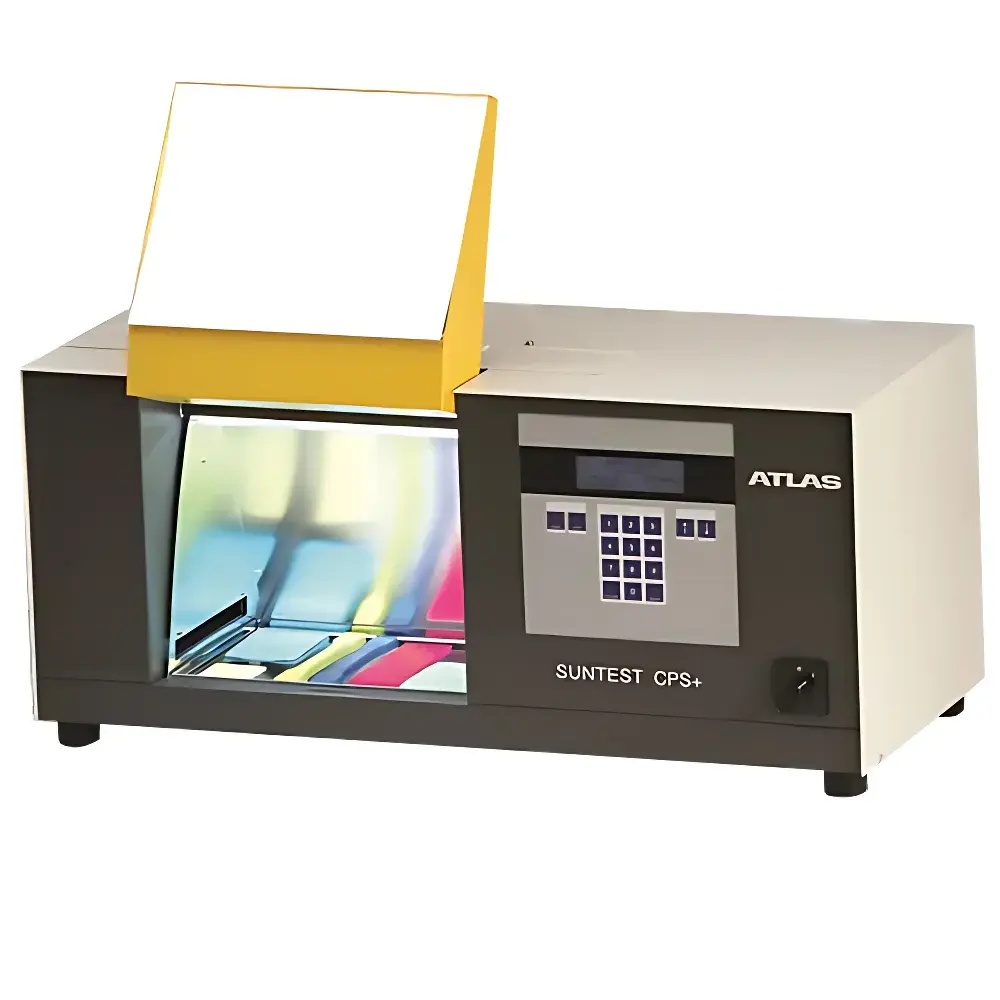
ATLAS SUNTEST CPS Benchtop Xenon Arc Weathering Test Chamber
| Brand | ATLAS |
|---|---|
| Origin | USA |
| Model | SUNTEST CPS |
| Xenon Lamp Power | 1500 W |
| Irradiance Range | 30–65 W/m² (300–400 nm) |
| Black Standard Temperature (BST) Range | 35–100 °C (without SunCool) |
| Exposure Area | 560 cm² |
| Dimensions (W×D×H) | 90 × 35 × 35 cm |
| Cooling | Air-cooled lamp |
| Control System | Microprocessor-based with programmable keypad and monochrome display |
| Compliance | ISO 4892-1, CIE Publication No. 85 |
Overview
The ATLAS SUNTEST CPS is a compact, benchtop xenon arc weathering test chamber engineered for accelerated simulation of solar radiation, temperature, and moisture effects on materials. It employs a 1500 W air-cooled xenon lamp as its spectral source, filtered through precision optical components—including quartz envelope coatings and selective reflectors—to reproduce the terrestrial solar spectrum with high fidelity in accordance with CIE Publication No. 85. Unlike UV fluorescent or metal halide sources, xenon arc technology delivers continuous spectral output across the full UV–visible–near-IR range (290–1100 nm), enabling realistic photodegradation assessment under controlled climatic conditions. The chamber supports irradiance control in two critical bands: 300–400 nm (UV-A/UV-B) and 300–800 nm (broadband), allowing users to align testing protocols with specific material degradation mechanisms—such as polymer chain scission, pigment fading, or coating delamination. Integrated black standard temperature (BST) sensing per ISO 4892-1 ensures traceable thermal loading at the sample surface, while optional humidity management (via SunFlood) and active cooling (via SunCool) extend operational flexibility for pharmaceutical, cosmetic, and architectural coating applications.
Key Features
- Benchtop footprint (90 × 35 × 35 cm) with 560 cm² exposure area—optimized for flat panels, 3D components, and standardized test specimens
- Microprocessor-controlled operation with intuitive keypad interface and monochrome display supporting 11 languages (including English, German, French, Spanish, Chinese, Russian, and Polish)
- Direct digital setpoint control of irradiance (30–65 W/m² @ 300–400 nm; 250–765 W/m² @ 300–800 nm) and BST (35–100 °C without SunCool)
- Pre-programmed test methods: three factory-defined protocols plus six user-definable sequences, including 300-hour default cycle for rapid method validation
- Real-time monitoring of chamber temperature (CHT), irradiance, BST, and diagnostic status via on-screen display
- RS-232 serial interface for data logging and remote parameter interrogation
- Dual irradiance monitoring points (300–400 nm and 300–800 nm) with optional calibrated sensors (SunCal BB/WB/Lux)
Sample Compatibility & Compliance
The SUNTEST CPS accommodates diverse sample geometries and material classes through modular accessories: SunTray (8-position PMMA tray for SPF testing), SunFlood (40 L thermostatically controlled immersion bath for paint, sealant, and concrete evaluation), and water-cooled sample stages for thermally sensitive formulations. Optional optical filters—including window glass, Daylight ID65, and retail lighting filters—enable spectral tailoring to match application-specific exposure environments (e.g., automotive interiors, museum lighting, pharmaceutical packaging). All BST measurements comply with ISO 4892-1 requirements for black standard thermometers, ensuring metrological consistency across laboratories. The system supports GLP-compliant workflows via audit-trail-capable data export and meets foundational requirements for ASTM G155, ISO 11341, and ICH Q1B/Q5C when configured with appropriate calibration and documentation protocols.
Software & Data Management
While the SUNTEST CPS operates autonomously via embedded firmware, its RS-232 interface enables integration with external PCs running ATLAS proprietary software or third-party data acquisition platforms. Irradiance and BST values are timestamped and exportable in CSV format for traceability and statistical analysis. Calibration routines utilize NIST-traceable SunCal sensors (BB, WB, Lux), each certified for both irradiance (W/m²) and BST (°C) measurement across defined wavelength ranges. Firmware supports configurable end-of-test triggers based on accumulated radiant exposure (J/m²) or elapsed time, facilitating automated batch processing in quality control labs operating under ISO/IEC 17025 or FDA 21 CFR Part 11–aligned environments.
Applications
- Automotive: Accelerated evaluation of dashboard polymers, exterior trim, and headlamp lenses for color shift, gloss loss, and microcracking
- Pharmaceuticals: Photostability testing of solid dosage forms per ICH Q1B, using SunCool for sub-ambient BST control and ICH-D10/D20 powder holders
- Coatings & Adhesives: Correlation of xenon exposure data with outdoor Florida/Arizona field trials for architectural paints and elastomeric sealants
- Cosmetics: SPF validation via SunTray-based in vitro sun protection factor assays under simulated daylight spectra
- Packaging: UV barrier efficacy assessment of multilayer films and blister packs exposed through window glass filters
- Textiles & Plastics: Quantification of yellowing index (YI), carbonyl index (FTIR), and tensile retention after controlled irradiance dosing
FAQ
What standards does the SUNTEST CPS comply with?
It conforms to ISO 4892-1 for apparatus specifications and supports testing protocols aligned with ISO 4892-2, ASTM G155, IEC 60068-2-9, and ICH Q1B when properly configured and calibrated.
Can the chamber operate with humidity control?
Humidity is not built-in but can be introduced via the optional SunFlood immersion system, which maintains temperature-controlled aqueous environments for coated or porous substrates.
Is radiometric calibration included with purchase?
Factory calibration certificates are provided for BST and baseline irradiance; however, periodic recalibration using SunCal BB/WB sensors is required for ISO/IEC 17025 compliance.
What lamp lifetime can be expected?
The 1500 W xenon lamp typically delivers 1,500–2,000 hours of stable output before spectral drift exceeds ±5%—lamp life is monitored via integrated hour meter and irradiance feedback loop.
How is temperature uniformity ensured across the exposure plane?
Airflow distribution, lamp-to-sample distance (fixed at optimal geometry), and BST sensor placement per ISO 4892-1 minimize thermal gradients; spatial uniformity is validated during installation qualification (IQ) per GMP guidelines.



