
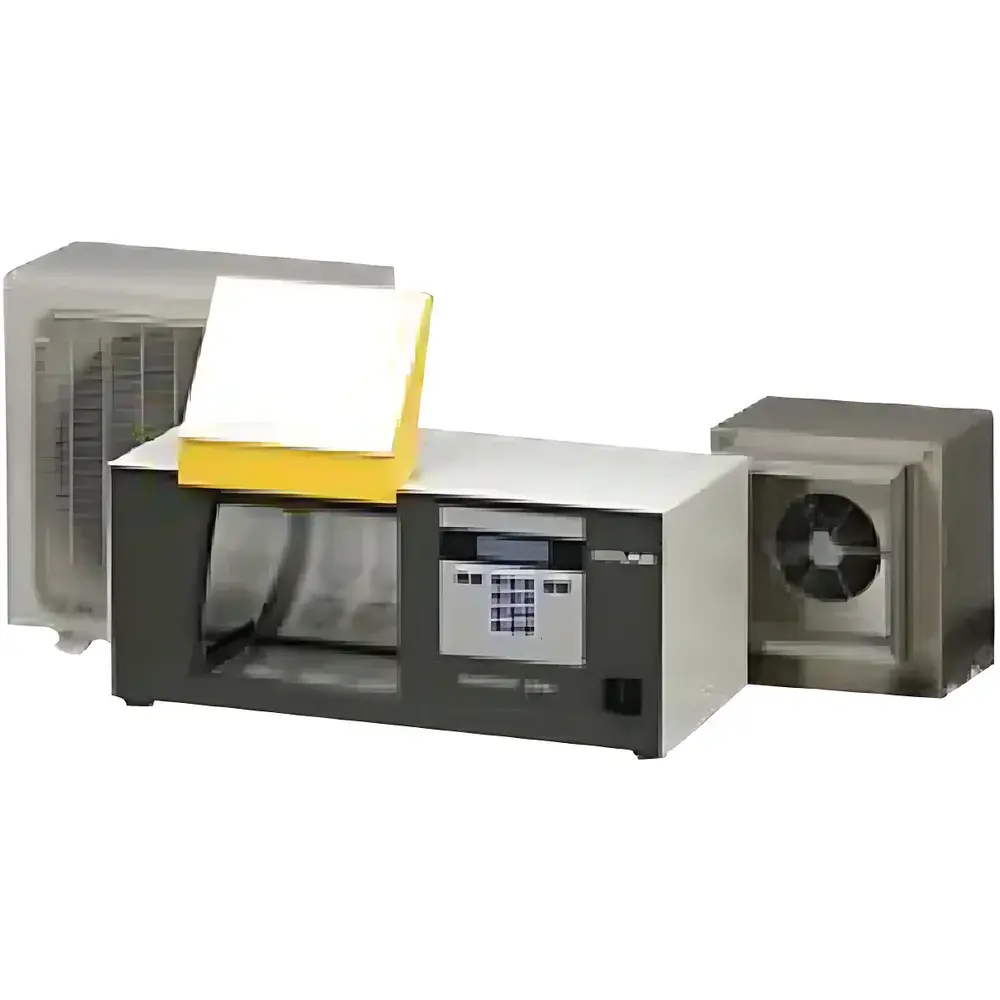
Atlas SUNTEST CPS+ Xenon Arc Weathering Test Chamber
| Brand | ATLAS |
|---|---|
| Origin | USA |
| Model | SUNTEST CPS+ |
| Chamber Dimensions | 90 × 35 × 35 cm |
| Exposure Area | 560 cm² (28 × 20 cm) |
| Lamp | Air-Cooled 1500 W Xenon Arc Lamp |
| Irradiance Control Range | 30–65 W/m² (300–400 nm) |
| Black Standard Temperature (BST) Range | 35–100 °C (without SunCool) |
| Predefined Test Methods | 2 |
| User-Defined Test Programs | 6 |
| Display | Monochrome LCD with Keypad Interface |
| Language Support | English, German, Italian, French, Spanish, Polish, Russian, Chinese |
| Compliance | ISO 4892-1, ASTM G155, IEC 60068-2-9, JIS D 0205, SAE J2527 |
| Optional Accessories | Window Glass Filter, Daylight ID65 Filter, Cool White Fluorescent Filter, SunCool Active Cooling System, SunFlood Immersion System (40 L, temp-controlled), SunTray Sample Exchange Unit (8 × PMMA trays), Water-Cooled Sample Stage, ICH-D10/20/30 Powder Holders, SunCal BB/WB/Lux BST Calibration Sensors |
Overview
The Atlas SUNTEST CPS+ is a benchtop xenon arc weathering test chamber engineered for precise, reproducible simulation of solar radiation, temperature, and moisture exposure in accelerated material aging studies. It operates on the principle of xenon arc lamp irradiation—filtered through advanced quartz optics and selective reflectors—to replicate natural daylight spectra per CIE Publication 85 (1989), ensuring high-fidelity spectral match across critical UV, visible, and near-infrared bands (300–800 nm). Unlike broad-spectrum UV fluorescent or metal halide systems, the CPS+ delivers true daylight-weighted irradiance control, enabling correlation of laboratory results with real-world outdoor degradation mechanisms such as photooxidation, polymer chain scission, pigment fading, and surface embrittlement. Its compact footprint (90 × 35 × 35 cm) and 560 cm² exposure area support both flat specimens and three-dimensional components, making it suitable for R&D labs, quality control environments, and regulatory testing laboratories operating under GLP or ISO/IEC 17025 frameworks.
Key Features
- Microprocessor-based control system with intuitive keypad interface and monochrome LCD display for real-time monitoring of irradiance, black standard temperature (BST), chamber air temperature (CHT), and diagnostic status.
- Direct digital setpoint control of irradiance intensity (30–65 W/m² at 300–400 nm; 250–765 W/m² at 300–800 nm) and BST (35–100 °C), with automatic feedback regulation via integrated sensors.
- CIE 85-compliant spectral output achieved through proprietary coated quartz filters and dichroic reflectors—optimized to minimize IR heat load while preserving photobiologically relevant UV-B and UV-A bands.
- Two factory-preprogrammed test protocols plus six user-definable cycles, supporting time-based or radiant exposure (J/m²)-terminated testing with configurable ramp profiles.
- Multi-language firmware (English, German, French, Italian, Spanish, Polish, Russian, Chinese) compliant with international lab operation requirements.
- RS-232 serial interface for data logging, remote parameter adjustment, and integration into centralized LIMS or QA documentation workflows.
Sample Compatibility & Compliance
The SUNTEST CPS+ accommodates diverse sample geometries—including rigid panels, flexible films, molded plastics, coated metals, textiles, pharmaceuticals, and cosmetic formulations—via modular accessories such as the SunTray (8-position PMMA tray system), water-cooled sample stage (for thermally sensitive substrates), and ICH-D series powder holders (1–3 mm depth, compliant with ICH Q1A(R2) stability guidance). All BST measurements conform to ISO 4892-1 requirements for black standard thermometer placement and thermal mass. The instrument meets core international standards including ASTM G155 (xenon-arc exposure apparatus), ISO 4892-2 (methods for plastics), IEC 60068-2-9 (damp heat cycling), JIS D 0205 (automotive interior materials), and SAE J2527 (automotive exterior materials). Optional window glass and Daylight ID65 filters enable simulation of filtered sunlight conditions relevant to indoor applications or automotive glazing testing.
Software & Data Management
While the CPS+ operates autonomously via its embedded controller, its RS-232 interface supports bidirectional communication with external PCs running third-party data acquisition software or custom scripts. All operational parameters—including irradiance setpoints, BST targets, elapsed time, cumulative radiant exposure, and fault codes—are timestamped and exportable in CSV format. Calibration traceability is maintained through NIST-traceable SunCal sensors: SunCal BB (300–400 nm irradiance + BST), SunCal WB (300–800 nm irradiance + BST), and SunCal Lux (illuminance in lux and lux-hours). These enable periodic verification per ISO/IEC 17025 Clause 6.5 and support audit readiness for FDA 21 CFR Part 11–governed environments where electronic records require integrity, confidentiality, and long-term retention.
Applications
The SUNTEST CPS+ serves as a primary tool for predictive durability assessment across regulated and industrial sectors. In automotive OEM supply chains, it validates colorfastness and gloss retention of interior trims under simulated dashboard exposure. Coatings manufacturers use it to rank UV resistance of architectural paints and marine antifoulants per ASTM D4587. Pharmaceutical firms apply it to photostability testing of solid dosage forms under ICH Q1B guidelines, particularly when combined with SunCool active cooling for sub-ambient BST control. Cosmetic formulators assess SPF performance using SunTray-mounted in vitro substrates per COLIPA/ISO 24444 protocols. Additionally, the SunFlood immersion module enables cyclic wet/dry corrosion testing of sealants and construction adhesives under controlled irradiance and humidity profiles.
FAQ
What spectral range does the SUNTEST CPS+ simulate?
It replicates full-spectrum daylight from 300 nm to 800 nm, with optional filtering to emulate unfiltered sunlight, window-filtered sunlight, or artificial indoor lighting.
How is irradiance calibrated and verified?
Using NIST-traceable SunCal BB or WB sensors, which provide simultaneous calibration of irradiance (W/m²) and black standard temperature (°C) across defined wavelength bands.
Can the CPS+ perform cyclic weathering tests with moisture?
Yes—when equipped with the optional SunFlood immersion system, it supports programmable spray, condensation, and immersion phases synchronized with irradiance and temperature profiles.
Is the instrument compliant with FDA 21 CFR Part 11 requirements?
While the base unit lacks built-in electronic signature or audit trail functionality, its RS-232 output and calibration traceability support integration into validated Part 11–compliant LIMS or ELN platforms.
What is the maximum sample thickness compatible with the SunTray system?
The standard SunTray accommodates specimens up to 10 mm thick; custom fixtures are available for thicker or irregularly shaped samples upon request.



