
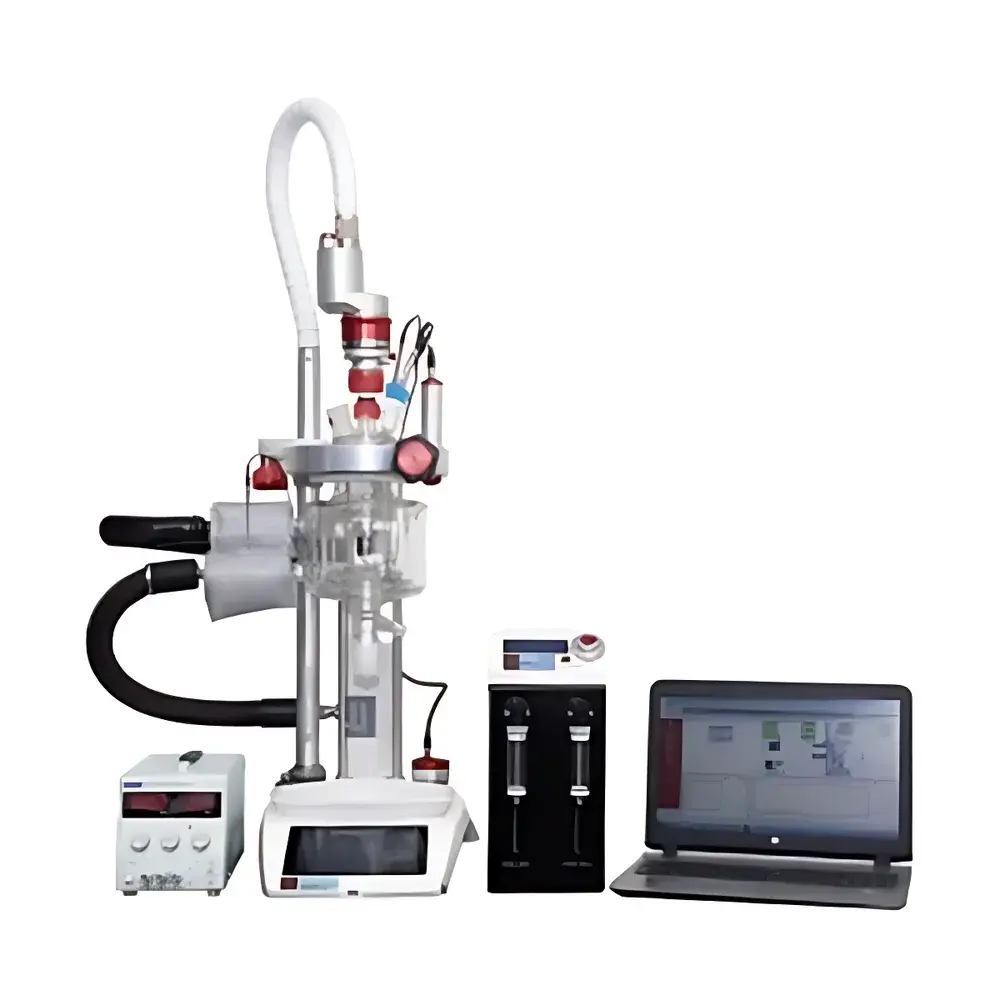
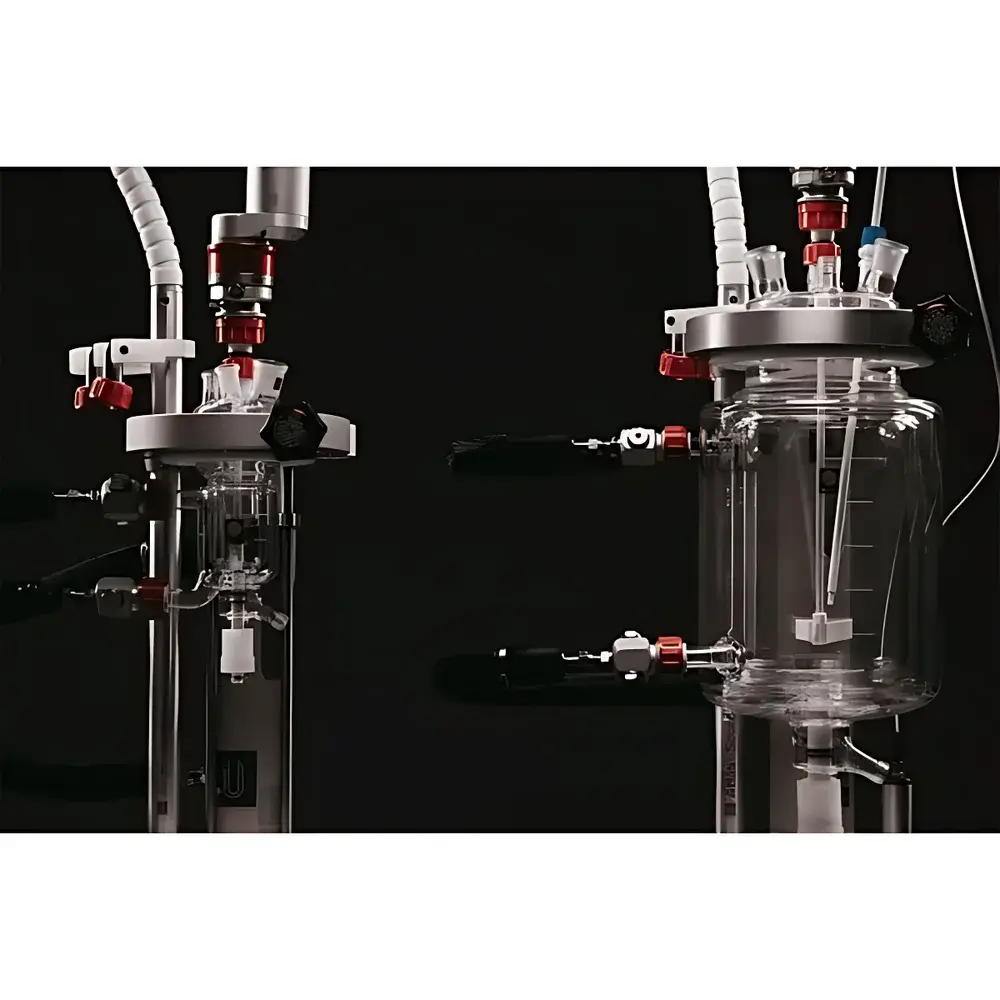
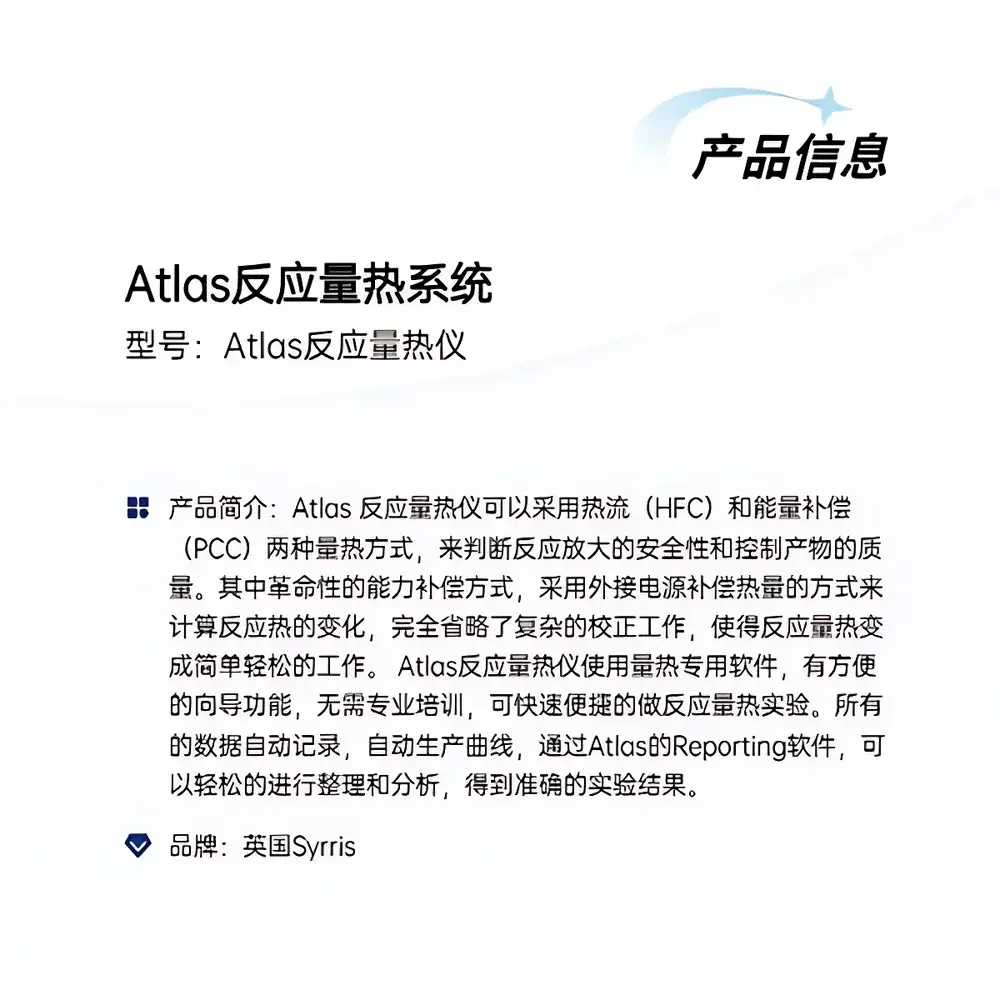
Atlas Syrris Atlas Reaction Calorimeter
| Brand | Syrris |
|---|---|
| Origin | United Kingdom |
| Model | Atlas |
| Calorimetry Modes | Heat Flow Calorimetry (HFC) & Power Compensation Calorimetry (PCC) |
| Reactor Type | Triple-walled vacuum-jacketed vessel |
| Volume Range | 250 mL – 2 L |
| Temperature Range | −40 °C to +200 °C |
| Temperature Accuracy | ±0.1 °C (dependent on external circulator performance) |
| Max. PCC Power Compensation | 50 W |
| Max. HFC Energy Density | 100 W/L |
| Calorimetric Accuracy | 1–5% (subject to experimental conditions and integration time) |
| Sensitivity | <0.1 W/kg |
| Mechanical Stirring | 0–800 rpm |
| Magnetic Stirring | 0–1200 rpm |
| Gas Handling | Inert gas purging, vacuum & pressure operation capable |
| Optional Modules | Gravimetric & volumetric dosing systems (balances, syringe pumps, peristaltic pumps), in-line FTIR, turbidity/ particle size analyzers for crystallization studies, pH probes with automated pH control |
Overview
The Syrris Atlas Reaction Calorimeter is an engineered platform for precise, real-time measurement of thermal activity during chemical synthesis under controlled laboratory conditions. It operates on two complementary calorimetric principles—Heat Flow Calorimetry (HFC) and Power Compensation Calorimetry (PCC)—enabling rigorous thermodynamic characterization of exothermic and endothermic reactions across a broad operational envelope (−40 °C to +200 °C). The system integrates a triple-walled, vacuum-insulated reactor vessel with high-fidelity RTD-based temperature sensing and closed-loop PID temperature regulation, ensuring exceptional thermal stability and reproducibility. Designed for both batch and flow-integrated reaction workflows, the Atlas supports GMP-aligned process development, safety screening (e.g., RC1-type assessments), and mechanistic kinetic studies—particularly in pharmaceutical, fine chemical, and catalysis research where heat evolution profiles directly inform scale-up decisions and hazard evaluation.
Key Features
- Fully automated operation: coordinated control of temperature setpoints, reagent addition (gravimetric and volumetric), stirring speed, gas atmosphere, and pressure management via unified software interface
- Dual-mode calorimetry: seamless switching between HFC (ideal for high-thermal-mass, long-duration reactions) and PCC (optimized for low-heat-capacity or fast-transient systems) without hardware modification
- Vacuum-jacketed reactor architecture: minimizes radial heat loss and enhances signal-to-noise ratio in heat flow measurements; available in volumes from 250 mL to 2 L
- High-resolution thermal control: ±0.1 °C accuracy maintained via precision PID algorithms coupled with external recirculating chillers/heaters (e.g., Huber units)
- Modular agitation: interchangeable mechanical (0–800 rpm) and magnetic (0–1200 rpm) stirrers accommodate heterogeneous slurries, viscous media, and gas-liquid mass transfer requirements
- Rapid reactor exchange: tool-free vessel mounting enables full reactor swap in under 60 seconds—critical for multi-reaction screening campaigns
Sample Compatibility & Compliance
The Atlas accommodates diverse reaction chemistries—including organometallic couplings, hydrogenations, nitrations, polymerizations, and crystallization-driven transformations—under inert (N₂, Ar), reduced-pressure, or elevated-pressure (up to 10 bar, with appropriate accessories) environments. Its design conforms to ISO 11358 (polymer thermal analysis), ASTM E698 (kinetic analysis of decomposition), and supports alignment with ICH Q5C (stability testing) and Q7 (GMP for APIs). When configured with audit-trail-enabled software and electronic signatures, the system meets FDA 21 CFR Part 11 requirements for regulated environments. All sensor calibrations—including RTD, load cell, and pH—are traceable to NIST standards, and calibration records are exportable for GLP/GMP documentation.
Software & Data Management
Atlas Calorimetry & Reporting Software provides a validated, intuitive interface for method definition, real-time monitoring, and post-run analysis. It natively computes heat flow (W), cumulative enthalpy (kJ), specific power (W/g), and adiabatic temperature rise (ΔTad)—with configurable integration windows and baseline correction algorithms. Raw data (time-stamped temperature, power, mass, pH, FTIR absorbance, turbidity) are stored in vendor-neutral CSV and HDF5 formats. Batch comparison tools enable overlay of multiple runs; statistical summaries (mean, SD, RSD) support DOE analysis. The software supports automated report generation compliant with internal SOPs or regulatory submission templates (e.g., EMA Annex 15).
Applications
- Reaction safety assessment: determination of ΔHr, MTSR, and thermal accumulation for RC1-style hazard evaluation
- Process optimization: quantifying heat effects during reagent addition sequences, cooling/heating ramps, and hold periods
- Crystallization kinetics: correlating in-line turbidity or ATR-FTIR signals with enthalpic events to map nucleation and growth regimes
- Catalyst screening: comparative exotherm profiling across ligand/metal combinations under identical thermal protocols
- Continuous flow reaction calorimetry: integration with Syrris Asia or FLUENT systems for residence-time-resolved thermal mapping
- Formulation stability studies: monitoring degradation enthalpies in API-excipient mixtures under accelerated temperature profiles
FAQ
Can the Atlas perform both HFC and PCC on the same reaction run?
No—HFC and PCC are mutually exclusive modes selected prior to experiment initiation, as they rely on distinct thermal management strategies and data acquisition configurations.
Is remote monitoring supported?
Yes; the system supports secure remote access via VNC or TeamViewer when deployed on a local network with appropriate firewall configuration and IT governance approval.
What validation documentation is supplied?
Syrris provides Factory Acceptance Test (FAT) reports, IQ/OQ protocol templates, and instrument-specific calibration certificates for all critical sensors (RTD, load cell, pressure transducer).
How is heat loss compensation handled in non-adiabatic conditions?
The software applies dynamic heat loss correction using real-time jacket temperature differentials and empirically derived U-values from system characterization runs.
Are third-party analytical modules (e.g., Agilent FTIR) supported?
Yes—via analog voltage output (0–10 V) or OPC UA connectivity; Syrris provides integration guidelines and timing synchronization protocols for synchronized data capture.



