
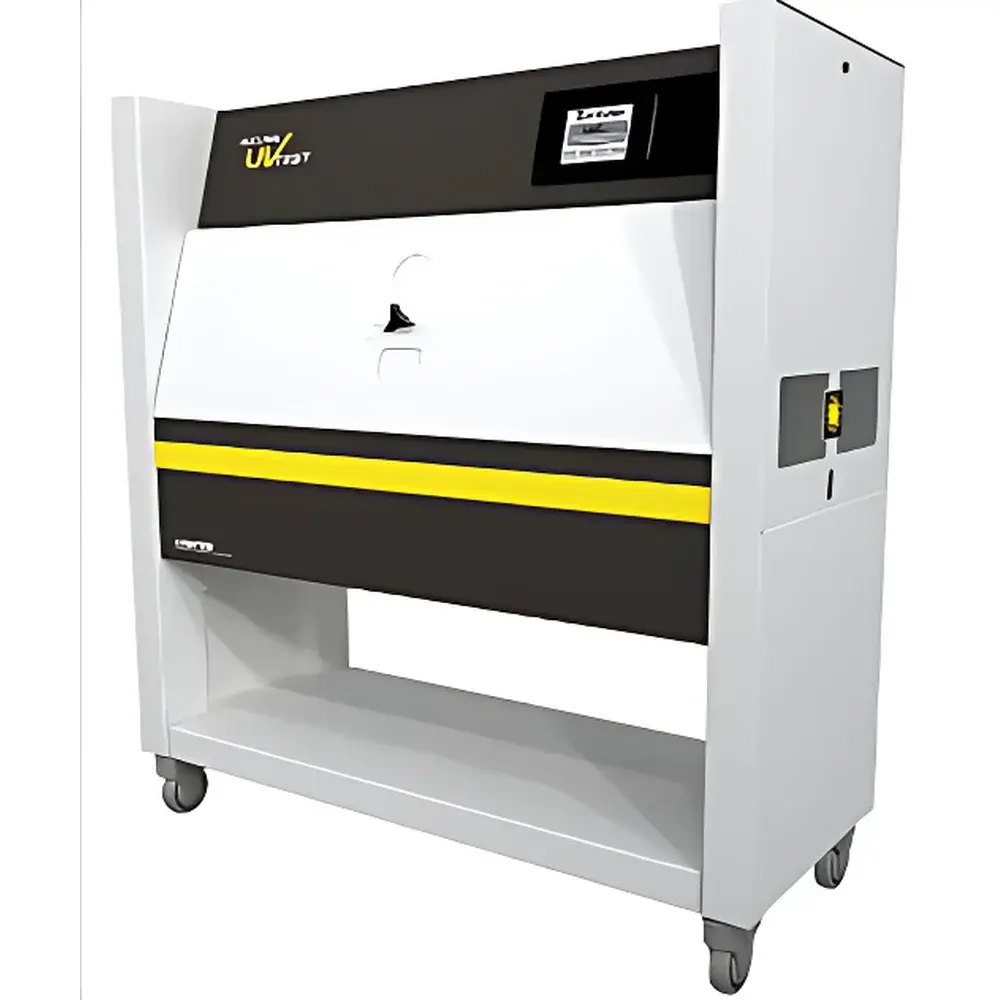
Atlas UVTest UV Fluorescent Weathering Test Chamber
| Brand | ATLAS |
|---|---|
| Origin | USA |
| Model | UVTest |
| Radiation Uniformity | ±4% |
| Irradiance Range | 0.35–1.55 W/m² (UVA), 0.35–1.00 W/m² (UVB) |
| Black Panel Temperature Range (UV Phase) | 35–80°C (95–176°F) |
| (Condensation Phase) | 35–60°C (95–140°F) |
| Sample Capacity | Up to 48 specimens on 24 dual-position sample racks |
| Approx. Weight | 140 kg (310 lbs) |
| Power Supply | 120 V (±10%), 1-phase, 2-wire (1/N/PE), 50/60 Hz, 12 A |
| Spray Water Pressure | 25–40 psi (1.7–2.7 bar) |
| Condensate Water Pressure | 2–60 psi (0.1–4.1 bar) |
Overview
The Atlas UVTest UV Fluorescent Weathering Test Chamber is a precision-engineered environmental simulation system designed for accelerated material degradation testing under controlled ultraviolet (UV) radiation, temperature, and humidity conditions. Developed by ATLAS—a global leader in weathering science with over 90 years of applied expertise—the UVTest leverages fluorescent UV lamp technology to replicate the photochemical effects of solar UV exposure, particularly in the UVA (315–400 nm) and UVB (280–315 nm) spectral bands. Unlike xenon arc systems that simulate full-spectrum sunlight, the UVTest is optimized for high-intensity, short-wavelength UV stress—making it especially suitable for evaluating polymer photostability, coating durability, ink resistance, and additive performance where UV-driven degradation mechanisms dominate. Its chamber architecture integrates calibrated irradiance delivery, precise black panel temperature control (via Pt1000 sensors), and programmable condensation cycles—all compliant with key international test standards including ASTM G154, ISO 4892-3, and SAE J2020.
Key Features
- Fluorescent UV lamp array with selectable UVA-340 or UVB-313 lamp configurations—enabling compliance with multiple standard exposure protocols
- Real-time irradiance monitoring and automatic feedback control ensuring ±4% spatial uniformity across specimen plane
- Dual-phase thermal management: independent UV irradiation phase (35–80°C BPT) and condensation phase (35–60°C BPT), both monitored via traceable Pt1000 black panel thermometers
- Integrated touch-screen interface supporting multilingual operation (English, Chinese, Korean, French, German, Spanish, Portuguese) with intuitive program storage, real-time trend graphs, alarm logging, and scheduled maintenance prompts
- In-situ irradiance calibration port—allowing sensor recalibration without opening chamber door or disabling safety interlocks, minimizing operator UV exposure risk
- Modular spray system with adjustable nozzles, optional recirculating spray kit, and configurable water pressure (25–40 psi) and purity requirements (conductivity < 5 µS/cm)
- Robust mechanical design featuring height-adjustable leveling feet, integrated water-level safety switch, splash-protected gas heater assembly, and stackable chassis configuration for space-efficient lab deployment
Sample Compatibility & Compliance
The UVTest accommodates up to 48 flat specimens (e.g., films, coatings, textiles, composites, automotive trim) mounted on 24 dual-position racks—supporting standardized sample dimensions per ASTM D6675 and ISO 4892-3. All critical operational parameters—including irradiance, black panel temperature, cycle timing, and spray duration—are programmable and auditable. The system meets GLP-relevant data integrity requirements through WXView Ethernet-based data acquisition, enabling timestamped, user-logged event records compatible with 21 CFR Part 11-compliant electronic signature workflows when deployed with validated software environments. Calibration procedures follow NIST-traceable methodologies, and temperature and irradiance sensors are certified to ISO/IEC 17025-accredited laboratories upon installation and at defined intervals.
Software & Data Management
Control and monitoring are executed via the embedded WXView-compatible firmware platform, which supports remote access over standard Ethernet networks. All test parameters, real-time sensor outputs (irradiance, BPT, chamber humidity), and system status events—including door interlock states, lamp-on hours, and alarm triggers—are logged with millisecond timestamps. Export formats include CSV and XML for integration into LIMS or QA documentation systems. Firmware updates preserve historical calibration coefficients and user-defined test methods. Optional audit trail modules provide immutable logs of parameter changes, user logins, and calibration interventions—essential for ISO 9001, IATF 16949, and FDA-regulated quality systems.
Applications
- Accelerated UV stability assessment of automotive interior plastics and exterior clearcoats per SAE J2020 and GMW14124
- Photodegradation kinetics studies of pharmaceutical packaging materials under ICH Q1B guidelines
- Validation of UV stabilizers and HALS additives in polyolefins and PVC compounds
- Correlation of laboratory UV exposure results with field aging data for architectural sealants and roofing membranes
- Quality conformance testing of printed electronics, OLED encapsulation layers, and optical adhesives
- Routine QC screening of batch-to-batch consistency in pigment-dispersed coatings and inks
FAQ
What UV lamp types are supported?
The UVTest accepts industry-standard UVA-340 (simulating terrestrial solar UV down to 295 nm) and UVB-313 (enhanced short-wave UV for aggressive stress testing) fluorescent lamps—both compliant with ASTM G154 Annex A1 and ISO 4892-3.
Can the system operate unattended for extended cycles?
Yes. With its auto-restart function following power interruption, sealed condensate reservoir, and predictive maintenance alerts, the UVTest supports fully autonomous multi-day exposures without manual intervention.
Is deionized water mandatory for spray operation?
Deionized water is strongly recommended to prevent mineral scaling in nozzles and reservoirs; however, conditioned tap water may be used with increased cleaning frequency and potential impact on long-term irradiance stability due to lens fouling.
How is irradiance uniformity verified?
Uniformity is validated using a NIST-traceable UV radiometer scanned across the specimen plane per ASTM G154 Section 7.3—documenting maximum deviation ≤ ±4% from mean irradiance value.
Does the UVTest support regulatory audit requirements?
When paired with validated WXView software and configured with electronic signature and audit trail modules, the system satisfies data integrity expectations for FDA 21 CFR Part 11, EU Annex 11, and ISO/IEC 17025 accredited testing laboratories.



