
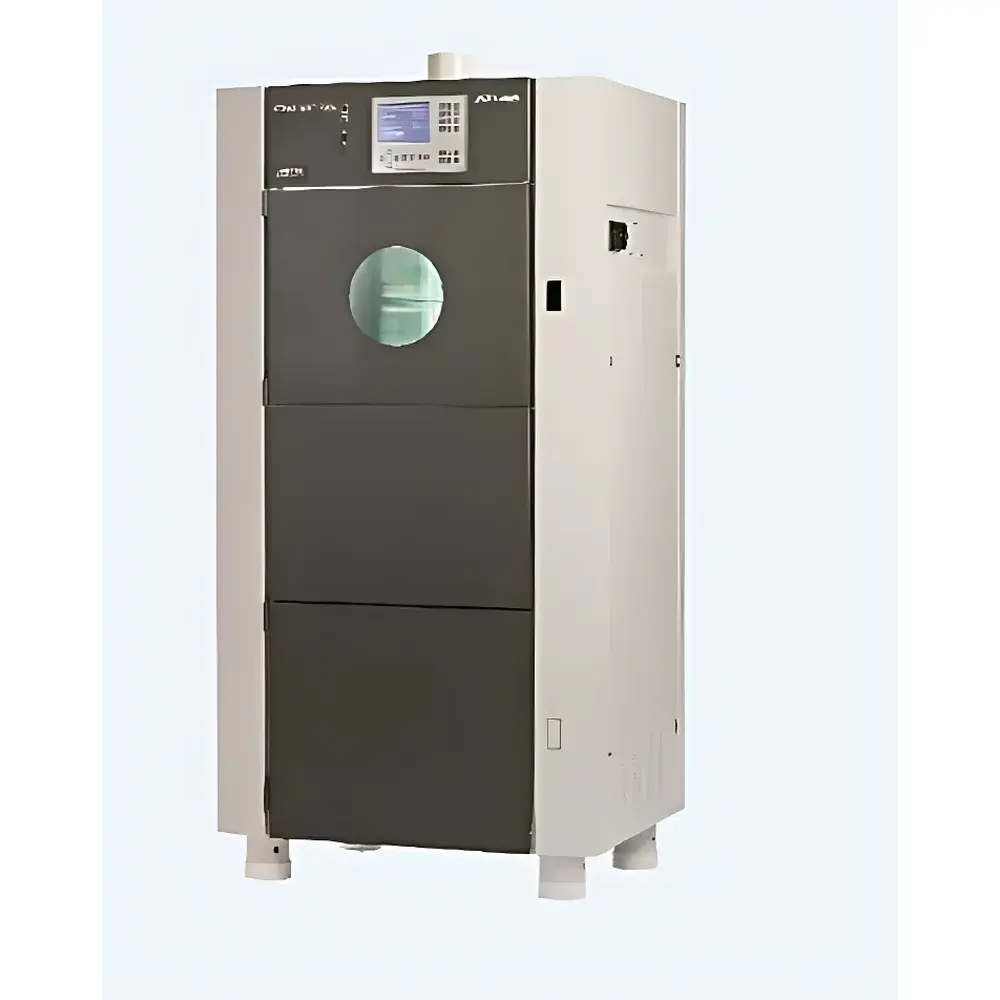
Atlas Xenotest 220 / Xenotest 220+ Xenon Arc Weathering Test Chamber
| Brand | ATLAS |
|---|---|
| Origin | USA |
| Model | Xenotest 220 / Xenotest 220+ |
| Lamp | One 2200 W air-cooled xenon arc lamp |
| Exposure Area | 2310 cm² |
| Irradiance Control Range | 300–400 nm |
| Black Standard Temperature Control | Up to 100 °C (dual-control mode) |
| Chamber Temperature Control | Up to 65 °C (single-mode) or synchronized with black standard (dual-mode) |
| Relative Humidity Range (Illuminated Phase) | 20–85 % RH |
| Humidity System | Ultrasonic humidification with 60 L integrated reservoir and auto-refill |
| Sample Capacity | 38 standard textile specimens (19 dual-position sample holders) |
| Compliance | ISO 105-B02, AATCC TM16-2004 Option 3, Marks & Spencer C9/C9A |
| User Interface | Monochrome keypad panel (Xenotest 220) or color touchscreen with multilingual UI (Xenotest 220+) |
| Data Storage | Internal flash memory |
Overview
The Atlas Xenotest 220 and Xenotest 220+ are high-capacity, air-cooled xenon arc weathering test chambers engineered for accelerated lightfastness and weathering evaluation of textiles, coatings, plastics, and nonwovens. Based on the fundamental principle of xenon arc irradiation—mimicking full-spectrum solar radiation including UV, visible, and near-infrared wavelengths—these instruments replicate natural outdoor exposure under controlled, reproducible laboratory conditions. Unlike water-cooled systems, the 220 series utilizes a single 2200 W air-cooled xenon lamp, delivering stable spectral output while minimizing infrastructure demands (no external chiller or high-flow water supply required). Its 2310 cm² exposure area accommodates up to 38 standardized textile specimens simultaneously—nearly double the throughput of comparable mid-range units such as the Xenotest 150 S+, all within identical footprint constraints. This design reflects an optimization of test economy, operational efficiency, and regulatory alignment—particularly for labs performing routine conformance testing per ISO 105-B02 and AATCC TM16-2004 Option 3.
Key Features
- Single 2200 W air-cooled xenon arc lamp with long-life filter system ensuring spectral stability across extended test cycles
- XENONSENSIV® intelligent sample rack: integrates real-time irradiance (W/m², 300–400 nm) and black standard temperature (°C) monitoring directly at specimen level
- Dual thermal control architecture: independent regulation of chamber air temperature (max 65 °C) and black standard temperature (max 100 °C), with fan-assisted differential management
- Ultrasonic humidity generation with 60 L built-in reservoir and automatic refill—maintaining precise 20–85 % RH during irradiated phases
- Modular user interface: monochrome membrane keypad and LCD (Xenotest 220) or full-color capacitive touchscreen with multilingual support (Xenotest 220+)
- Preloaded test protocols for ISO 105-B02 and AATCC TM16-2004 Option 3; programmable termination by radiant exposure (kJ/m²), elapsed time, or irradiance dose
- UV-blocking observation window with integrated safety interlock and real-time diagnostic display
- Internal flash memory for secure storage of up to 10 user-defined test methods and full-cycle runtime logs
Sample Compatibility & Compliance
The Xenotest 220/220+ is validated for use with standardized textile substrates per ISO 105-B02 (Textiles — Tests for colour fastness — Part B02: Colour fastness to artificial light: Xenon arc fading lamp test) and AATCC TM16-2004 Option 3 (with controlled humidity and black standard temperature). Its mechanical sample holder accepts 19 dual-position carriers—each holding two 100 × 40 mm specimens—enabling parallel assessment of material batches, dye lots, or finishing variants. The chamber’s internal geometry, airflow distribution, and irradiance uniformity meet the spatial homogeneity requirements specified in ASTM G155 Annex A1 and ISO 4892-2. Filter configurations comply with Daylight-Q/B (quartz/borosilicate) spectral filtering per ISO 4892-2:2016, ensuring traceable correlation to terrestrial solar irradiance. All firmware and data handling functions support audit-ready operation under GLP environments, with optional XenoTouch Ethernet module enabling 21 CFR Part 11–compliant electronic signatures and access controls.
Software & Data Management
Test configuration, execution, and data retrieval are managed through embedded firmware with deterministic real-time scheduling. The 220+ model supports direct irradiance setpoint input (300–400 nm), black standard and chamber temperature setpoints, and RH target values—all adjustable during active test phases. Runtime diagnostics—including lamp voltage/current, filter age estimation, humidity sensor drift alert, and cooling fan RPM—are continuously logged to internal flash memory. Data export is supported via removable SD card (FAT32 formatted) or RS232 serial interface using ASCII-delimited text files compatible with LIMS integration. Optional XenoTouch modules extend functionality: XenoTouch 1 enables remote start/stop and status polling via Ethernet; XenoTouch 2 adds SMTP-based email alerts for test completion or fault conditions; XenoTouch 3 delivers browser-based live monitoring with graphical trend overlays (irradiance, BST, RH, chamber T). No proprietary software installation is required—data files conform to ISO/IEC 17025–recommended structured logging conventions.
Applications
These instruments serve quality assurance and R&D laboratories in global textile supply chains, automotive interior component development, and architectural coating formulation. Typical applications include comparative lightfastness ranking of reactive dyes on cotton, UV stabilizer efficacy screening in polypropylene nonwovens, fade resistance validation of digital textile prints, and accelerated aging of flame-retardant finishes under cyclic wet/dry irradiation. The dual-temperature control mode is essential for simulating thermal load effects in dark-phase recovery periods—critical for predicting real-world performance of heat-sensitive substrates. Due to its high specimen density and low per-sample energy cost, the Xenotest 220/220+ is frequently deployed in contract testing facilities serving brands requiring M&S C9/C9A, OEKO-TEX® Standard 100, or ZDHC MRSL compliance documentation.
FAQ
What standards does the Xenotest 220/220+ support out-of-the-box?
ISO 105-B02 and AATCC TM16-2004 Option 3 are preconfigured; additional protocols may be manually defined using irradiance, temperature, and humidity setpoints.
Can the instrument operate without continuous operator supervision?
Yes—fully autonomous cycle execution is supported, including automatic shutdown upon reaching programmed exposure dose or time, with fault-triggered alerts via XenoTouch 2 (email) or local audible/visual indicators.
Is calibration traceable to national metrology institutes?
Irradiance sensors are factory-calibrated against NIST-traceable reference cells; annual recalibration services are available through ATLAS-certified service centers.
What maintenance intervals are recommended for the xenon lamp and filters?
Lamp replacement is advised every 1500 hours of operation; filter sets (inner/outer) require replacement every 2000 hours or when spectral deviation exceeds ±5% from baseline, per ATLAS Maintenance Bulletin XB-220-M1.
Does the system support multi-user access with role-based permissions?
Native firmware supports password-protected user profiles; full role-based access control (RBAC) and electronic audit trails require XenoTouch 3 with configured LDAP or local directory authentication.



