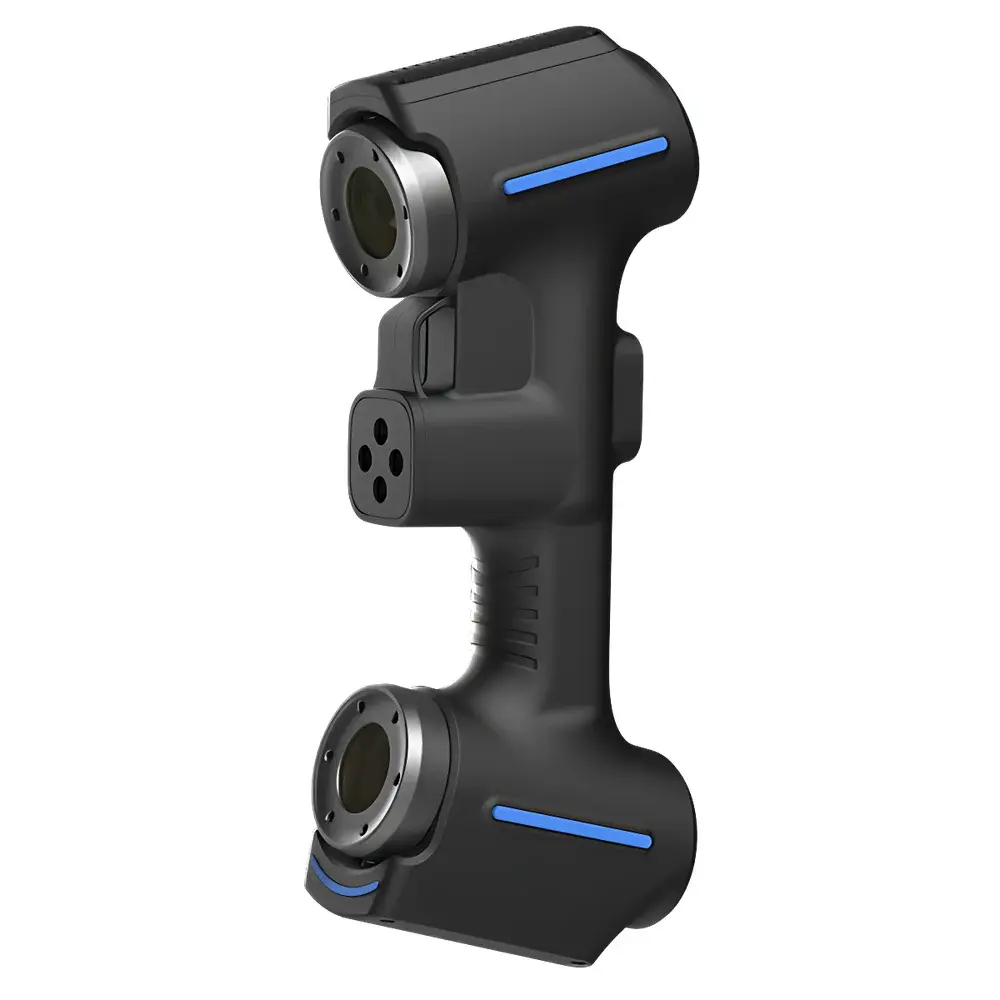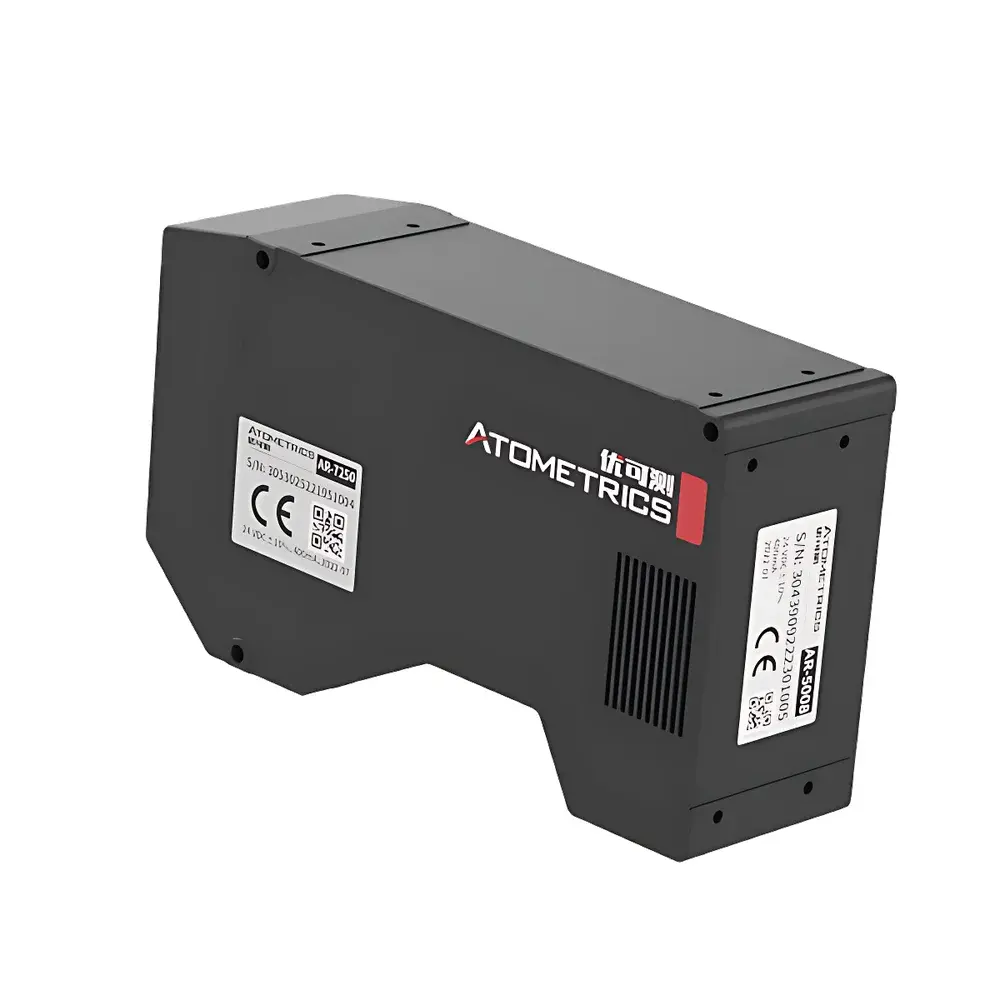
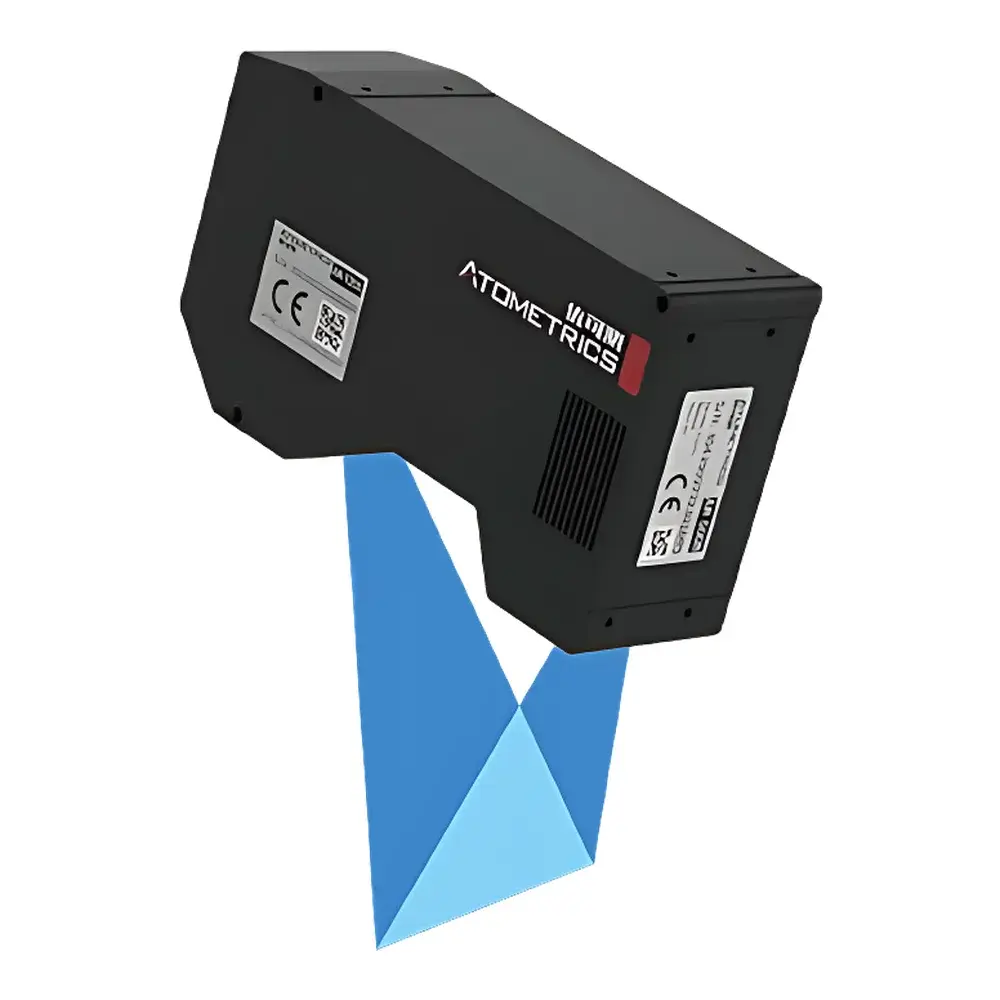
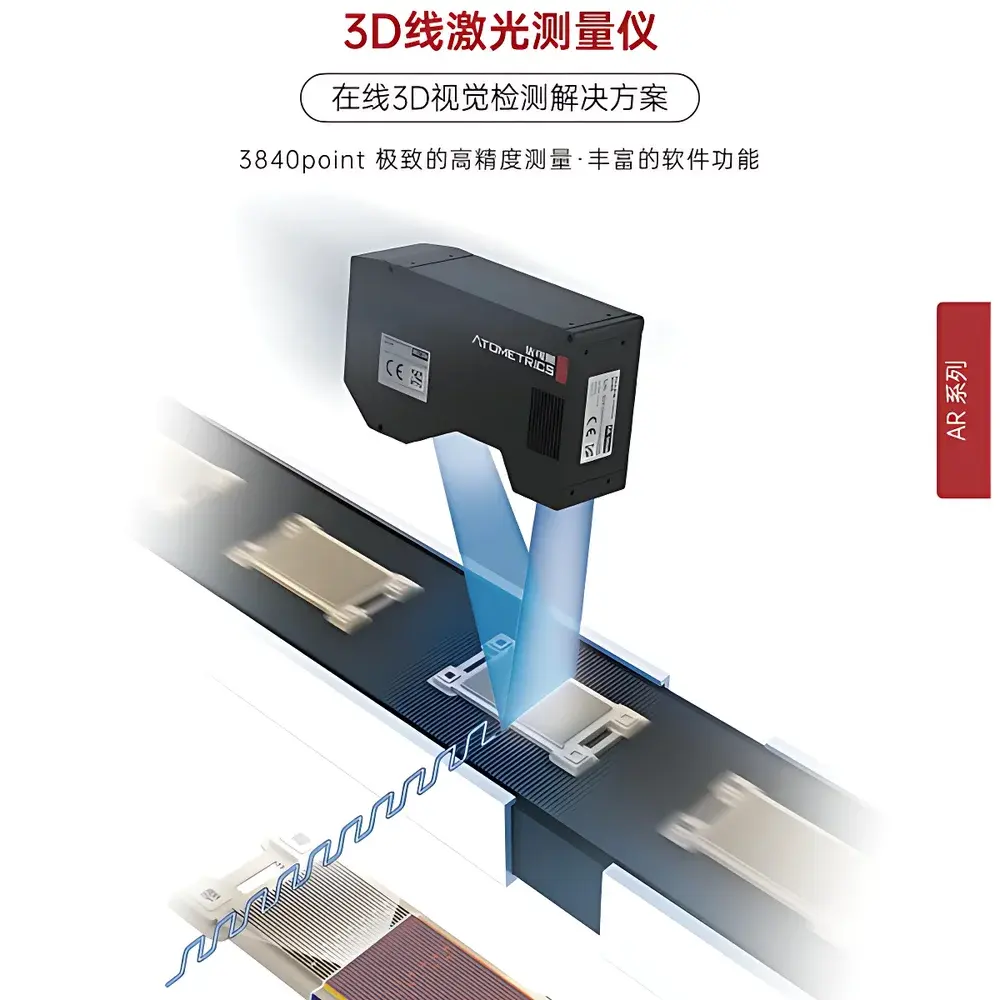
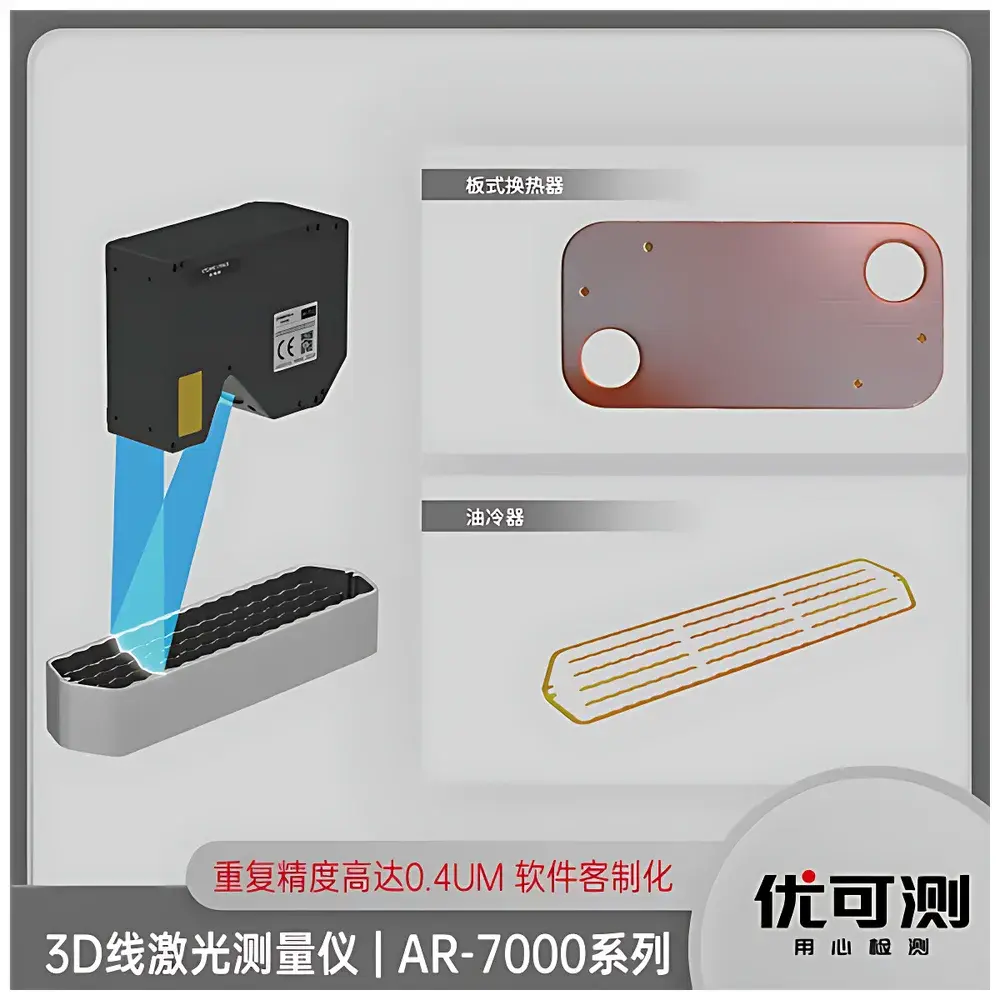
Atometrics AR-7020 3D Line Laser Profilometer for Online 3D Contour, Dimensional, and Flatness Metrology
| Brand | Atometrics |
|---|---|
| Model | AR-7020 |
| Type | 3D Line Laser Scanner |
| Resolution | 3840 measurement points per profile |
| Repeatability | ±0.4 µm |
| Origin | Guangdong, China |
| Manufacturer | Atometrics (OEM/ODM capable) |
| Software Platform | BSmart Pro / BSmart Lite (API-enabled, ROI-customizable, multi-head synchronized) |
Overview
The Atometrics AR-7020 is a high-speed, high-resolution 3D line laser profilometer engineered for real-time, non-contact geometric metrology in automated production environments. Based on triangulation principle with precision collimated blue-violet laser illumination (405 nm) and high-dynamic-range CMOS imaging, the system captures full-field 3D topography at up to 12 kHz line rate — enabling sub-micron repeatability (±0.4 µm) and stable point cloud acquisition even on challenging reflective or low-contrast surfaces. Designed explicitly for inline process control, the AR-7020 delivers calibrated XYZ coordinate data per scan line, supporting traceable dimensional verification compliant with ISO 10360-8 (coordinate measuring machines) and ASTM E2925 (laser scanning performance evaluation). Its rigid aluminum-alloy housing, IP65-rated optical head, and thermal-stable mounting interface ensure long-term stability under factory-floor conditions — from cleanroom battery module assembly to high-vibration automotive powertrain lines.
Key Features
- 3840-point per-scan-line resolution with 2.5 µm lateral sampling pitch and <1 µm Z-axis repeatability under controlled ambient lighting
- Dual-software architecture: BSmart Pro (full 3D reconstruction, multi-head stitching, GD&T analysis, cloud-ready API) and BSmart Lite (rapid setup for flatness, step height, coplanarity, and parallelism — four-step configuration)
- Adaptive optical design minimizing blind zones and specular saturation — optimized for polished aluminum, copper busbars, stainless steel weld seams, and anodized consumer electronics housings
- Multi-head synchronization support: up to six sensors daisy-chained via GigE Vision, enabling seamless large-area coverage (e.g., EV battery module width >600 mm) or spatial multi-angle fusion
- Customizable ROI (Region of Interest) masking — dynamically suppresses ambient light interference and increases effective frame rate without hardware modification
- Fully programmable trigger interface (TTL, encoder, PLC-sync) with sub-millisecond latency for motion-coupled scanning
Sample Compatibility & Compliance
The AR-7020 is validated across diverse industrial substrates including bare and coated metals (Al6061, Cu, SUS304), polymer composites, ceramic substrates, and laminated PCBs. Its high-gain, low-noise CMOS sensor maintains signal integrity on highly reflective surfaces (e.g., busbar surfaces with >90% reflectivity) without active polarization filtering. System calibration adheres to VDI/VDE 2634 Part 2 (optical 3D measuring systems) and supports NIST-traceable artifact-based verification. For regulated industries, the software platform logs all measurement parameters, user actions, and system diagnostics with timestamped audit trails — meeting foundational requirements for GLP/GMP documentation and FDA 21 CFR Part 11 electronic record compliance when deployed with validated IT infrastructure.
Software & Data Management
BSmart Pro provides native support for ISO GPS (Geometrical Product Specifications) standards — including flatness (ISO 1101), position (ISO 5459), and weld seam geometry (ISO 13920). It enables direct export of point clouds (PLY, STL), GD&T reports (PDF/XML), and statistical process control (SPC) datasets compatible with Minitab, JMP, and MES platforms. The SDK includes C++/C#/.NET libraries, RESTful APIs, and HALCON-compatible interfaces — facilitating integration into robotic inspection cells, PLC-controlled conveyors, or custom AI-driven defect classification pipelines. BSmart Lite offers factory-floor usability: drag-and-drop plane definition, automatic reference plane fitting, and pass/fail thresholding with visual overlay directly on live 3D mesh.
Applications
- Battery Manufacturing: Electrode tab flatness (±2 µm tolerance), weld seam crown height and undercut quantification, module side-wall straightness, busbar coplanarity across 12+ contact points
- Consumer Electronics: Smartphone chassis planarity (≤5 µm over 150×150 mm), Type-C connector step height, metal shield warpage, camera module bracket coplanarity
- Automotive Powertrain: Transmission housing surface deviation mapping, engine block deck flatness (ISO 1101 Class A), EV motor stator lamination stack height uniformity
- PCB & Semiconductor Packaging: BGA solder ball height distribution, solder paste volume estimation (via cross-section integration), flex PCB bend-induced warpage
- Industrial Coating & Adhesive Application: Real-time glue bead width/height consistency monitoring, dispensing path deviation tracking, sealant gap fill verification
FAQ
What is the maximum working distance and field of view for the AR-7020?
Standard configuration offers 30 mm working distance with 20 mm × 15 mm FOV; optional lenses extend range to 100 mm (FOV: 65 mm × 48 mm) or 250 mm (FOV: 160 mm × 120 mm) — all maintaining ≤0.4 µm Z repeatability.
Does the system support dynamic scanning on moving parts?
Yes — with encoder-synchronized triggering and motion compensation algorithms embedded in BSmart Pro, the AR-7020 achieves sub-pixel registration accuracy on conveyors operating up to 2 m/s.
Can the AR-7020 be integrated into existing PLC-based automation?
Fully supported via standard Modbus TCP, EtherNet/IP, and PROFINET gateways; digital I/O signals (pass/fail, error, ready) are configurable per inspection routine.
Is SDK documentation and technical support available for custom software development?
Yes — comprehensive API reference manuals, sample code repositories (GitHub), and remote debugging assistance are provided under Atometrics’ Developer Support Program, including on-site integration engineering for Tier-1 OEMs.
How is calibration maintained during continuous operation?
The system includes automated daily self-check using internal reference targets; full volumetric calibration (including lens distortion and laser alignment) is recommended every 6 months or after mechanical shock — performed by certified Atometrics field service engineers.