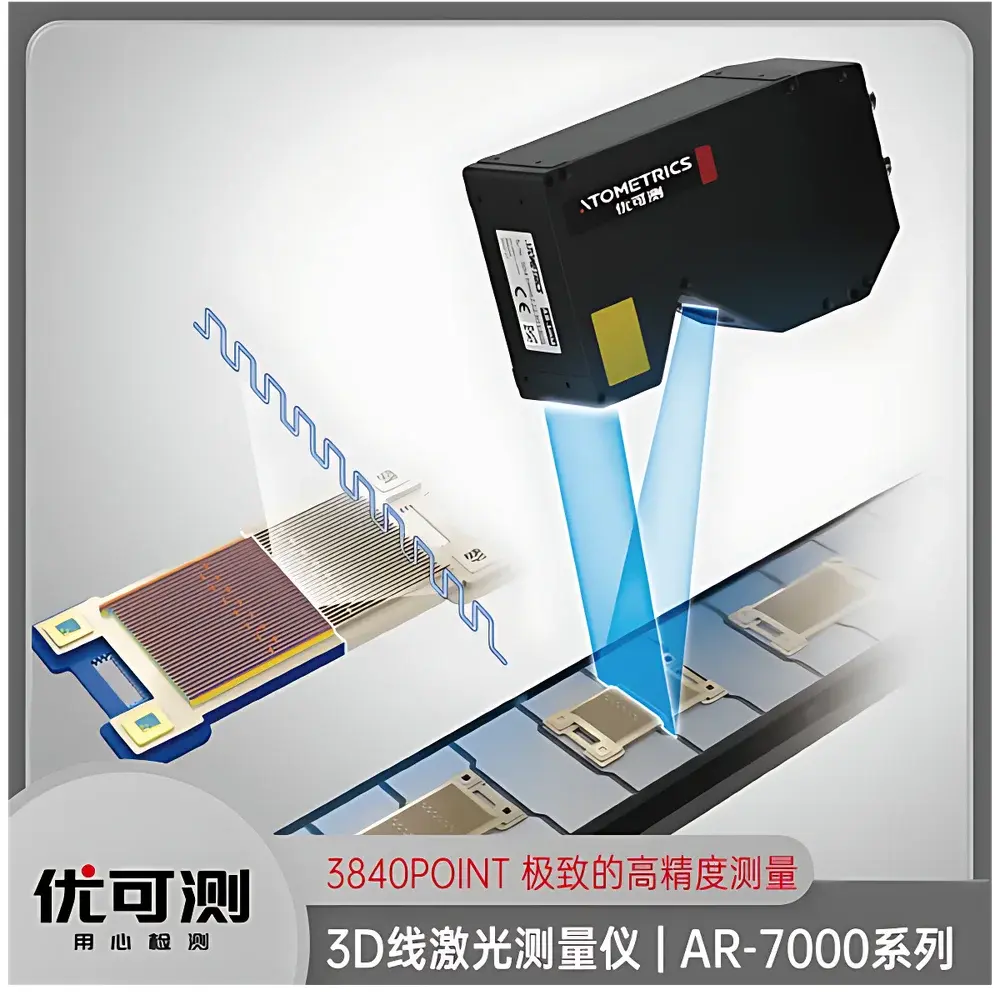
Atometrics AR-7040 High-Precision 3D Line Laser Scanner for Weld Seam Inspection
| Brand | Atometrics |
|---|---|
| Origin | Guangdong, China |
| Manufacturer Type | OEM/ODM Manufacturer |
| Country of Origin | China |
| Model | AR-7040 |
| Instrument Category | 3D Line Laser Scanner |
| Point Density | 3840 points per profile |
| Repeatability | ±0.4 µm |
| Software Platform | BSmart Pro / BSmart Lite |
| Multi-Sensor Support | Up to 6 sensors (daisy-chainable) |
| Target Applications | Weld seam inspection, flatness measurement, height differential analysis, surface defect detection, ROI-based glue bead verification |
Overview
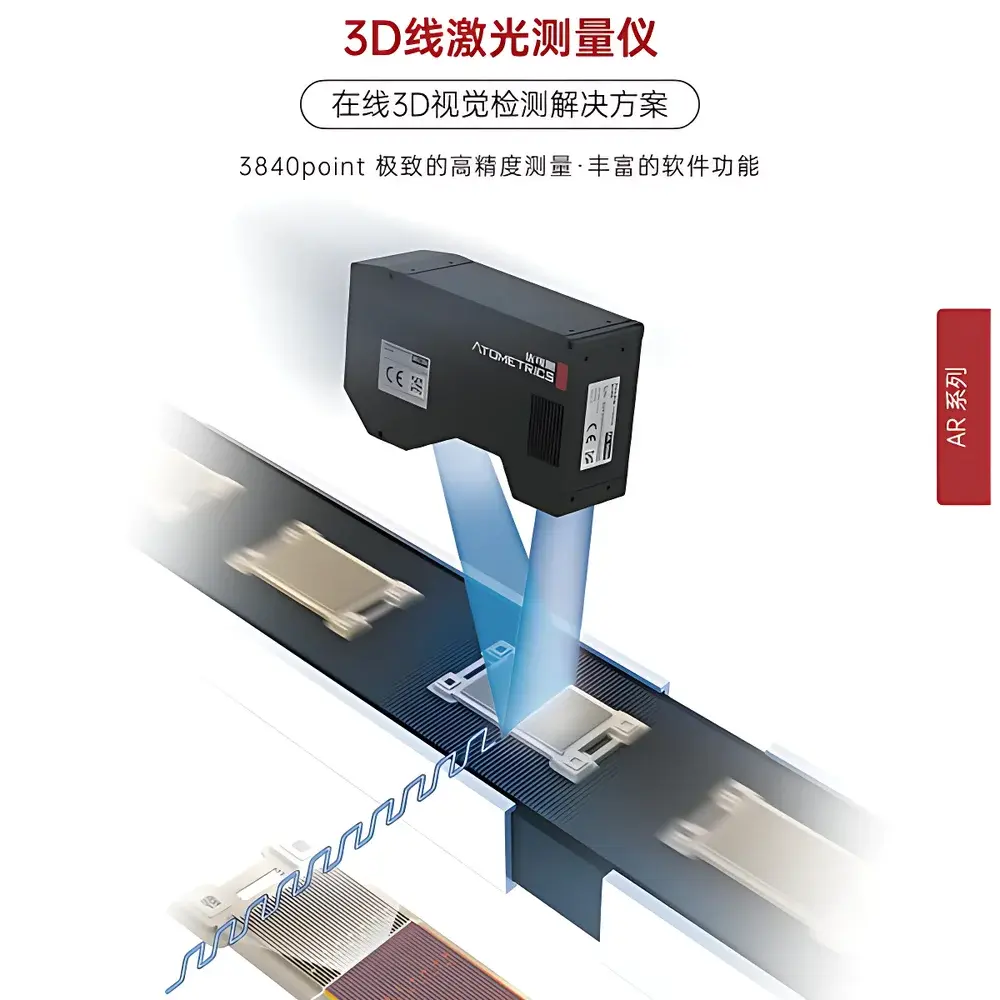
The Atometrics AR-7040 is a high-resolution, industrial-grade 3D line laser scanner engineered for non-contact, real-time geometric metrology in automated manufacturing environments. Based on triangulation principle with structured blue-line laser illumination and high-sensitivity CMOS imaging, the AR-7040 captures dense, distortion-corrected point clouds at up to 3840 points per scan profile. Its sub-micron repeatability (±0.4 µm) enables traceable dimensional verification compliant with ISO 10360-2 and VDI/VDE 2634 Part 2 standards for optical 3D measuring systems. Designed specifically for inline weld seam inspection—such as busbar welding, battery module side seams, and top-cover full-penetration welds—the system delivers calibrated Z-axis resolution suitable for ISO 13920 tolerance evaluation and ASME Y14.5 GD&T validation.
Key Features
- High-fidelity 3D profiling: 3840-point linear array with active laser line projection ensures consistent point spacing and minimal shadowing, even on reflective or low-contrast metallic surfaces (e.g., anodized aluminum, stainless steel, copper busbars).
- Dual-software architecture: BSmart Pro supports advanced multi-sensor stitching, GD&T feature extraction (flatness, position, profile of a line/surface), and defect classification; BSmart Lite provides streamlined setup for routine flatness, step-height, and coplanarity checks in under four configuration steps.
- Optimized optical design: Custom collimated blue-laser diode (450 nm) combined with high-dynamic-range CMOS sensor minimizes specular reflection artifacts and extends effective working distance range (WD: 40–120 mm, FOV: 40 × 30 mm typical).
- Scalable integration: Native support for daisy-chained multi-head configurations (up to six AR-7040 units via Ethernet/IP or EtherCAT), enabling large-area coverage without mechanical translation—ideal for conveyor-based battery module inspection or rail component scanning.
- ROI-driven acquisition: User-defined regions of interest suppress ambient light interference and increase effective frame rate (>2 kHz line rate with ROI), critical for high-speed glue bead verification on PCBs or Type-C connector assemblies.
Sample Compatibility & Compliance
The AR-7040 demonstrates robust performance across diverse material classes including polished metals, matte plastics, and composite laminates. Its high-gain CMOS sensor maintains stable signal-to-noise ratio on highly reflective surfaces (e.g., lithium-ion battery terminal plates, EV busbars), eliminating need for surface treatment or spray coating. The system complies with IEC 61496-1 (Type 3 safety light curtain interface readiness), CE marking per Machinery Directive 2006/42/EC, and meets EMC immunity requirements per EN 61326-1. Measurement data output adheres to ISO 10360-5 traceability protocols, and optional audit trail logging satisfies GLP/GMP documentation needs for regulated production lines.
Software & Data Management
BSmart Pro provides native support for ASTM E2924-compliant measurement reporting, including uncertainty budgeting per GUM (JCGM 100:2008). All measurement sessions generate timestamped, metadata-embedded HDF5 files containing raw intensity images, calibrated XYZ coordinates, and user-defined GD&T annotations. API access (C++/Python SDK) enables seamless integration into MES platforms (Siemens Opcenter, Rockwell FactoryTalk) and supports custom algorithm deployment—including AI-assisted weld bead classification or outlier detection based on statistical process control (SPC) limits. Data export formats include STEP AP214, ASCII XYZ, and industry-standard .STL for downstream CAE validation.
Applications
The AR-7040 is deployed across precision manufacturing sectors requiring micron-level geometric fidelity. In electric vehicle battery production, it performs pre-weld alignment verification, post-weld seam geometry quantification (width, reinforcement, undercut), and full-surface flatness assessment of module end plates per GB/T 34014–2017. For 3C electronics, it measures step-height tolerances on smartphone chassis (< ±2 µm), Type-C port coplanarity, and solder paste volume estimation via cross-sectional area integration. In automotive powertrain, it verifies flatness of oil cooler mounting surfaces (ISO 1101) and detects micro-defects in laser-welded transmission housings. Additional use cases include PCB BGA ball height mapping, shielding can coplanarity validation, and adhesive bead continuity inspection in medical device assembly.
FAQ
What is the maximum working distance and field of view for the AR-7040?
Standard configuration offers 40–120 mm working distance with 40 mm × 30 mm FOV; custom optics extend WD up to 300 mm with corresponding FOV scaling.
Does the AR-7040 support real-time feedback to PLCs or motion controllers?
Yes—via EtherCAT or Ethernet/IP, with sub-10 ms latency for trigger-to-data delivery, enabling closed-loop robotic path correction during weld monitoring.
Can measurement data be exported to SPC software such as Minitab or JMP?
All quantitative results export directly to CSV with column headers conforming to ANSI/ISO SPC metadata conventions, including LSL/USL, Cp/Cpk, and timestamped subgroup identifiers.
Is calibration certificate included with shipment?
Each unit ships with NIST-traceable factory calibration report (per ISO/IEC 17025 accredited lab), covering Z-axis linearity, point spacing uniformity, and temperature-induced drift compensation coefficients.
How is thermal drift managed during extended operation?
Internal thermal stabilization circuitry maintains sensor and laser diode junction temperature within ±0.2°C, validated per ISO 230-3 thermal drift test protocol over 8-hour continuous operation.