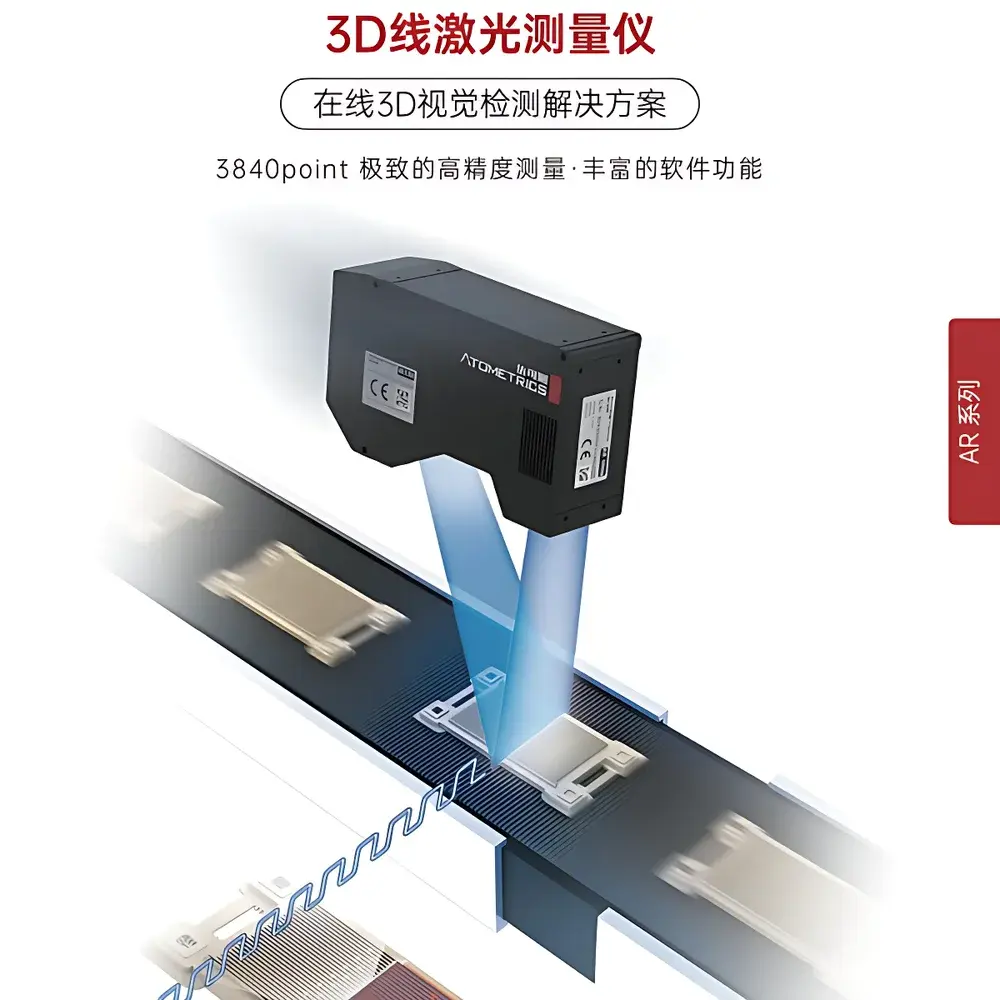
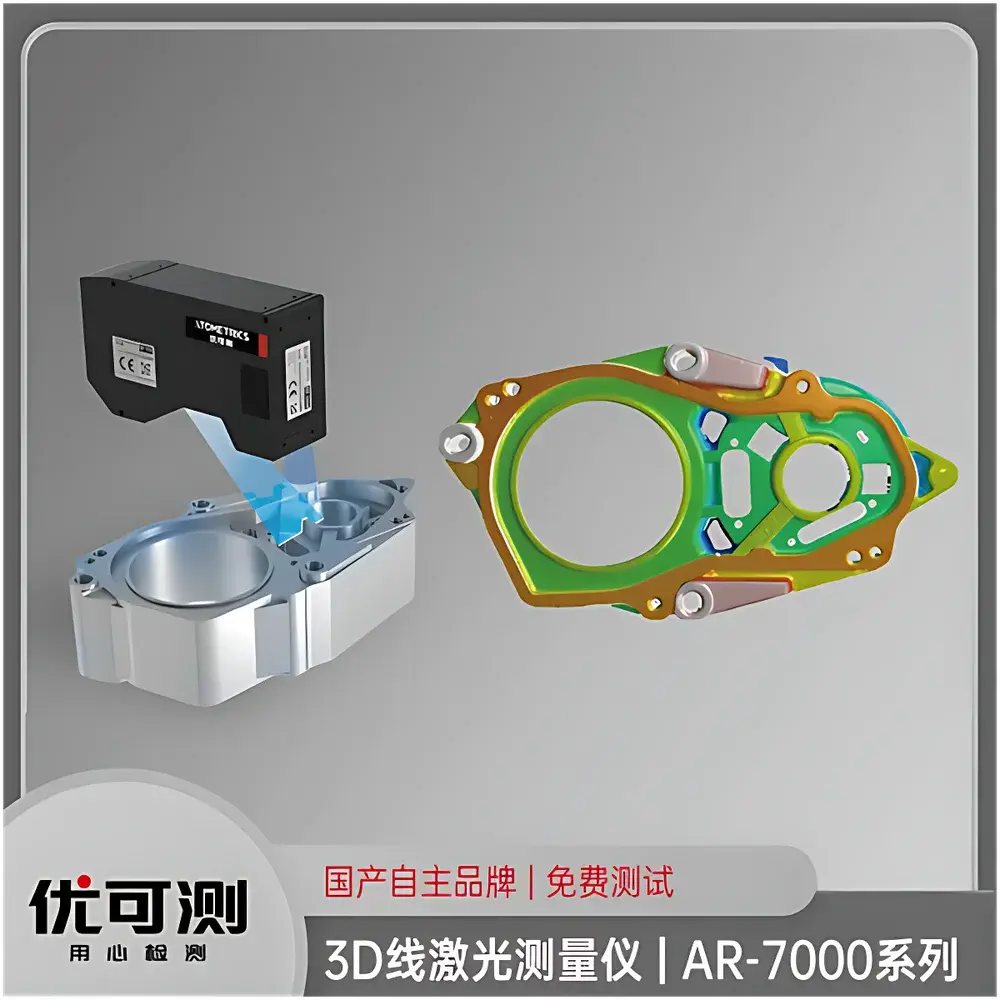
Atometrics AR-7120 High-Precision 3D Laser Line Profile Measuring System
| Brand | Atometrics |
|---|---|
| Origin | Guangdong, China |
| Manufacturer Type | Direct Manufacturer |
| Product Category | Domestic |
| Model | AR-7120 |
| Instrument Type | Laser-Based 3D Line Scanner |
| Key Specifications | 3840-point per scan line |
| Repeatability | ±0.4 µm |
| Measurement Principle | Triangulation-based laser line profiling |
| Software Platform | BSmart Pro / BSmart Lite |
Overview
The Atometrics AR-7120 is a high-precision, industrial-grade 3D laser line profile measuring system engineered for non-contact geometric metrology in automated quality control environments. Utilizing triangulation-based laser scanning with a 3840-point linear sensor array, the AR-7120 delivers sub-micron repeatability (±0.4 µm) and high-resolution surface topography reconstruction. Its optical architecture features an optimized collimated laser line generator and a high-sensitivity CMOS imaging module designed for stable acquisition from reflective, low-contrast, and highly specular surfaces—including polished aluminum, copper busbars, stainless steel weld seams, and coated battery cell components. The system operates at fixed or variable scan speeds, enabling integration into inline production lines for real-time dimensional verification without mechanical contact or thermal loading.
Key Features
- 3840-point per-scan-line resolution for enhanced spatial fidelity in flatness, position, and weld seam characterization
- Dual-software ecosystem: BSmart Pro for advanced 3D stitching, defect classification, GD&T evaluation (flatness, parallelism, coplanarity), and multi-head synchronization; BSmart Lite for rapid setup of routine height, step, and planarity checks with four-step configuration
- Multi-head support (up to six sensors on one controller) for large-field-of-view tiling, spatially registered 3D mapping, and complex part coverage
- Customizable ROI (Region of Interest) masking to suppress ambient light interference and increase effective frame rate during high-speed inspection
- Proprietary high-gain, low-noise CMOS sensor optimized for high-reflectivity metallic surfaces—validated on battery pole caps, busbar terminals, and precision-machined aluminum housings
- Modular mechanical design with IP54-rated enclosure options for factory-floor deployment and compatibility with robotic arms or gantry-mounted positioning systems
Sample Compatibility & Compliance
The AR-7120 is validated for measurement of geometric features on electric vehicle battery modules (e.g., pole cap flatness, full-penetration weld seam continuity, side-seam integrity), consumer electronics components (Type-C connector step height, smartphone chassis planarity, BGA solder ball height), automotive powertrain parts (heat exchanger plate flatness, oil cooler surface deviation), and rail transit structural assemblies. It supports ISO 1101-compliant GD&T reporting for flatness, position, and profile of a surface. Data acquisition workflows are compatible with GLP/GMP-aligned documentation practices, including timestamped raw point cloud archives, operator ID logging, and configurable audit trails—facilitating alignment with internal QA protocols and external regulatory review requirements.
Software & Data Management
BSmart Pro provides a traceable, scriptable environment for metrological analysis, supporting ASTM E2924-22–aligned measurement uncertainty estimation, statistical process control (SPC) charting, and export of calibrated XYZI point clouds in standard formats (PLY, STL, CSV). All software modules enforce role-based access control, electronic signature capture for critical measurements, and optional 21 CFR Part 11 compliance packages (including electronic records retention, change history, and biometric authentication integration). Raw data is stored locally with SHA-256 hash verification; cloud sync via encrypted TLS 1.3 channels is available for centralized SPC dashboards across global manufacturing sites.
Applications
- Battery Manufacturing: Pre-weld electrode flatness verification, post-weld seam geometry assessment (width, penetration depth, convexity), module-level coplanarity validation across 12+ cells
- Consumer Electronics: Smartphone frame planarity (≤±2 µm tolerance), metal bracket height differential, PCB trace height and solder joint geometry
- Automotive Power Systems: Condenser plate flatness (ASTM B548), busbar coplanarity in high-voltage junction boxes, heat sink fin alignment
- Precision Machining: Connector pin height distribution analysis, multi-feature coplanarity on stamped metal parts, adhesive bead volume and contour consistency
- Rail & Industrial Components: Surface deviation mapping on extruded aluminum structural rails, weld seam profiling on traction motor housings
FAQ
What is the typical calibration interval recommended for the AR-7120?
Annual calibration using NIST-traceable step gauges and certified flatness artifacts is recommended; in-process verification with reference standards can be scheduled per shift or batch.
Does the system support real-time feedback to PLCs or MES platforms?
Yes—via TCP/IP Modbus TCP or OPC UA interfaces, with configurable pass/fail outputs and ASCII/JSON-formatted measurement reports.
Can the AR-7120 measure transparent or semi-transparent materials?
Not natively; its triangulation engine requires diffuse surface reflectance. Optional polarization filters or structured-light auxiliary modules may extend capability—contact technical support for application-specific feasibility assessment.
Is multi-sensor synchronization deterministic and jitter-free?
Yes—the master-slave timing architecture achieves sub-10 µs inter-sensor skew under nominal operating conditions, verified per IEEE 1588-2019 PTP profiles.
How is measurement uncertainty quantified and documented?
Uncertainty budgets follow GUM (JCGM 100:2008) methodology, incorporating contributions from laser line width, pixel pitch, lens distortion, temperature drift, and mechanical mounting stability—all reported in BSmart Pro’s Certificate of Conformance.