
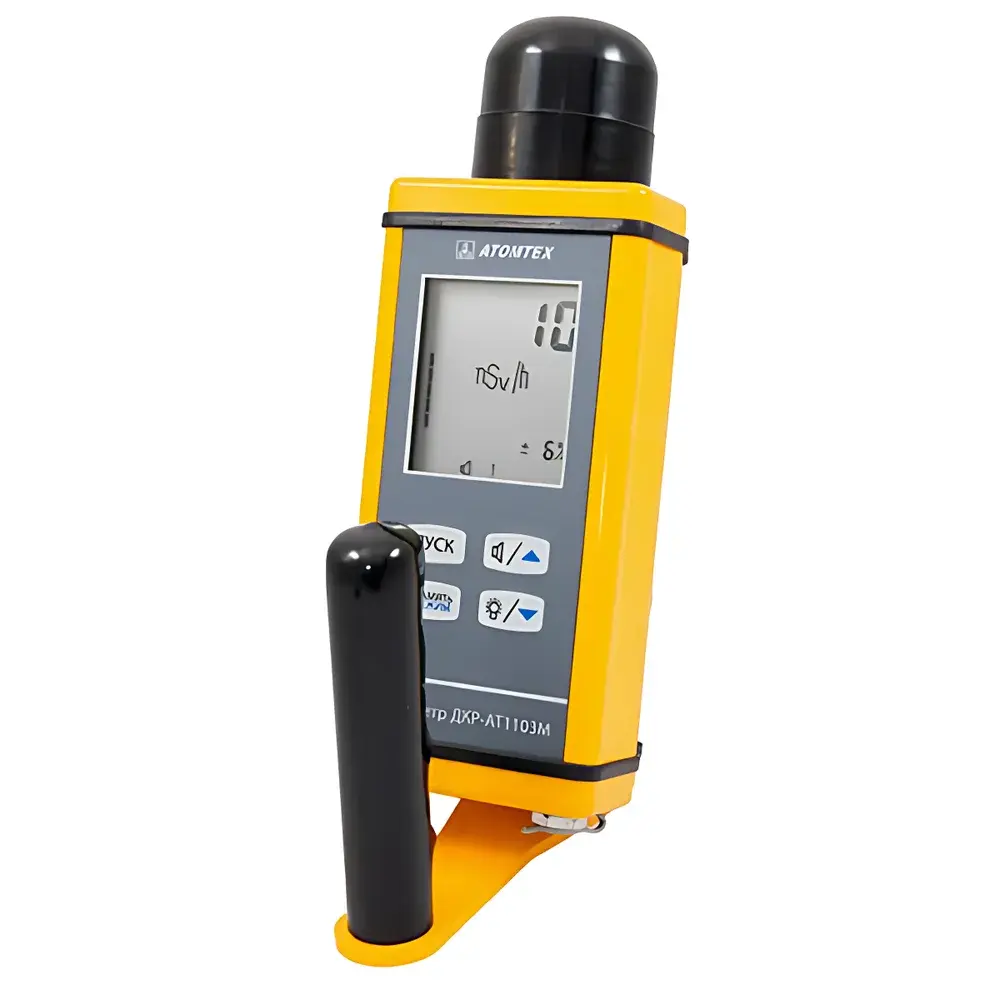
ATOMTEX AT1103M Portable X- and Low-Energy Gamma Radiation Dose Rate Meter
| Brand | ATOMTEX |
|---|---|
| Model | AT1103M |
| Type | Portable Dose Rate Meter |
| Detector | Be-window NaI(Tl) Scintillator (Ø9×2 mm) |
| Measured Quantity | Ambient Dose Equivalent Rate H′(0.07) |
| Measurement Range | 50 nSv/h – 100 µSv/h |
| Energy Range | 5–160 keV |
| Energy Response | ±35% (5–60 keV), ±30% (60–160 keV) |
| Accuracy | ±15% (full range), ±5% (calibration sources: ⁵⁵Fe, ²⁴¹Am, ¹⁰⁹Cd, ⁵⁷Co) |
| Operating Temperature | 0–+40 °C |
| Relative Humidity | ≤90% at +35 °C |
| IP Rating | IP54 |
| Weight | 0.8 kg |
| Dimensions | 233×85×67 mm |
| Power | Rechargeable Ni-MH battery (6 V), AC 220 V / 50 Hz, DC 12 V |
| Battery Life | ≥24 h |
| Data Storage | 100 measurement records + 256-channel MCA spectrum storage |
| Compliance | IEC 60846, CISPR 22:1997, IEC 61000-4-2:1995, IEC 61000-4-3:1995 |
Overview
The ATOMTEX AT1103M is a portable, battery-powered radiation dose rate meter engineered for precise assessment of ambient dose equivalent rate H′(0.07) in the low-energy X-ray and soft gamma radiation field. Designed specifically for monitoring shallow-dose quantities relevant to skin, lens of the eye, and mucous membranes, it operates on scintillation detection principles using a beryllium-window sodium iodide (NaI(Tl)) detector (Ø9×2 mm), optimized for photon interactions in the 5–160 keV energy band. Its physical design and spectral response align with the operational definitions of H′(0.07) per IEC 60846, ensuring metrological traceability for occupational and environmental radiation protection applications. The instrument delivers continuous real-time readout without requiring radioactive reference sources, thanks to an integrated LED-based stabilization system that maintains detector gain stability under varying temperature and count-rate conditions.
Key Features
- High-sensitivity Be-window NaI(Tl) scintillation detector optimized for low-energy photon detection (5 keV threshold)
- Direct measurement of directional ambient dose equivalent rate H′(0.07), compliant with IEC 60846 requirements for personal and area monitoring
- Real-time acoustic and visual alarm triggered upon user-defined dose rate thresholds, with adjustable alarm levels
- Backlit large-digit LCD display with analog bar graph for intuitive signal interpretation under low-light or high-glare conditions
- Onboard 256-channel multichannel analyzer (MCA) for spectral acquisition; spectra exportable via USB or serial interface for offline analysis
- Internal non-volatile memory storing up to 100 full measurement records, including timestamp, dose rate, accumulated dose, and measurement duration
- Triple power supply support: rechargeable Ni-MH battery (6 V), AC mains (220 V / 50 Hz), and external DC input (12 V), enabling uninterrupted operation in field or laboratory settings
- Ruggedized housing rated IP54 — dust-protected and splash-resistant — suitable for industrial, medical, and emergency response environments
- Automatic background compensation and statistical noise suppression algorithms ensure stable baseline readings even at near-background levels
Sample Compatibility & Compliance
The AT1103M is calibrated and validated for use with common low-energy radionuclides encountered in nuclear medicine, industrial radiography, and legacy equipment monitoring, including 55Fe (5.9 keV), 241Am (59.5 keV), 239Pu (L-lines ~10–20 keV), and 129I (29–35 keV). Its angular response and energy compensation profile are verified across isotropic irradiation geometries per IEC 60846 Annex B. The device meets electromagnetic compatibility (EMC) requirements per IEC 61000-4-2 (ESD immunity) and IEC 61000-4-3 (radiated RF immunity), and satisfies emission limits defined in CISPR 22:1997 Class B. It supports regulatory workflows aligned with national radiation protection frameworks implementing EURATOM Directive 2013/59 and IAEA Safety Standards Series No. GSR Part 3, particularly where extremity and lens dose monitoring is mandated.
Software & Data Management
Data acquisition and post-processing are supported via dedicated PC software compatible with Windows OS. The software enables full retrieval of stored measurements, visualization of acquired spectra, energy calibration verification, and generation of audit-ready reports in PDF or CSV format. All measurement sessions include embedded metadata: date/time stamp, detector live time, dead time correction factor, and battery voltage. Spectral data files conform to IEEE 1252-2000 (Standard for Nuclear Spectroscopy Data Exchange) conventions, facilitating integration into laboratory information management systems (LIMS) or radiation safety databases. Firmware updates are delivered via signed binary packages with cryptographic integrity verification, supporting long-term compliance with evolving GLP and ISO/IEC 17025 documentation requirements.
Applications
- Routine monitoring of X-ray emitting devices: CRT displays, night vision equipment, electron beam welders, and legacy vacuum tube apparatus
- Verification of shielding integrity and leakage radiation around diagnostic X-ray tubes, fluoroscopy units, and baggage scanners
- Decommissioning surveys of contaminated surfaces, scrap metal, and retired medical equipment containing 241Am or 55Fe sources
- Emergency response screening for orphan sources or illicit radioactive materials in customs, border control, and waste processing facilities
- Quality assurance testing of radiation shielding garments, lead aprons, and protective barriers used in interventional radiology suites
- Environmental surveillance near nuclear medicine departments, radioisotope production labs, and low-level waste storage areas
FAQ
What radiation quantities does the AT1103M measure?
It measures ambient dose equivalent rate H′(0.07) and accumulated ambient dose equivalent H′(0.07), both referenced to the ICRU sphere phantom and defined for weakly penetrating radiation.
Can the AT1103M distinguish between different radionuclides?
While not a nuclide-identification spectrometer, its 256-channel MCA provides sufficient resolution to separate characteristic peaks of 55Fe (5.9 keV), 241Am (59.5 keV), and 109Cd (22.1 & 88.0 keV), enabling qualitative source attribution when combined with known geometry and attenuation conditions.
Is factory calibration traceable to national standards?
Yes — each unit is calibrated against accredited reference fields at the ATOMTEX Calibration Laboratory, with traceability documented to the Belarusian State Metrological Institute (BelGIM) and cross-verified against PTB (Germany) reference sources.
Does the instrument support dose record archiving for regulatory audits?
Yes — all measurement data, including timestamps, alarm events, and spectral snapshots, are stored with write-once attributes and can be exported with digital signatures to satisfy ALARA reporting and 21 CFR Part 11 electronic record requirements.
How often does the detector require recalibration?
Annual recalibration is recommended under normal use; however, the built-in LED stabilization system minimizes drift, and routine verification using check sources (e.g., 241Am disc) is advised before each shift or mission-critical deployment.







