
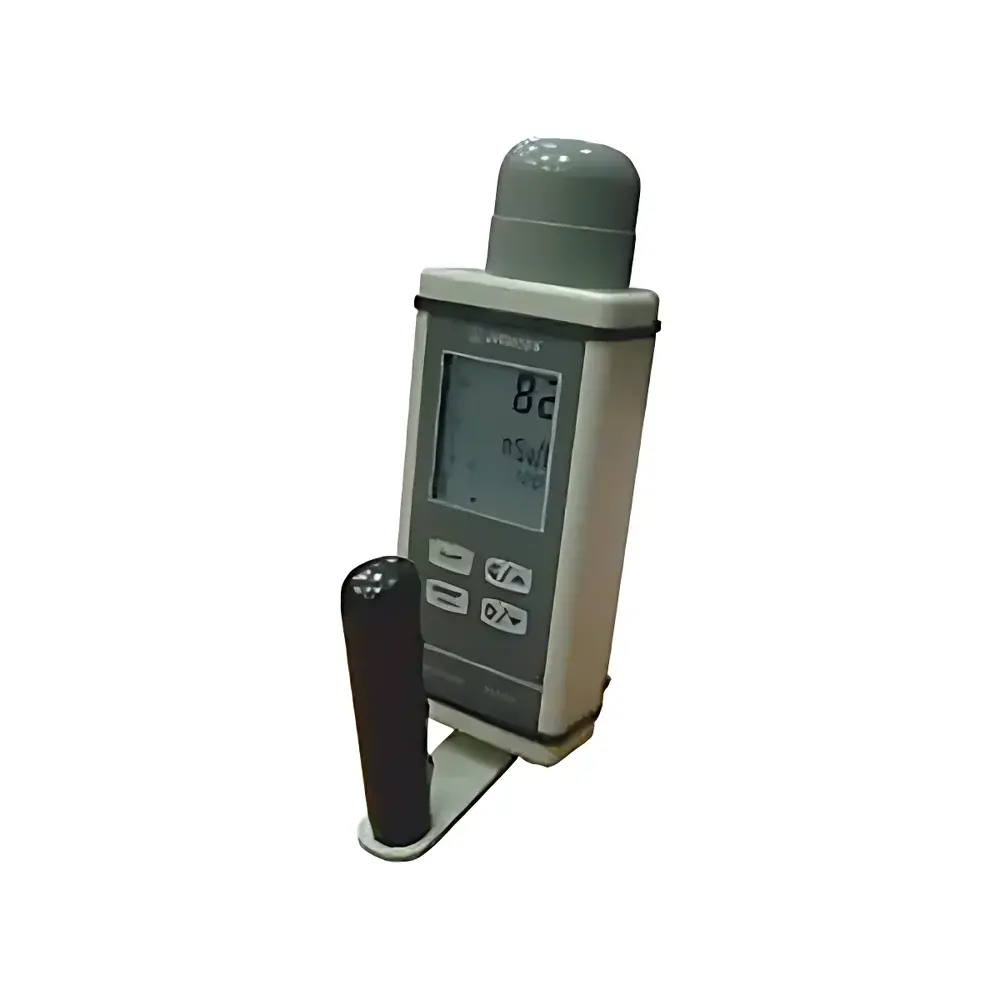
ATOMTEX AT1121 Portable X- and γ-Ray Radiation Detector
| Brand | ATOMTEX |
|---|---|
| Origin | Belarus |
| Model | AT1121 |
| Detection Principle | Scintillation (plastic scintillator with heavy metal admixture) |
| Measuring Quantity | Ambient Dose Equivalent H*(10) |
| Continuous Dose Rate Range | 50 nSv/h – 10 Sv/h |
| Short-Term Dose Rate Range | 5 µSv/h – 10 Sv/h |
| Pulse Dose Rate Capability | Down to 10 ns (for AT1123 variant |
| Energy Range | 15 keV – 10 MeV |
| β Detection | Yes (with optional collimator/filter cap) |
| Display | Backlit LCD |
| Data Storage | 100 measurements |
| Interface | RS-232, 300–19200 baud |
| Operating Temperature | −30 °C to +40 °C |
| IP Rating | IP54 |
| Weight | 0.9 kg |
| Dimensions | 233 × 85 × 67 mm |
| Power | Rechargeable 6 V battery / AC 220 V / DC 12 V |
| Compliance | IEC 61000-4-2:1995, IEC 61000-4-3:1995, CISPR 22:1997 |
Overview
The ATOMTEX AT1121 is a portable, microprocessor-controlled radiation detector engineered for reliable measurement of ambient dose equivalent H*(10) from X-ray and gamma radiation under continuous, short-term, and pulsed exposure conditions. Designed in accordance with IEC 60846-1:2014 and aligned with the metrological requirements of EURATOM Directive 2013/59, the instrument employs a plastic scintillation detector doped with heavy metal compounds (30 × 15 mm active volume), delivering high sensitivity across a broad photon energy range — from 15 keV to 10 MeV. Its real-time pulse-height discrimination logic enables robust response to transient radiation events, including those as brief as 30 ms in duration (pulse mode operation is extended to 10 ns on the AT1123 series; the AT1121 provides optimized short-term and continuous monitoring). The detector operates without external calibration sources thanks to an integrated LED-based stability monitoring system, ensuring long-term reproducibility of readings in field-deployed environments such as emergency response zones, nuclear facilities, or medical radiology departments.
Key Features
- Triple-mode radiation assessment: continuous, short-term (≥30 ms), and pulse-triggered detection with automatic peak-hold and max-dose-rate logging
- Self-stabilizing scintillation detection via embedded LED reference system — eliminates need for periodic source-based recalibration
- Backlit graphical LCD with intuitive menu navigation and real-time dose rate/dose accumulation display
- Configurable alarm thresholds with simultaneous audible (piezo buzzer) and visual (flashing LED + screen alert) notification
- Three power options: internal rechargeable 6 V battery (≥12 h operation), AC adapter (220 V), or external DC input (12 V)
- Ruggedized housing rated IP54 for dust resistance and limited water ingress protection — suitable for outdoor and industrial use
- Onboard memory stores up to 100 measurement records with timestamp, dose, and dose rate metadata
- RS-232 serial interface supporting data transfer at configurable baud rates (300–19200 bps) for integration with laboratory or incident command systems
Sample Compatibility & Compliance
The AT1121 is validated for direct measurement of H*(10) from isotropic photon fields generated by 137Cs, 60Co, 241Am, and bremsstrahlung sources. With its removable “0.06–10 MeV” filter cap (included), the detector achieves flat energy response within ±25% over 60 keV–3 MeV — critical for accurate environmental and occupational monitoring. Beta sensitivity (≥3 × 10⁻⁷ μSv·h−1·Bq−1) permits qualitative identification of mixed β/γ emitters when used with appropriate shielding protocols. The instrument conforms to electromagnetic compatibility standards IEC 61000-4-2 (ESD immunity) and IEC 61000-4-3 (radiated RF immunity), and meets CE marking requirements per Directive 2014/30/EU (EMC) and 2014/53/EU (Radio Equipment). It supports GLP-aligned audit trails when paired with ATOMTEX’s optional PC software (Radiation Logger Pro), which logs operator ID, calibration status, and firmware version per measurement session.
Software & Data Management
Radiation Logger Pro — supplied with optional USB-to-RS232 cable — enables full configuration, firmware updates, and secure data export in CSV and XML formats. The software implements time-synchronized batch download, spectral trend visualization, and customizable report generation compliant with ISO/IEC 17025 documentation requirements. All stored measurements retain traceable timestamps, operational mode flags (continuous/short-term/pulse), and real-time environmental temperature/humidity metadata (when connected to optional external sensors). Audit logs record every parameter change, alarm activation, and user login event — satisfying FDA 21 CFR Part 11 electronic record integrity criteria when deployed in regulated healthcare or nuclear medicine settings.
Applications
- Radiation safety surveys in diagnostic X-ray rooms, PET/CT suites, and radiotherapy bunkers
- Emergency response during radiological dispersal device (RDD) incidents or transportation accidents involving radioactive materials
- Decommissioning support in nuclear power plants and research reactors — particularly for low-dose-rate mapping and hot-spot localization
- Non-destructive testing (NDT) facility compliance monitoring, including industrial radiography and weld inspection zones
- Environmental monitoring around uranium mining sites, waste repositories, and legacy contamination areas
- Training and education in health physics laboratories where reproducible, source-free verification of instrument stability is required
FAQ
Does the AT1121 require annual calibration with a radioactive reference source?
No — its built-in LED stabilization system continuously monitors photomultiplier gain drift and applies real-time correction. However, traceable calibration against accredited 137Cs or 60Co sources is recommended every 24 months per ISO/IEC 17025 and national regulatory guidelines.
Can the AT1121 detect beta radiation independently of gamma fields?
Yes — when used with the supplied filter cap removed and appropriate collimation, it responds to high-energy β particles (Emax > 0.5 MeV); quantitative separation requires spectral deconvolution or auxiliary thin-window GM probe pairing.
Is remote operation supported beyond 25 meters?
The standard 25 m control cable supports full functional parity; extension beyond this length is possible using shielded twisted-pair cabling and signal repeaters, though latency and noise immunity must be validated per site-specific EMC conditions.
What is the minimum detectable dose rate in continuous mode?
At 15 keV, the lower limit of detection (LLD) is 50 nSv/h with ≤10% statistical uncertainty over a 60 s integration period, assuming background subtraction and stable thermal conditions.
How does temperature affect measurement accuracy between −30 °C and +40 °C?
The instrument applies automatic temperature compensation algorithms; total systematic error remains within ±10% across the full operating range, verified per IEC 61526 Annex B test protocols.







