
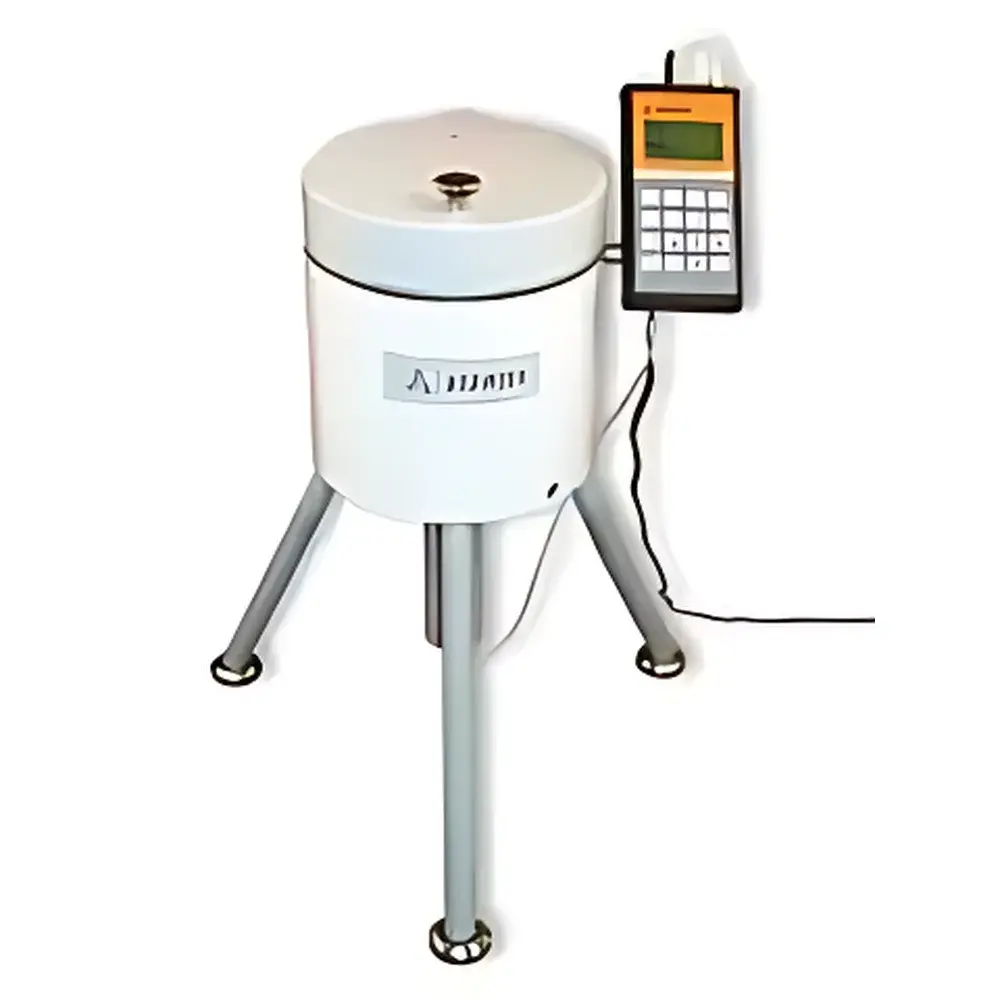
Atomtex AT1320 Gamma Activity Meter
| Brand | Atomtex |
|---|---|
| Model | AT1320 |
| Detector Type | Scintillation-based Gamma Spectrometer |
| Detector Crystal | NaI(Tl), Ø63×63 mm |
| Activity Range (¹³⁷Cs) | 3.7–1,000,000 Bq/kg (or Bq/L) |
| Activity Range (⁴⁰K) | 50–20,000 Bq/kg |
| Activity Range (²²⁶Ra & ²³²Th) | 10–10,000 Bq/kg |
| Energy Range | 50–3000 keV |
| Energy Resolution (¹³⁷Cs, 662 keV) | 7.0–8.5 % FWHM |
| Intrinsic Nonlinearity | ≤1 % |
| Relative Uncertainty in Specific Activity Measurement | ≤±20 % |
| Minimum Detectable Activity (¹³⁷Cs in 1 L Marinelli beaker, 3 h, P=0.95) | 3.0 Bq/L |
| Sample Density Range | 0.1–3.0 g/cm³ |
| Operating Temperature | 0–40 °C |
| Power Supply | 220 V ±10 %, 50 Hz ±2 Hz |
| Power Consumption | ≤8 VA |
| Continuous Operation Time | ≤24 h |
| 24-h Drift | ≤3 % |
| Dimensions (Detector) | 97×405 mm, 3.0 kg |
| Dimensions (Processing Unit) | 200×109×35 mm, 0.62 kg |
| Shielding Assembly | Ø600×700 mm, 110 kg |
| AC Adapter | 92×62×52 mm, 0.8 kg |
| EMC Compliance | IEC/EN 61000-4-2:1995, IEC/EN 61000-4-3:1995, IEC/EN 61000-4-4:1995, IEC/EN 61000-4-11:1994, CISPR 22:1997 |
Overview
The Atomtex AT1320 Gamma Activity Meter is a portable, scintillation-based gamma spectrometer engineered for precise, field-deployable measurement of specific activity concentrations of naturally occurring and anthropogenic radionuclides in environmental and industrial matrices. It employs a high-efficiency thallium-doped sodium iodide [NaI(Tl)] scintillation detector (Ø63 × 63 mm) coupled with a built-in multichannel analyzer (MCA) based on Wilkinson-type architecture (256 channels), enabling energy-resolved gamma-ray spectroscopy without external PC dependency. The instrument operates on the principle of gamma photon detection via scintillation light conversion, photomultiplier tube amplification, and digital pulse height analysis—providing quantitative identification and quantification of key isotopes including 137Cs, 40K, 226Ra, and 232Th. Designed for regulatory compliance and routine monitoring, it supports standardized geometries (Marinelli beakers: 0.1 L, 0.5 L, 1 L; plastic container: 10 L) and delivers trace-level sensitivity under controlled counting conditions—meeting analytical requirements for environmental surveillance, food safety screening, raw material certification, and nuclear waste characterization.
Key Features
- Integrated 256-channel Wilkinson-type multichannel analyzer (MCA) with real-time spectral processing
- Self-calibrating LED-stabilized photomultiplier system ensuring long-term gain stability
- Automated background subtraction with onboard storage of reference spectra (up to 500 full spectra)
- Energy-windowed analysis mode for rapid isotope-specific activity calculation
- Backlit 128×64 pixel LCD display with intuitive menu navigation and real-time count rate visualization
- Embedded spectral library and configurable energy region-of-interest (ROI) settings for 137Cs (662 keV), 40K (1461 keV), 226Ra (186 keV, 242 keV, 295 keV, 352 keV), and 232Th progeny (239 keV, 583 keV, 911 keV, 2615 keV)
- Dedicated firmware platform supporting geometry correction, density compensation (0.1–3.0 g/cm³), and decay correction
- RS-232 interface for bidirectional communication with Windows-based acquisition and reporting software (included)
- Field-reconfigurable calibration using user-supplied standard sources (e.g., 133Ba, 152Eu, 60Co) for multi-isotope validation
- Optimized shielding configuration (110 kg lead-steel composite) achieving 137Cs background ≤2 cps and enabling low-background measurements in non-laboratory environments
Sample Compatibility & Compliance
The AT1320 accommodates heterogeneous solid and liquid samples across diverse density ranges (0.1–3.0 g/cm³), including drinking water, agricultural commodities (grains, dairy, mushrooms, berries), mineral ores, construction materials, metallurgical slags, petroleum by-products, and low-level radioactive waste. Its standardized Marinelli geometry (1 L) ensures reproducible efficiency calibration per ISO 10703:2022 and ASTM D3648-19 for environmental gamma spectrometry. The instrument complies with electromagnetic compatibility (EMC) standards IEC/EN 61000-4-2, -4-3, -4-4, -4-11 and CISPR 22:1997, confirming operational integrity in electrically noisy field settings. While not intrinsically certified for GLP or 21 CFR Part 11 environments, its audit-ready data export (ASCII, CSV, binary .SPE), timestamped spectral logging, and firmware-controlled calibration history support integration into validated QA/QC workflows aligned with ISO/IEC 17025:2017 requirements.
Software & Data Management
Supplied acquisition software enables spectral deconvolution, peak identification (using built-in nuclide library), efficiency curve generation, and activity calculation with uncertainty propagation per ISO 11929:2019. Raw spectra (.SPE) and processed reports (.CSV, .PDF) are exportable with full metadata: acquisition time, live time, dead time, detector temperature, high voltage setting, and geometry identifier. The software supports batch processing of up to 100 spectra, comparative overlay analysis, and customizable report templates compliant with national radiation monitoring program formats (e.g., EPA 900-R-94-001, EURATOM Directive 2013/59). All calibration parameters—including energy calibration coefficients, efficiency factors, and background subtraction masks—are stored within the instrument firmware and synchronized during each software session to ensure traceability.
Applications
- Regulatory monitoring of radioactivity in public drinking water supplies per WHO Guidelines and EU Council Directive 2013/51/Euratom
- Screening of foodstuffs (mushrooms, berries, milk, meat) for post-Chernobyl/Fukushima 137Cs contamination
- Assessment of natural radionuclide content (40K, 226Ra, 232Th) in building materials and fertilizers per EC RP 112 and IAEA Safety Reports Series No. 47
- Characterization of mining tailings, phosphogypsum, and NORM (Naturally Occurring Radioactive Material) residues in oil & gas operations
- Pre-release verification of decommissioning waste streams from nuclear facilities against clearance levels defined in IAEA RS-G-1.7
- Research-grade gamma spectrometry in university laboratories and environmental research institutes requiring portable, self-contained instrumentation
FAQ
What radionuclides can the AT1320 quantify with certified accuracy?
The instrument is factory-calibrated for 137Cs, 40K, 226Ra, and 232Th using traceable standard sources. Additional nuclides may be added via user-defined calibration with appropriate reference materials.
Is the detector resolution sufficient for separating overlapping gamma peaks?
With 7.0–8.5 % FWHM at 662 keV, the NaI(Tl) detector resolves major environmental gamma lines but does not resolve closely spaced peaks (e.g., 214Pb/214Bi); spectral deconvolution software assists in partial separation where necessary.
Can the AT1320 operate unattended for extended periods?
Yes—continuous operation up to 24 hours is supported; however, thermal drift compensation requires ambient temperature stability within 0–40 °C and periodic background verification every 8–12 h for optimal precision.
Does the system meet international radiation protection standards for field use?
It conforms to IEC 62327:2017 for portable radiation detection instruments and fulfills performance criteria outlined in IAEA Technical Reports Series No. 488 for environmental gamma survey meters.
How is geometric efficiency validated for non-standard sample containers?
Efficiency interpolation is performed using the built-in density-compensated calibration model; users may generate custom efficiency curves using the included software and reference sources in matching geometries.
Related Products







