
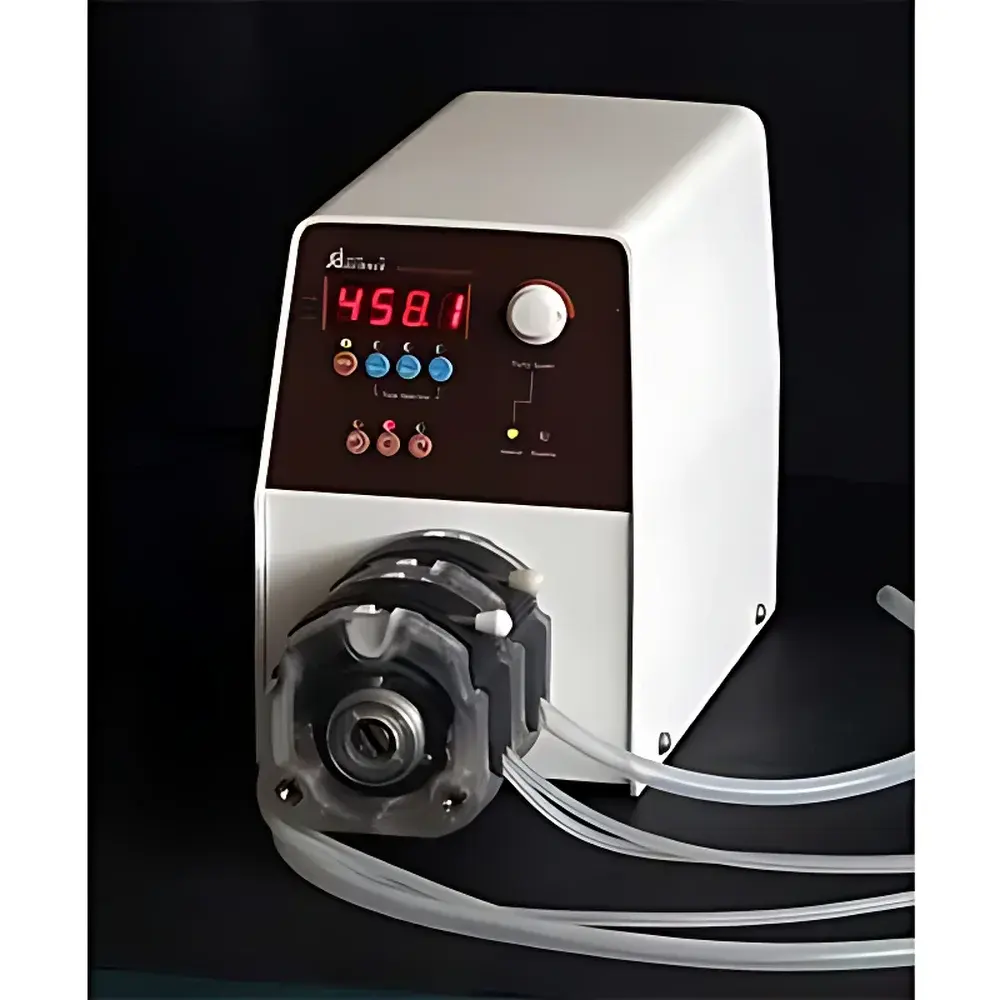
ATP-3200 Peristaltic Pump by Autoscience
| Brand | Autoscience |
|---|---|
| Origin | Tianjin, China |
| Model | ATP-3200 |
| Flow Rate Range | 0.21–2060 mL/min (dependent on tubing size) |
| Speed Range | 1–460 rpm |
| Speed Resolution | 0.1 rpm |
| Speed Stability | ≤ ±0.3 rpm |
| Max Pressure | 1.5 kg/cm² |
| Max Fluid Viscosity | 2000 cP |
| Operating Temperature | –10–100 °C (fluid), 0–50 °C (ambient) |
| Humidity | <80% RH |
| Dimensions (W×H×D) | 120 × 230 × 270 mm |
| Power Supply | 220 ±15% V, 50 Hz |
| Power Consumption | 150 W |
| Net Weight | 5.5 kg |
| Direction Control | Forward/Reverse |
| Tubing Compatibility | #14, #17, #18, #25 (Pharmed®/Norprene®-compatible) |
Overview
The ATP-3200 Peristaltic Pump is a precision-engineered laboratory-grade peristaltic pump developed by Autoscience — a Tianjin-based manufacturer established in 1992 as a wholly foreign-owned enterprise of MEDILAB Canada. Designed for continuous, pulse-minimized fluid transfer in analytical and preparative workflows, the ATP-3200 operates on the fundamental principle of peristalsis: rollers compress elastomeric tubing against a curved occlusion surface, generating positive displacement without contacting the fluid. This design ensures complete fluid isolation, eliminating cross-contamination risk and enabling safe handling of aggressive solvents, biological suspensions, and sterile reagents. Its robust architecture supports integration into HPLC sample introduction systems, column post-derivatization setups (e.g., PCX-500), solid-phase extraction manifolds (ASE series), and continuous-flow reaction monitoring — all while maintaining compliance with core laboratory operational standards including ISO/IEC 17025 traceability requirements for flow-critical instrumentation.
Key Features
- Four independently selectable tubing sizes (#14, #17, #18, #25) supported via optimized occlusion heads — engineered to maximize tube lifespan and minimize fatigue-induced flow drift.
- Dual-pump-head configuration available for parallel operation: doubles volumetric throughput and reduces pulsation amplitude by >70% compared to single-head mode (measured per ASTM D4007).
- High-resolution speed control: 0.1 rpm resolution across 1–460 rpm range with ≤ ±0.3 rpm stability under load — validated at 25 °C ambient and constant backpressure ≤1.5 kg/cm².
- Simultaneous multi-channel capability: drives up to four independent tubing paths using a single controller — ideal for gradient mixing, parallel sample processing, or reagent distribution networks.
- Bi-directional flow control with instantaneous start/stop response (<50 ms rise/fall time), enabling precise volume metering and timed dispensing protocols.
- Integrated LED display with dual readout: real-time rpm value + calibrated flow rate (mL/min) for each tubing ID — eliminating manual conversion tables during method development.
- External I/O interface (0–5 V analog input / TTL trigger output) supports synchronization with programmable logic controllers (PLCs), chromatography data systems (CDS), or custom LabVIEW-based automation frameworks.
Sample Compatibility & Compliance
The ATP-3200 accommodates fluids ranging from deionized water (1 cP) to viscous polymer solutions (up to 2000 cP) and operates reliably across a –10 °C to +100 °C fluid temperature range — compatible with common silicone, Viton®, and Pharmed® tubing materials. It meets electrical safety requirements per IEC 61010-1:2010 (Edition 3) for laboratory equipment. While not certified for use in Class I Div 1 hazardous locations, its non-sparking motor design and sealed electronics enclosure make it suitable for general-purpose chemical and life science laboratories operating under GLP or GMP-aligned quality systems. The pump’s flow repeatability (RSD <0.8% over 1 hr at 200 rpm, #18 tubing, 25 °C) supports method validation per USP and ASTM D341 viscosity correlation workflows.
Software & Data Management
The ATP-3200 does not include embedded firmware-based software but provides hardware-level interoperability for external control and audit trail generation. Its analog input allows direct rpm setpoint modulation from third-party platforms (e.g., Empower™, Chromeleon™, or Python-controlled DAQ systems). When integrated into regulated environments, users may implement 21 CFR Part 11-compliant electronic records by logging speed commands, direction toggles, and run durations via upstream SCADA or LIMS interfaces. Internal EEPROM retains user-defined default settings (speed, direction, tubing ID) across power cycles — supporting consistent instrument configuration during routine QC testing and method transfer between labs.
Applications
- HPLC and UHPLC auxiliary fluid delivery: mobile phase degassing (DG series), post-column derivatization reagent infusion (PCX-500), and fraction collector triggering.
- Automated sample preparation: continuous loading of SPE cartridges (ASE series), membrane filtration support, and solvent-assisted extraction loops.
- Cell culture and bioprocessing: gentle media perfusion in bioreactors, pH/DO probe calibration solution delivery, and waste line evacuation.
- Environmental and food testing: sequential injection of standards and blanks in automated digestion systems, leachate sampling manifolds, and turbidity-controlled dilution modules.
- Materials science: controlled slurry dosing in rheological sample loading, nanoparticle dispersion delivery, and inkjet printhead priming verification.
FAQ
What tubing sizes are supported, and how do I select the correct one for my application?
The ATP-3200 supports #14, #17, #18, and #25 tubing IDs. Selection depends on required flow rate, pressure tolerance, and fluid compatibility — refer to Autoscience’s tubing performance matrix (available upon request) for burst pressure, chemical resistance, and lifetime estimates under cyclic compression.
Can the pump be used in sterile or cleanroom environments?
Yes — provided appropriate tubing (e.g., gamma-sterilizable C-Flex® or PharmPure®) is installed and the unit is housed within an ISO Class 5–7 laminar flow hood or pass-through chamber. No internal lubricants contact the fluid path.
Is remote programming supported out of the box?
The pump includes analog and digital I/O ports but requires external controller integration (e.g., Arduino, PLC, or CDS) for programmable sequences. No proprietary SDK or driver is supplied.
How often should tubing be replaced to maintain flow accuracy?
Under continuous operation at 200 rpm with #18 tubing and aqueous buffer, replacement is recommended every 200–300 hours. Autoscience provides tubing wear monitoring guidelines based on flow deviation tracking per ISO 5725-2.
Does the ATP-3200 comply with FDA or EU regulatory requirements for GxP workflows?
The device itself is not CE-marked or FDA-listed, but its design enables integration into validated systems meeting 21 CFR Part 11 and Annex 11 requirements when paired with appropriate access controls, audit trails, and calibration documentation.



