
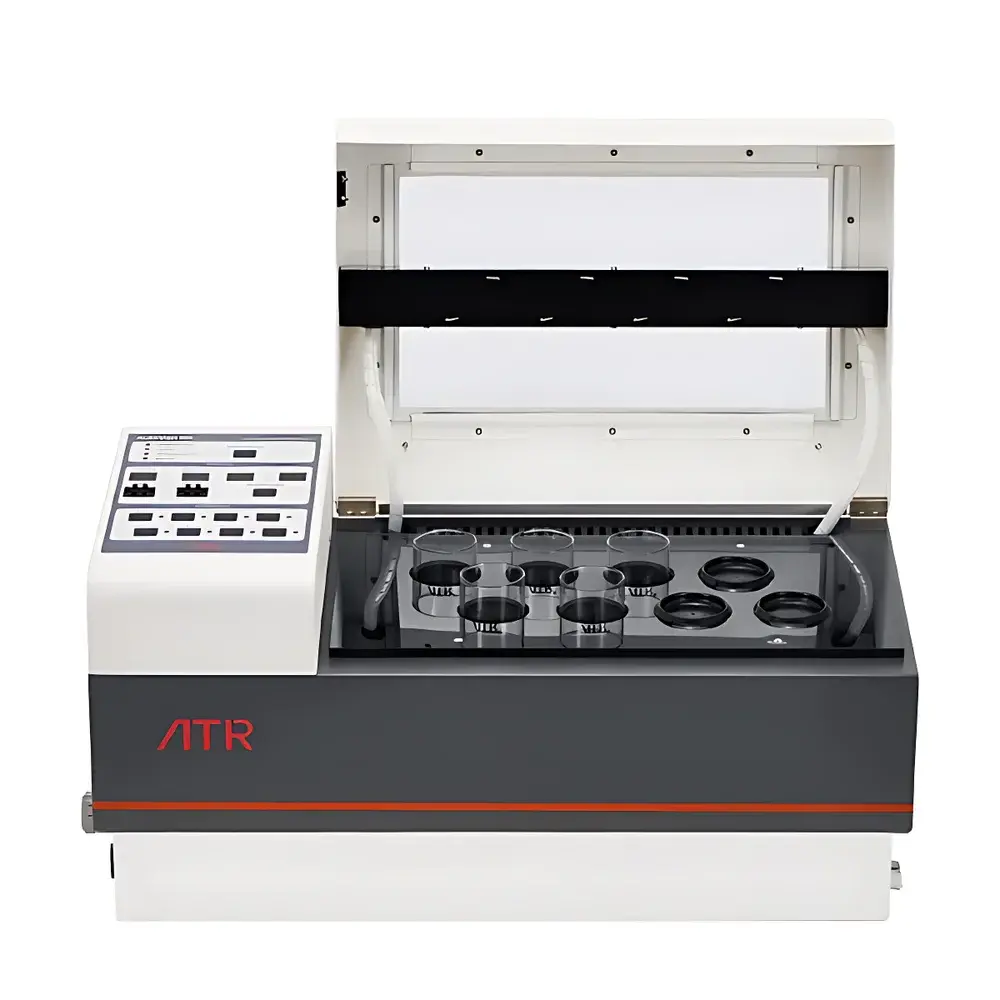
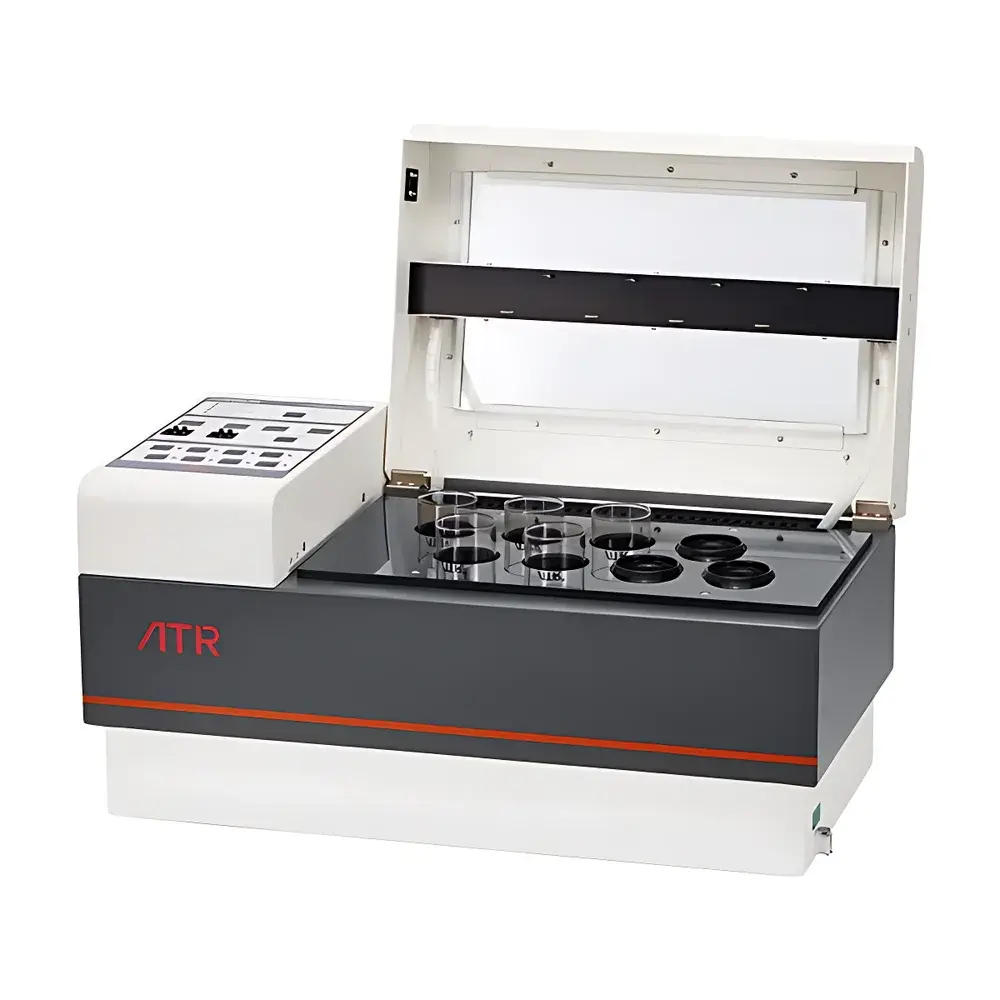
ATR AutoVap S8 Automated Quantitative Sample Concentrator
| Brand | ATR |
|---|---|
| Origin | USA |
| Model | AutoVap S8 |
| Instrument Type | Automated Quantitative Concentrator |
| Temperature Range | Ambient to 99°C |
| Temperature Control Accuracy | ±0.5°C |
| Sample Volume Capacity | 0–50 mL (standard), optional 0–200 mL |
| Endpoint Detection | 0.5 mL or 1.0 mL optical sensing |
| Parallel Channels | 8 independent channels |
| Concentration Speed | 3–5× faster than conventional nitrogen blow-down systems |
| Sample Recovery Rate | ≥90% (typical, matrix-dependent) |
| Endpoint Precision | <5% volume error |
Overview
The ATR AutoVap S8 Automated Quantitative Sample Concentrator is an engineered solution for high-throughput, reproducible solvent removal in analytical laboratories. It employs a proprietary vortex gas flow methodology—combining precisely directed nitrogen gas delivery at oblique angles with uniform water-bath heating—to accelerate evaporation while minimizing thermal degradation and analyte loss. Unlike passive nitrogen purge or rotary evaporation, the AutoVap S8 integrates real-time optical endpoint detection at each of its eight sample positions, enabling true quantitative concentration to user-defined final volumes (0.5 mL or 1.0 mL) without manual intervention. Designed for compliance-critical environments, it supports unattended operation across multi-hour protocols and delivers consistent performance under variable ambient conditions, making it suitable for routine QC, environmental monitoring, food safety testing, and pharmaceutical impurity analysis.
Key Features
- Eight independently controlled sample channels with dedicated optical sensors—enabling simultaneous yet asynchronous concentration across heterogeneous sample sets.
- Optical endpoint detection system insensitive to sample color, turbidity, or solvent refractive index—validated for transparent, amber, and dark-colored matrices including soil extracts, biological fluids, and pesticide residue solutions.
- Precise temperature regulation (ambient to 99°C, ±0.5°C) via PID-controlled water bath, ensuring thermal stability critical for thermolabile compounds.
- Vortex gas flow architecture delivering 3–5× higher evaporation efficiency compared to standard linear nitrogen blow-down systems—demonstrated with solvents such as dichloromethane (27 min for 180 mL → 1 mL), hexane (23 min), acetone (27 min), and methanol (58 min) at 40°C and 12 PSI.
- Multi-mode operation: Sensor-only, time-only, sensor-and-time hybrid, or manual override—providing method flexibility across diverse SOPs.
- Integrated self-diagnostic functionality for optical sensors and gas flow integrity, reporting status via front-panel display and optional remote notification.
- Ergonomic design features including tactile membrane keypad, large observation window, auto-drain water bath, and modular nitrogen inlet compatible with on-site ATR nitrogen generators.
Sample Compatibility & Compliance
The AutoVap S8 accommodates standard 12–16 mm OD test tubes, culture tubes, and EPA-compliant vials (e.g., 40-mL VOA vials, 125-mL Erlenmeyer flasks). Its open-tube configuration supports direct transfer from extraction workflows—eliminating need for intermediate transfers that compromise recovery. The system meets core requirements for GLP and GMP environments: audit-trail-capable operation logs (via optional software), user-access-level controls, and hardware-based endpoint verification. While not certified to ISO/IEC 17025 out-of-the-box, its performance repeatability (<5% inter-channel volume deviation under identical conditions) aligns with ASTM D5295 (for petroleum distillates) and EPA Methods 505, 525.3, and 8081B validation criteria for solvent removal steps.
Software & Data Management
Control is managed via embedded firmware with intuitive menu navigation; no PC dependency is required for basic operation. Optional ATR Connect software (Windows-compatible) enables method storage, run history export (CSV), real-time remote monitoring, and SMS/email alerts upon endpoint detection—leveraging cellular or Ethernet connectivity. All notifications include timestamp, channel ID, final volume, and elapsed time. Audit trails record operator ID, parameter changes, and sensor calibration events—supporting FDA 21 CFR Part 11 compliance when deployed with electronic signature modules and secure user authentication.
Applications
- Environmental labs: Pre-concentration of water, soil, and sediment extracts prior to GC-MS or LC-MS analysis per EPA 1664, 8270, and 525.3.
- Food & beverage testing: Pesticide multiresidue analysis (EN 15662), mycotoxin cleanup, and flavor compound isolation.
- Pharmaceutical QA/QC: Residual solvent removal from API intermediates and finished dosage forms per ICH Q3C guidelines.
- Clinical & forensic toxicology: High-volume urine or plasma sample prep for drug screening panels.
- Academic research: Method development for novel extraction techniques requiring precise final volume control and minimal analyte carryover.
FAQ
How does the optical endpoint detection work—and is it affected by sample color?
The system uses near-infrared reflectance photometry calibrated to detect meniscus position changes at sub-milliliter resolution. It has been validated across clear aqueous solutions, yellowish humic extracts, and dark hydrocarbon mixtures—no recalibration required.
Can I add or remove samples mid-run without interrupting other channels?
Yes. Each channel operates autonomously; inserting or withdrawing a tube triggers immediate reinitialization of that position only—other channels continue uninterrupted.
What nitrogen supply specifications are recommended?
A minimum pressure of 12 PSI (0.8 bar) and flow rate of 10–15 L/min total (adjustable per channel) is required. Use of an ATR NG-12 nitrogen generator is recommended to ensure purity (>99.5%) and eliminate cylinder dependency.
Is the water bath corrosion-resistant for acidic or saline samples?
The stainless-steel bath is electropolished and passivated; however, prolonged exposure to >10% HCl or seawater requires post-run rinsing with deionized water to prevent pitting.
Does the system support 200 mL sample capacity natively?
The 0–200 mL configuration requires optional tall-tube adapter kit (Part #AV-S8-200K) and modified gas nozzle alignment—installed at time of purchase or as field upgrade.



