
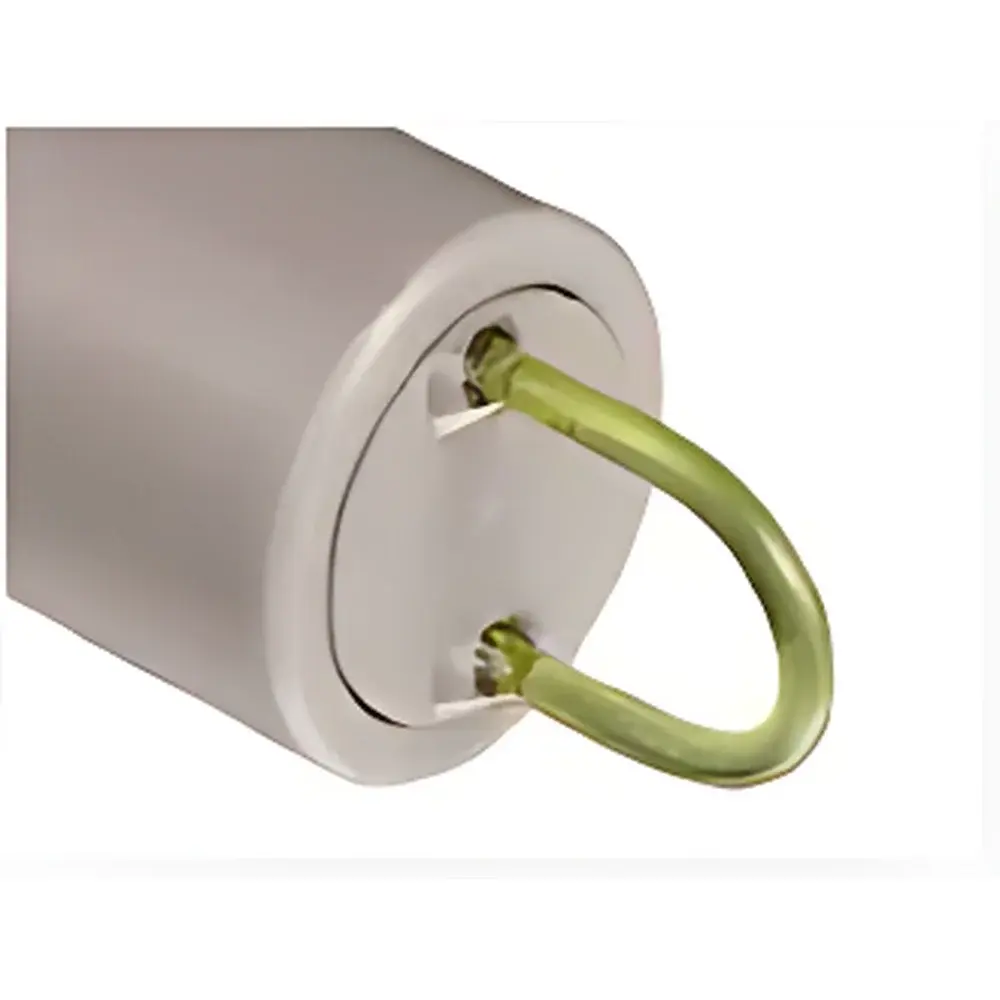
ATR Loop Probe – ART Photonics newopto Series for Mid-IR Spectroscopy
| Brand | ART Photonics |
|---|---|
| Origin | Germany |
| Model | newopto |
| Fiber Type | Chalcogenide (CIR) / Polycrystalline (PIR) |
| Transmission Range | 6500–1700 cm⁻¹ (CIR) / 3600–600 cm⁻¹ (PIR) |
| Max. Temp. | ≤90°C (CIR) / ≤100°C (PIR) |
| Total Length | 1 m (standard) |
| Shaft Length | 120 mm |
| Shaft Diameter | 10 mm |
| Shaft Material | PEEK |
| Protective Tube Material | PEEK |
| Connector | Long SMA (custom options available) |
| Detachable Loop Configuration | Single-loop, double-loop, triple-loop, and multi-loop variants |
Overview
The ART Photonics newopto ATR Loop Probe is a purpose-engineered mid-infrared (mid-IR) evanescent wave sensing component designed for integration with Fourier Transform Infrared (FTIR), Quantum Cascade Laser (QCL), and filter-based IR spectrometers. Based on the principle of Attenuated Total Reflection (ATR), this probe enables non-destructive, in situ, and real-time molecular absorption measurements by coupling IR radiation into a high-refractive-index waveguide—typically a chalcogenide (CIR) or polycrystalline (PIR) infrared-transmitting fiber—that forms a closed loop at the probe tip. When sample material contacts the loop surface, the evanescent field extending beyond the fiber core interacts selectively with vibrational modes in the analyte, generating characteristic absorption spectra. Unlike conventional ATR crystals requiring direct optical alignment and mechanical pressure, the loop geometry provides consistent contact area and robust signal reproducibility across heterogeneous or flowing media—making it especially suitable for process monitoring, remote diagnostics, and multi-point spectroscopic configurations.
Key Features
- Optimized mid-IR transmission: CIR variant covers 6500–1700 cm⁻¹; PIR variant spans 3600–600 cm⁻¹—encompassing fundamental C–H, O–H, N–H, C=O, and C–O stretching/bending bands critical for organic, pharmaceutical, and biological analysis.
- Modular loop architecture: Detachable fiber loops allow rapid replacement without recalibration; configurable as single-loop, double-loop, triple-loop, or custom multi-loop geometries to enhance pathlength and sensitivity.
- Thermally stable construction: Shaft and protective tubing fabricated from polyether ether ketone (PEEK), rated for continuous operation up to 90°C (CIR) or 100°C (PIR), ensuring dimensional stability and chemical resistance in demanding industrial environments.
- Standardized optical interfacing: Equipped with long-thread SMA connectors compatible with most commercial FTIR spectrometer sampling interfaces; optional connector types (e.g., FC/PC, ST, or custom OEM mounts) available upon request.
- Flexible deployment: Total probe length configurable from 1 m (standard) up to 10 m (CIR) or 5 m (PIR), enabling remote sensing in hazardous, confined, or hygienically restricted zones without compromising spectral fidelity.
Sample Compatibility & Compliance
The newopto ATR Loop Probe supports direct contact measurement of liquids, slurries, pastes, gels, and semi-solid films—including aqueous, organic, and corrosive matrices—without solvent extraction or dilution. Its loop geometry accommodates variable sample viscosity and flow dynamics while maintaining uniform evanescent coupling. The probe complies with ISO 17025-relevant design principles for traceable optical instrumentation and is routinely deployed in environments adhering to GLP and GMP frameworks. While not an active medical device, its use in clinical research applications aligns with ASTM E1421 and ISO 13485-supported validation protocols for spectroscopic biomarker detection systems.
Software & Data Management
The probe operates transparently within existing spectrometer control software (e.g., OPUS, GRAMS/AI, or QCL vendor platforms) and requires no proprietary drivers. Spectral acquisition retains full resolution and signal-to-noise ratio (SNR) inherent to the host instrument. When integrated into automated process analytical technology (PAT) workflows, the probe supports time-stamped spectral logging, batch metadata tagging, and export to CSV, JCAMP-DX, or HDF5 formats. Audit trails and user-access controls are maintained at the host spectrometer level, satisfying FDA 21 CFR Part 11 requirements when deployed with validated software environments.
Applications
- Real-time monitoring of chemical reactions in reactors and pipelines via remote mid-IR spectroscopy.
- Multi-loop ATR configurations for simultaneous measurement across parallel process streams or spatially distributed bioreactor zones.
- Molecular fingerprinting in point-of-care diagnostics—e.g., serum glucose, lactate, or urea quantification using partial least squares (PLS) regression models trained on loop-collected spectra.
- Quality control of polymer melts, pharmaceutical granules, and food emulsions where conventional ATR crystals suffer from fouling or thermal drift.
- Environmental analysis of hydrocarbon contaminants in soil leachates or wastewater effluents under field-deployable FTIR setups.
FAQ
What spectral resolution can be achieved using the newopto ATR Loop Probe?
Resolution is determined solely by the connected spectrometer—not the probe. The probe preserves the native resolution (e.g., 0.5 cm⁻¹, 1 cm⁻¹, or 4 cm⁻¹) and throughput of the host FTIR or QCL system.
Can the loop be sterilized for biomedical use?
PEEK components withstand autoclaving (121°C, 20 min) only for PIR-based probes rated to 100°C; CIR loops must be cleaned with isopropanol or ethanol and dried under inert gas—autoclaving degrades chalcogenide glass.
Is calibration required after loop replacement?
Yes—each loop exhibits minor variations in effective pathlength and Fresnel losses; a background reference scan (air or N₂) must be acquired post-replacement before sample measurement.
How is mechanical durability ensured during repeated bending or vibration?
The PEEK shaft and reinforced protective tube provide torsional rigidity and crush resistance; minimum bend radius is specified per fiber type (CIR: ≥50 mm; PIR: ≥30 mm) to prevent microcrack formation.
Does the probe support quantitative analysis out-of-the-box?
Quantitative capability depends on chemometric model development (e.g., PLS, PCR) using representative calibration standards; the probe delivers high-fidelity, reproducible spectra required for robust model training and transferability.





