
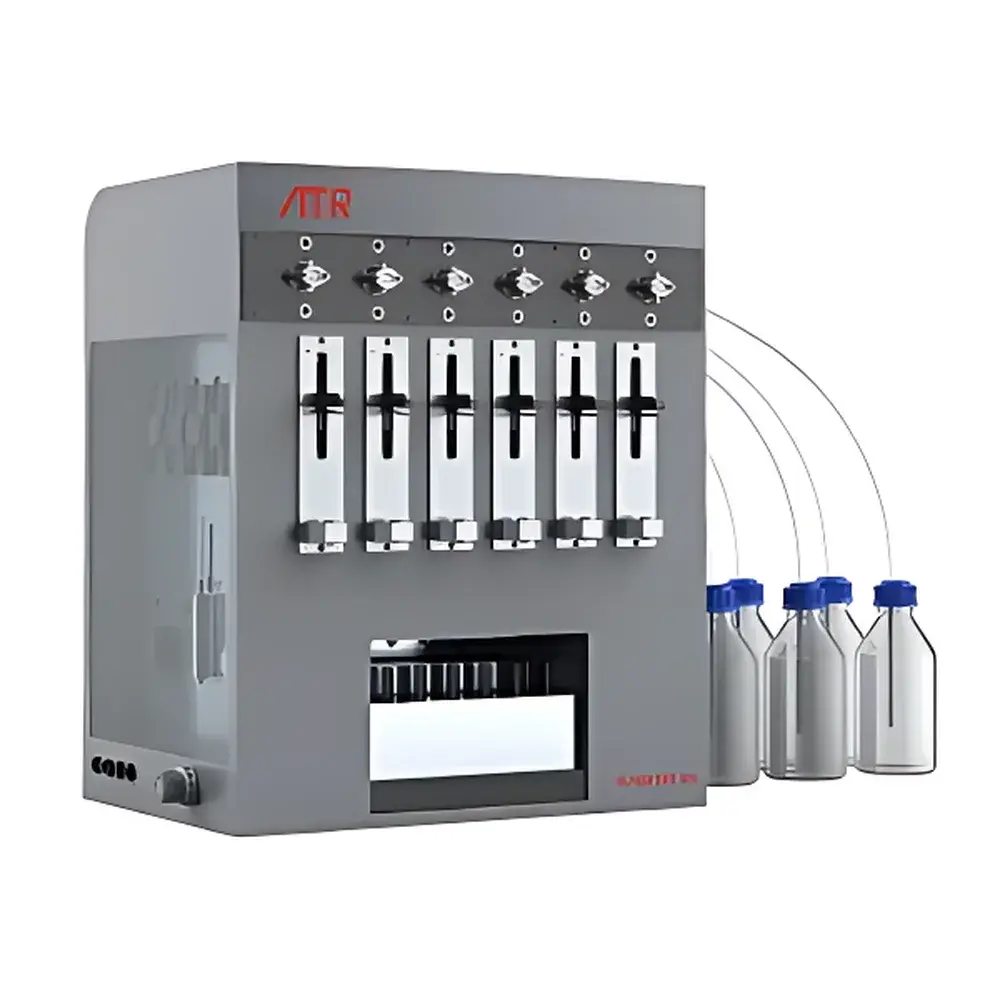
ATR Super SPE 300 Automated Solid Phase Extraction and Concentration System
| Brand | ATR |
|---|---|
| Origin | USA |
| Model | Super SPE 300 |
| Automation Level | Fully Automated |
| Number of Channels | 6 |
| SPE Format Compatibility | Cartridge and Membrane (25 mm & 47 mm) |
| Flow Rate Control | 0.1–60 mL/min (sample pump) |
| Solvent Reservoirs | 8 independent solvent ports |
| Sample Capacity | Up to 6 large-volume samples simultaneously |
| Sample Loading Volume | 10–20,000 mL |
| Wetted Materials | PTFE only |
| Method Compliance | EPA-approved methods |
| Control Interface | 12-inch touchscreen PC with bilingual (English/Chinese) GUI |
| Waste Segregation | Three dedicated waste lines (aqueous, general organic, chlorine-containing organic) |
| Optional Module | Integrated Automated Quantitative Concentration Unit (vortex-assisted nitrogen blow-down, 0–50 mL input, endpoint at 0.5 or 1.0 mL) |
Overview
The ATR Super SPE 300 Automated Solid Phase Extraction and Concentration System is an engineered solution for high-throughput, method-compliant enrichment and purification of trace organic analytes from large-volume aqueous matrices. Built on positive-pressure fluid delivery architecture, the system eliminates vacuum-induced clogging commonly encountered with particulate-laden environmental samples—such as surface water, groundwater, drinking water, wastewater, and food/beverage extracts. Its core measurement principle relies on controlled, programmable fluid displacement through solid-phase sorbent media (cartridges or membranes), enabling reproducible analyte retention, selective elution, and matrix removal under defined flow dynamics and solvent gradients. Designed for regulatory laboratory environments, the Super SPE 300 supports method traceability, audit-ready operation, and seamless integration into validated workflows compliant with U.S. EPA Methods 508, 525, 531, 552, and 8270, as well as China’s GB/T 5750, GB/T 17134, and HJ standards for pesticide, pharmaceutical, endocrine-disrupting compound, and PFAS analysis.
Key Features
- Six independent, pneumatically isolated channels—each equipped with a high-precision peristaltic sample pump and syringe-based reagent pump—enabling concurrent processing of up to six 20-L samples without cross-contamination or flow interference.
- PTFE-wetted fluid path throughout—including all valves, manifolds, tubing, and interface fittings—ensuring chemical inertness against aggressive solvents (e.g., DCM, acetone, acetonitrile, chlorinated hydrocarbons) and minimizing analyte adsorption or carryover.
- Positive-pressure loading mode (0.1–60 mL/min adjustable) prevents column/membrane blockage by suspended solids, eliminating pre-filtration requirements for turbid or sediment-rich samples.
- Universal SPE format support: compatible with 1–20 mL cartridges (1, 3, 6, 12, 20 mL formats) and disk-based extraction (25 mm and 47 mm PTFE-backed membranes), with no hardware modification or tooling required.
- Eight independently addressable solvent reservoirs permit complex multi-step protocols—including conditioning, loading, washing, elution, and post-elution drying—with precise volumetric delivery (±1.0% accuracy) and programmable dwell times.
- Triple-path waste management system segregates aqueous effluent, general organic solvents, and halogenated organics—supporting safe disposal, solvent recovery, and compliance with OSHA and EPA hazardous waste handling guidelines.
Sample Compatibility & Compliance
The Super SPE 300 accommodates liquid samples ranging from 10 mL to 20 L, including raw environmental waters, centrifuged or filtered extracts from solid/semi-solid matrices (e.g., soil leachates, tissue homogenates, dairy products), and clarified food/beverage filtrates. Its PTFE-only fluidic design ensures compatibility with acidic, basic, and highly polar solvents used in EPA SW-846 and ISO 17923-2021 workflows. Pre-loaded method libraries include validated protocols for organochlorine/organophosphate pesticides, PAHs, PCBs, phenols, nitrosamines, and emerging contaminants such as microplastic-associated additives and pharmaceutical residues. All operational parameters—including pump calibration logs, method version stamps, and run timestamps—are stored locally with optional network backup, supporting GLP/GMP documentation requirements and FDA 21 CFR Part 11 electronic record integrity when paired with validated software configurations.
Software & Data Management
Controlled via a 12-inch industrial touchscreen PC running embedded Windows IoT OS, the system features dual-language (English/Chinese) GUI with intuitive drag-and-drop method builder, real-time pressure monitoring per channel, and dynamic error logging. Software architecture supports user-defined method cloning, parameter locking for QA/QC batches, and automatic generation of run reports (PDF/CSV) containing sample IDs, solvent consumption, elapsed time, and critical event flags (e.g., low solvent, leak detection, pressure deviation >15%). Audit trails are timestamped, immutable, and exportable for internal review or regulatory submission. Optional integration with LIMS via TCP/IP or OPC UA enables automated sample queue ingestion and result pushback.
Applications
- Environmental monitoring labs performing routine analysis of drinking water, wastewater effluents, and ambient surface/groundwater per EPA and ISO regulatory frameworks.
- Food safety laboratories quantifying pesticide residues, mycotoxins, and veterinary drug metabolites in beverages, juices, and dairy matrices.
- Pharmaceutical QC facilities isolating low-concentration impurities or genotoxic degradants from process water and cleaning validation swab extracts.
- Research institutions conducting non-target screening of environmental pollutants using LC-HRMS, where high-recovery, low-background cleanup is essential prior to instrumental analysis.
- Forensic toxicology units enriching drugs of abuse and metabolites from large-volume urine or serum dilutions prior to GC-MS/MS confirmation.
FAQ
Does the Super SPE 300 require vacuum manifolds or external nitrogen sources?
No. It operates exclusively via integrated positive-pressure pumps and built-in compressed air regulation—no external vacuum or nitrogen gas supply is needed for standard SPE operation.
Can the system perform sequential multi-column SPE (e.g., tandem C18 + silica)?
Yes. The fluidic architecture supports programmable serial cartridge coupling across any channel, enabling multi-stage clean-up without manual intervention.
Is method validation support available from ATR?
ATR provides IQ/OQ documentation templates, pump linearity verification protocols, and EPA method correlation data packages upon request for laboratory-specific validation projects.
What maintenance intervals are recommended for long-term reliability?
PTFE valve cartridges and pump tubing are consumables with documented service life (≥10,000 cycles); full system performance verification is recommended every 6 months or after 500 runs, whichever occurs first.
How is leak detection implemented?
Each channel incorporates real-time pressure monitoring with adaptive threshold algorithms; sustained deviation (>20% from setpoint for >30 sec) triggers audible/visual alerts and automatic protocol pause, with event logged to the audit trail.



