
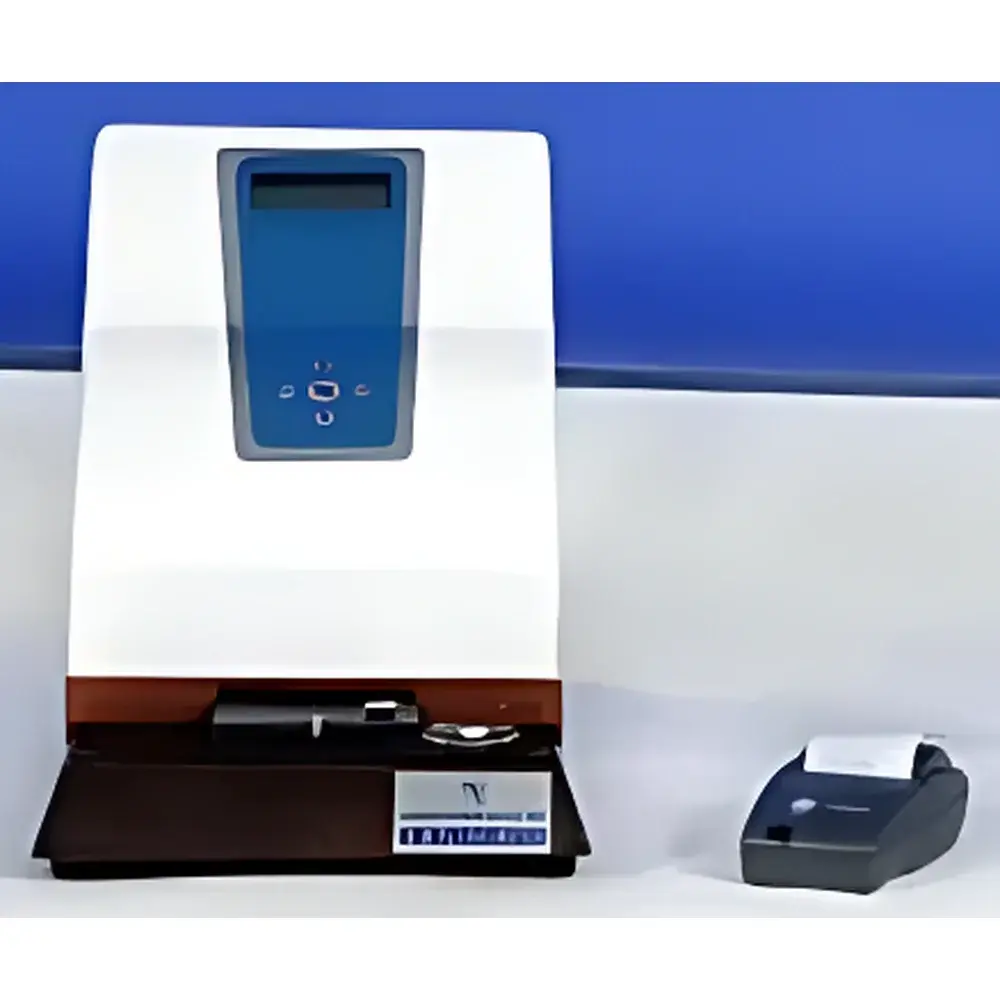
ATS 300GM Uranium Fluorescence Analyzer
| Brand | ATS |
|---|---|
| Origin | Switzerland |
| Model | 300GM |
| Spectral Dispersion | Grating and Interference Filters |
| Slit Width (Spectral Bandpass) | 1.5 nm |
| Resolution | 1 nm |
| Sensitivity | 200:1 (Signal-to-Noise Ratio) |
| Wavelength Accuracy | ±2 nm |
| Detection Range | 1–800 ppm U |
| Precision | ≤1% CV at 100 ppb U |
| Measurement Cycle Time | 5 s |
| Display | Backlit LCD/LED |
| Interface | RS-232, USB 2.0 |
| Power Supply | ATS/37009: 230 VAC, 50/60 Hz |
| ATS/37010 | 110 VAC, 60 Hz |
| Dimensions | 420 × 280 × 380 mm (L×W×H) |
| Net Weight | 9 kg |
Overview
The ATS 300GM Uranium Fluorescence Analyzer is a purpose-built, benchtop molecular fluorescence spectrometer engineered for quantitative determination of uranium in solid, liquid, and biological matrices. It operates on the principle of ultraviolet-induced fluorescence—specifically exploiting the characteristic luminescence of uranyl ion (UO22+) complexes upon excitation at ~365 nm, with emission detection centered near 500 nm. Unlike general-purpose fluorometers, the 300GM integrates optical path optimization, fixed-wavelength excitation/emission geometry, and chemometric calibration routines tailored exclusively for uranium speciation and quantification. Its design heritage traces to legacy Jarrell-Ash G-M fluorometric platforms but incorporates modern solid-state optics, microprocessor-controlled timing, and digital signal processing to eliminate manual alignment, reduce photomultiplier drift, and ensure trace-level reproducibility. The instrument complies with foundational requirements for field-deployable radiometric screening per IAEA Technical Reports Series No. 426 and supports laboratory workflows aligned with ISO/IEC 17025 accreditation criteria.
Key Features
- Optimized dual-optical-path architecture: Integrated grating monochromator and interference filter assembly ensures spectral purity and minimizes stray light—critical for distinguishing uranyl fluorescence from matrix autofluorescence in complex environmental samples.
- No-moving-parts optical train: Fixed-slit (1.5 nm bandwidth), pre-aligned excitation and emission channels eliminate routine collimation or focus adjustment—reducing operator dependency and long-term calibration drift.
- High-speed quantification cycle: Full measurement—including auto-zeroing, sample interrogation, and integrated signal averaging—completes within 5 seconds, enabling throughput of >100 samples per hour under routine operation.
- Digital signal integrity: Low-noise photomultiplier tube (PMT) coupled with 16-bit ADC and real-time baseline correction delivers ≤1% coefficient of variation (CV) at 100 ppb uranium concentration.
- Robust mechanical design: Aluminum alloy chassis with EMI-shielded enclosure; operating temperature range: 10–35 °C; relative humidity tolerance: ≤80% non-condensing.
- Modular power compatibility: Dual-voltage input (110 VAC / 230 VAC) with automatic frequency recognition—suitable for global deployment without external transformers.
Sample Compatibility & Compliance
The 300GM accepts aqueous extracts (e.g., nitric acid leachates), digested soil/sediment filtrates, urine supernatants, and clarified natural waters following standardized pretreatment protocols (e.g., EPA Method 908.1, ASTM D5174-18). Solid samples require acid digestion (HNO3/HF) prior to analysis. The system meets essential electromagnetic compatibility (EMC) requirements per EN 61326-1:2013 and safety standards per IEC 61010-1:2010. While not certified for Class I Division 1 hazardous locations, its sealed optical compartment and low-power UV LED excitation source (no mercury lamp) support safe operation in controlled laboratory and mobile field-lab environments. Data acquisition and storage adhere to ALCOA+ principles when used with optional ATS FluoroSoft™ software configured for audit trail and electronic signature compliance (21 CFR Part 11 readiness).
Software & Data Management
Instrument control and data handling are managed via the optional ATS FluoroSoft™ software suite (v3.2+), compatible with Windows 10/11. Core capabilities include: automated multi-point calibration (zero + single high-standard), linear and quadratic regression fitting, limit-of-detection (LOD) calculation per IUPAC recommendations, batch report generation (PDF/CSV), and GLP-compliant metadata tagging (operator ID, timestamp, instrument serial, calibration history). Raw intensity values and processed concentrations are exportable to LIMS via ODBC or direct file transfer. The embedded firmware supports firmware updates via USB drive and retains full configuration backup across power cycles. RS-232 and USB 2.0 interfaces enable bidirectional communication with external PCs or industrial PLCs for integration into automated QA/QC lines.
Applications
- Geological exploration: Quantitative screening of uranium-bearing minerals (autunite, torbernite, carnotite, uraninite) in drill core pulps and mill feed assays.
- Environmental monitoring: Regulatory compliance testing of surface water, groundwater, drinking water sources, and wastewater effluents per national radionuclide surveillance programs.
- Nuclear safeguards: Field verification of uranium enrichment levels in process streams and waste matrices at fuel cycle facilities.
- Occupational health: Rapid bio-monitoring of uranium exposure via urinary uranium concentration (U-Ur) assessment in nuclear industry personnel.
- Industrial raw material control: Verification of uranium content in phosphate rock, coal ash, and rare-earth element concentrates where U occurs as an impurity.
- Academic research: Kinetic studies of uranyl complexation, solvent extraction efficiency, and sorption behavior on clay minerals and engineered adsorbents.
FAQ
Is the 300GM suitable for regulatory reporting under EPA or EU directives?
Yes—when operated with documented SOPs, calibrated standards traceable to NIST SRM 4325, and paired with FluoroSoft™ audit-trail mode, it supports data submission under EPA Region 6 Uranium Methods and EU Council Directive 2013/51/Euratom for drinking water monitoring.
Does the instrument require annual recalibration by the manufacturer?
No—field recalibration using certified uranium standard solutions (e.g., 10 ppm U in 1% HNO3) is sufficient. Factory recalibration is recommended only after physical shock, PMT replacement, or failure to meet internal QC acceptance criteria (e.g., repeated >2% CV at 100 ppb).
Can the 300GM distinguish between U(VI) and U(IV) species?
No—it measures total fluorescent uranyl (UO22+) and assumes complete oxidation to hexavalent state during sample preparation. Speciation requires complementary techniques such as XANES or TRLFS.
What maintenance is required beyond routine cleaning?
Annual inspection of PMT gain stability and optical window transmission (using reference quartz slide); no lamp replacement needed—the solid-state UV excitation source has >10,000-hour operational lifetime.
Is method validation support available from ATS?
Yes—ATS provides application notes, validation templates (per ISO/IEC 17025 Annex B), and remote technical assistance for method transfer, precision/recovery studies, and uncertainty budgeting.



