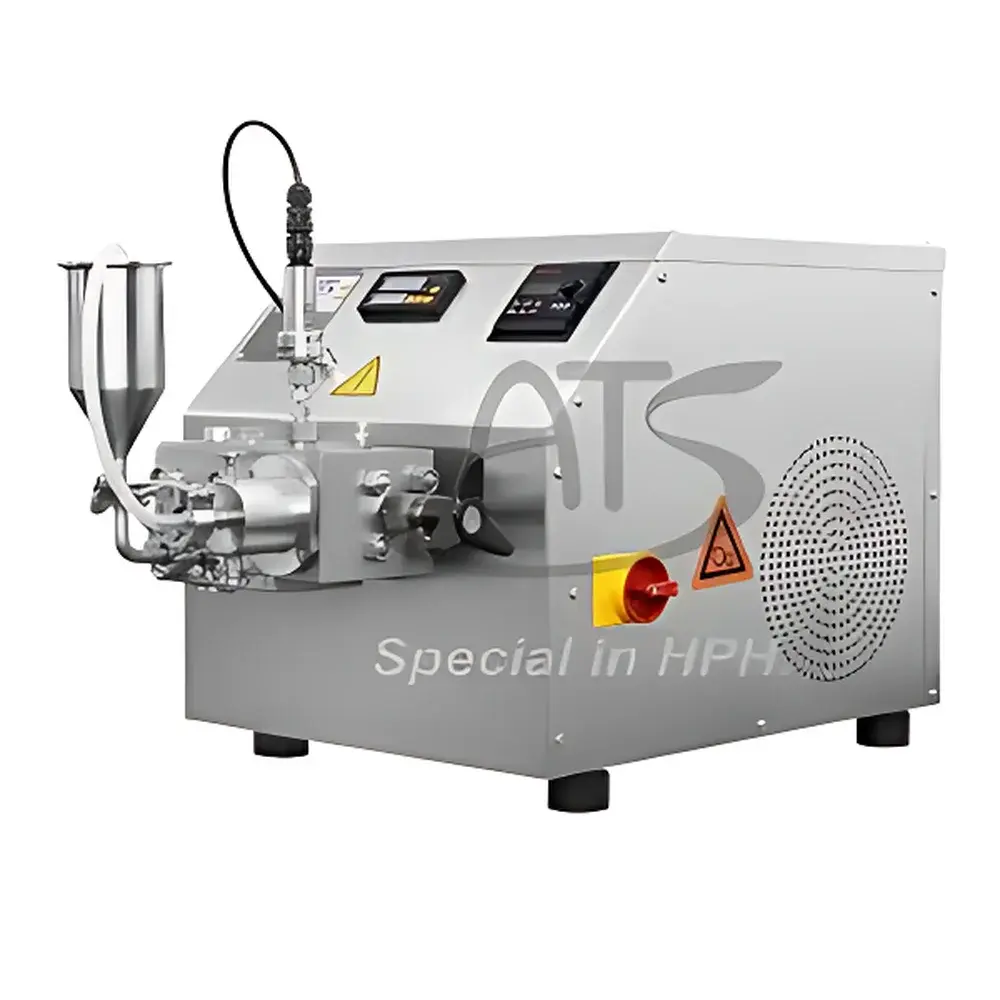
ATS AH-1500 High-Pressure Homogenizer
| Brand | ATS |
|---|---|
| Origin | Canada |
| Model | AH-1500 |
| Instrument Type | High-Pressure Cell Disruptor |
| Operating Pressure | 1500 bar (22,500 psi), up to 1800 bar (27,000 psi) |
| Motor Power | 2.2 kW, 380 V / 50 Hz |
| Throughput | 15 L/h |
| Minimum Sample Volume | 25 mL |
| In-Line Cooling System | Integrated, maintains sample temperature < 20 °C |
| Wetted Materials | 316L stainless steel |
| Compliance | CE-certified, GMP-compliant design |
| Particle Size Reduction | < 100 nm |
| Cell Disruption Efficiency | >95% for E. coli, >90% for yeast |
| Weight | 110 kg |
Overview
The ATS AH-1500 High-Pressure Homogenizer is an engineered solution for scalable, reproducible cell lysis and submicron particle size reduction in life science research and biopharmaceutical development. It operates on the principle of high-pressure homogenization—utilizing controlled hydraulic force to accelerate cell suspensions through a precisely dimensioned micro-orifice (the homogenization valve), followed by abrupt pressure release and impact against a collision ring. This process generates three concurrent physical mechanisms: cavitation, shear stress, and turbulent impact—collectively enabling efficient disruption of robust microbial cells (e.g., E. coli, yeast, algae) and delicate mammalian cells while preserving labile intracellular components such as enzymes, recombinant proteins, and nucleic acids. Designed for continuous operation at up to 1800 bar (27,000 psi), the AH-1500 delivers consistent performance across batch and semi-continuous workflows, supporting early-stage R&D through process development and small-scale GMP manufacturing.
Key Features
- High-integrity homogenization system rated for sustained operation at 1500 bar (22,500 psi), with peak capability up to 1800 bar (27,000 psi)
- Integrated in-line cooling module that actively extracts heat generated during homogenization, maintaining sample temperature below 20 °C without external chiller dependency
- Optional external cooling coil integration for enhanced thermal control in extended runs or thermosensitive applications
- GMP-aligned mechanical architecture: all fluid-contact surfaces fabricated from electropolished 316L stainless steel, compliant with ASME BPE surface finish standards
- Self-priming feed valve design eliminates manual air purging—enabling rapid start-up and minimizing sample loss or cross-contamination
- 2.2 kW industrial-grade motor with robust torque delivery across full pressure range, ensuring stable flow dynamics and pressure repeatability
- Single-stage homogenization configuration optimized for maximum disruption efficiency and minimal protein denaturation
- CE-marked and designed in accordance with ISO 13849-1 for functional safety in laboratory environments
Sample Compatibility & Compliance
The AH-1500 accommodates a broad spectrum of biological matrices—including bacterial cultures (E. coli, Bacillus spp.), yeasts (S. cerevisiae, P. pastoris), microalgae (Chlorella, Dunaliella), and suspension-adapted mammalian cells—with inlet particle size tolerance up to 100 µm. Its validated disruption efficiency (>95% for prokaryotes, >90% for yeasts) supports quantitative recovery of cytosolic and membrane-associated biomolecules. The system conforms to key regulatory expectations for bioprocess equipment: CE certification per Machinery Directive 2006/42/EC; materials traceability aligned with ASTM A276 and ASTM F899; and structural design compatible with GLP and GMP documentation requirements. While not pre-validated for specific USP or Ph. Eur. monographs, its operational parameters and material compatibility support qualification under ICH Q5D and Q5E guidelines for host-cell protein removal and particle size distribution control.
Software & Data Management
The AH-1500 operates via a dedicated local control interface featuring real-time pressure monitoring, flow rate estimation, and temperature logging at the homogenization zone. All critical operational parameters—including setpoint pressure, actual pressure deviation (±15 bar), motor current draw, and cooling loop outlet temperature—are timestamped and stored internally for ≥10,000 cycles. Data export is supported via USB interface in CSV format, enabling integration into LIMS or ELN platforms. Audit trail functionality meets FDA 21 CFR Part 11 foundational requirements for electronic records (user ID tagging, immutable event logs, and parameter change history), though full Part 11 compliance requires site-specific validation and supplementary access controls.
Applications
- Downstream processing of recombinant proteins expressed in E. coli or yeast hosts
- Preparation of whole-cell lysates for enzymatic assays, Western blotting, and mass spectrometry
- Production of virus-like particles (VLPs) and antigen preparations for human and veterinary vaccine development
- Nanoparticle formulation—e.g., liposome extrusion, polymeric micelle homogenization, and exosome isolation support
- Cell-free expression system feedstock preparation requiring intact ribosomal complexes
- Metabolomics and proteomics sample prep where thermal degradation must be minimized
- Scale-down modeling for clinical-stage biomanufacturing processes
FAQ
What is the minimum viable sample volume for the AH-1500?
The system supports reliable operation starting from 25 mL, with optimal reproducibility achieved above 100 mL due to flow stabilization dynamics.
Can the AH-1500 be used for sterile processing?
While the unit itself is not autoclavable, its 316L wetted path and smooth internal geometry support SIP (steam-in-place) protocols when integrated into closed-loop bioreactor systems—validation must be performed per facility SOPs.
Is remote monitoring or Ethernet connectivity available?
Standard configuration includes local HMI only; optional RS-485 Modbus RTU interface enables integration with SCADA or PLC-based supervisory systems.
How does the in-line cooling system differ from conventional jacketed chambers?
It employs direct-conduction heat exchange within the homogenization valve housing—reducing thermal lag and enabling tighter control of transient temperature spikes during pressure ramp-up.
What maintenance intervals are recommended for the homogenization valve assembly?
Valve wear inspection is advised every 200 operating hours or after processing 500 L of high-viscosity biomass; replacement frequency depends on feedstock abrasivity and pressure profile.