
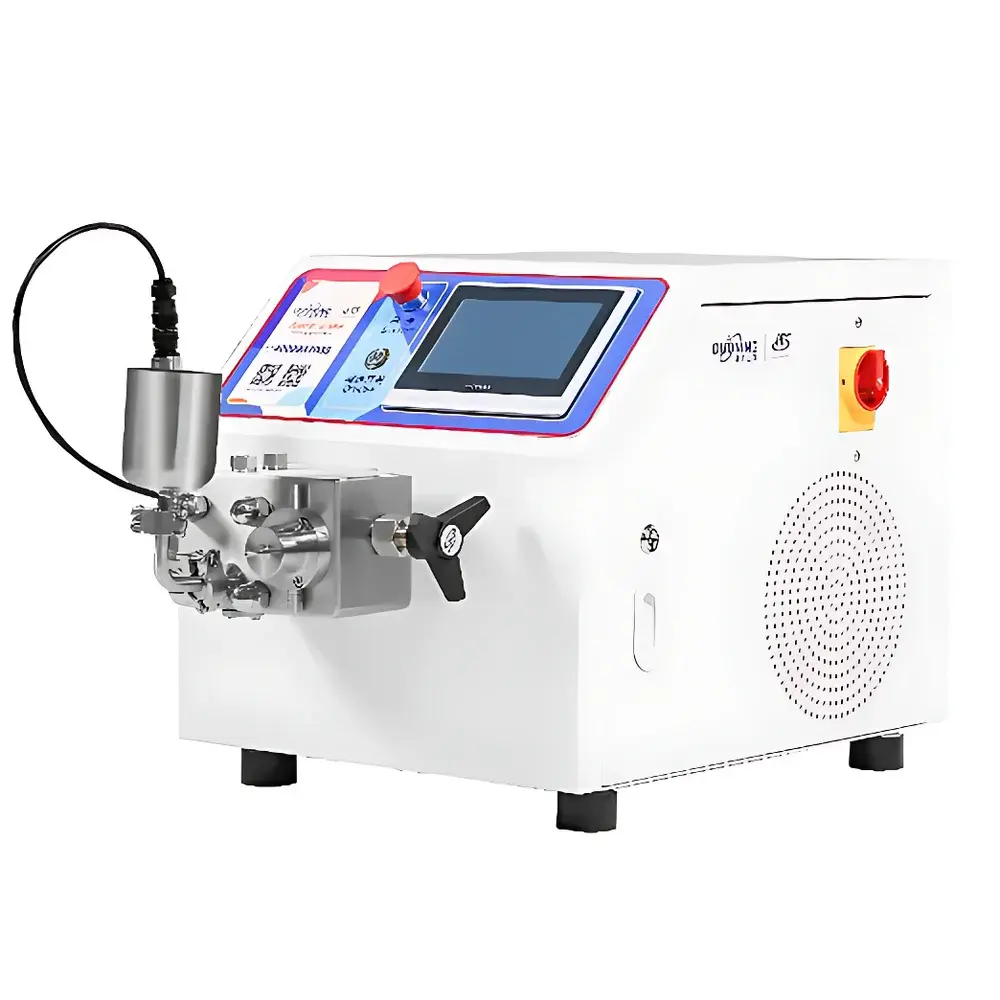
ATS AH-NANO Laboratory-Scale Ultra-High-Pressure Nanohomogenizer
| Brand | ATS |
|---|---|
| Origin | Jiangsu, China |
| Manufacturer Type | Authorized Distributor |
| Country of Manufacture | China |
| Model | AH-NANO |
| Instrument Type | High-Pressure Homogenizer |
| Dimensions (W×D×H) | 795 × 450 × 490 mm |
| Net Weight | 140 kg |
| Power Supply | 1.5 kW |
| Maximum Operating Pressure | 1800 bar |
| Flow Rate Range | 15 mL (batch mode) to 10 L/h (continuous mode) |
| Temperature Control Range | 5–10 °C (integrated chiller module) |
| Homogenization Valve Configuration | Dual-stage, interchangeable ceramic or hardened alloy valves |
| Pressure Display | Digital LED gauge with electronic overpressure protection |
Overview
The ATS AH-NANO is a laboratory-scale ultra-high-pressure nanohomogenizer engineered for precise, reproducible submicron and nanoscale particle size reduction, dispersion, and cell disruption. It operates on the principle of controlled high-pressure cavitation, shear, and impact—where pressurized fluid is forced through an adjustable micro-orifice valve at pressures up to 1800 bar. As the sample traverses the narrow clearance between the impact ring and seat in the dual-stage homogenizing valve, it experiences instantaneous pressure drop, turbulent flow, and intense hydrodynamic forces. These combined mechanisms—cavitation collapse, high-velocity collision, and laminar shear—effectively deaggregate colloidal clusters, exfoliate layered nanomaterials (e.g., graphene, CNTs), lyse microbial or mammalian cells, and stabilize emulsions and liposomal formulations. Designed specifically for R&D environments, the AH-NANO bridges the gap between benchtop feasibility studies and scalable process development, delivering consistent results under GLP-aligned operating conditions.
Key Features
- Dual-stage homogenizing valve system with user-selectable ceramic or hardened alloy construction—optimized for abrasion resistance and long-term pressure integrity across diverse sample matrices.
- Integrated temperature-controlled cooling module maintaining sample temperature between 5–10 °C during extended operation—critical for thermolabile biologics, proteins, and lipid-based nanocarriers.
- Digital LED pressure display with real-time monitoring and programmable electronic overpressure cutoff (setpoint adjustable within 100–1800 bar), ensuring operator safety and equipment longevity.
- Compact footprint (795 × 450 × 490 mm) and modular architecture enable seamless integration into standard fume hoods or ISO-classified clean benches without requiring dedicated utility infrastructure.
- Low minimum processing volume (15 mL batch mode) supports early-stage formulation screening with minimal reagent consumption—ideal for high-value APIs, monoclonal antibodies, or novel excipients.
Sample Compatibility & Compliance
The AH-NANO accommodates aqueous, organic, and biphasic suspensions, emulsions, and cell lysates with viscosities up to 500 mPa·s. It has been validated for use in applications requiring adherence to ASTM D6573 (emulsion stability), USP (liposome size distribution), and ISO 13320 (laser diffraction particle sizing methodology). While not certified as GMP-compliant out-of-the-box, its traceable pressure logging, non-contaminating wetted path (ceramic/alloy valves, stainless steel 316L fluid circuit), and absence of moving parts in contact with the sample support audit readiness for GLP-regulated preclinical development workflows. All electrical components conform to IEC 61000-6-3 (EMC) and IEC 61000-6-2 (immunity) standards.
Software & Data Management
The AH-NANO operates via a standalone control panel with tactile interface—no external PC or proprietary software required. Pressure setpoints, runtime duration, and cooling activation are manually configured and retained in non-volatile memory. For laboratories implementing 21 CFR Part 11 compliance, optional analog output (4–20 mA) enables integration with third-party SCADA or LIMS platforms for electronic recordkeeping. Audit trails—including date/time stamps, pressure deviation logs, and thermal event alerts—can be exported via RS-232 serial interface for internal quality review or regulatory submission.
Applications
- Pharmaceutical & Biotechnology: Preparation of nanoemulsions for oral delivery; extrusion-free liposome formation; bacterial and yeast cell lysis for recombinant protein recovery; nanoparticle synthesis for mRNA vaccine carriers.
- Food & Nutraceuticals: Stabilization of dairy-based nanoemulsions; production of fat-reduced functional beverages; dispersion of polyphenol-loaded micelles; homogenization of plant-based protein isolates.
- Advanced Materials: Exfoliation of graphite to graphene nanoplatelets; deagglomeration of metal oxide nanoparticles (TiO₂, ZnO); uniform dispersion of carbon nanotubes in polymer precursors; nanocellulose fibrillation for barrier film development.
- Cosmetics & Personal Care: Formulation of transparent, low-viscosity serums containing insoluble actives; stabilization of UV-filter nanodispersions; creation of non-greasy, fast-absorbing topical suspensions.
FAQ
What is the maximum allowable viscosity for continuous processing?
Samples up to 500 mPa·s may be processed continuously at flow rates ≤5 L/h; higher viscosities require batch recirculation mode with reduced throughput.
Can the AH-NANO be used for sterile processing?
Yes—when equipped with autoclavable ceramic valves and connected to a sterile-grade filtration train, it supports aseptic nanosuspension preparation under Class A/B cleanroom conditions.
Is validation documentation available for IQ/OQ protocols?
ATS provides a vendor-issued Factory Acceptance Test (FAT) report and mechanical calibration certificate; site-specific Installation Qualification (IQ) and Operational Qualification (OQ) templates are available upon request.
How frequently should the homogenizing valve be replaced?
Ceramic valves typically last ≥500 hours under standard aqueous operation; alloy valves show comparable durability with abrasive nanomaterial slurries—replacement intervals are tracked via cumulative runtime logging.
Does the system support automated pressure ramping?
No—pressure is manually set and held constant during operation; however, the dual-stage valve design inherently delivers stable, pulse-free flow essential for reproducible particle size distributions.



