
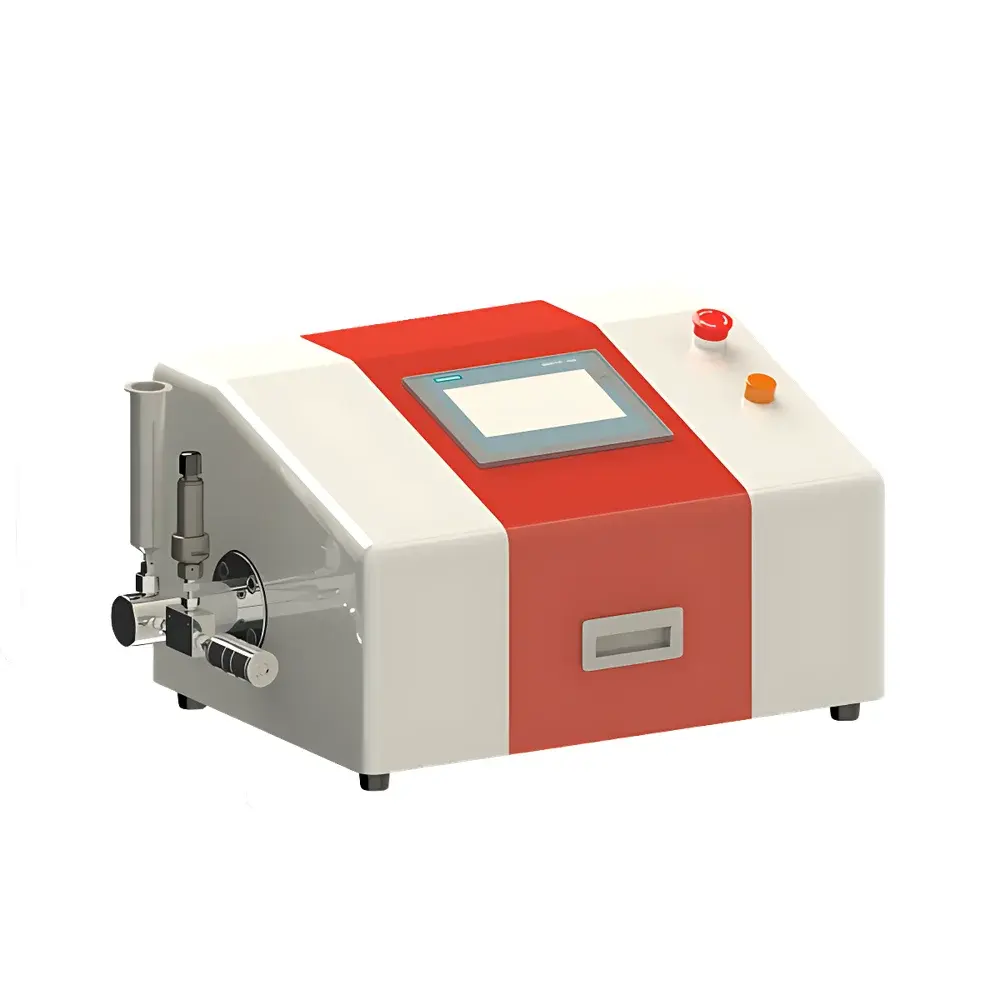
ATS AMH-MINI Microfluidic Nanoscale Homogenizer
| Brand | ATS |
|---|---|
| Origin | Jiangsu, China |
| Manufacturer Type | Direct Manufacturer |
| Region Category | Domestic (China) |
| Model | AMH-MINI |
| Pricing | Upon Request |
| Operating Pressure | 0–2200 bar |
| Throughput | 3–5 L/h |
| Minimum Sample Volume | 7 mL |
| Voltage | 380 V, 3-phase 4-wire |
| Power Consumption | 2 kW |
| Interaction Chamber Configuration | 300 µm Diamond Y/Z-Type Primary Chamber + 100 µm Diamond Secondary Chamber |
| Drive System | Servo-Driven Electro-Cylinder |
| Control System | Siemens PLC + Emerson Servo Motion Control |
| Dimensions (W×D×H) | 709 × 419 × 345 mm |
| Weight | 50 kg |
Overview
The ATS AMH-MINI Microfluidic Nanoscale Homogenizer is an engineered laboratory-scale high-pressure homogenization system designed for reproducible, scalable nanoparticle formation and cell disruption across pharmaceutical, biotechnology, cosmetic, food science, and advanced materials research. It operates on the principle of microfluidic interaction—where sample fluid is pressurized to up to 2200 bar (32,000 psi) and forced through fixed-dimension diamond microchannels (100 µm and 300 µm), generating supersonic jet streams that collide within a precisely engineered Y- or Z-type interaction chamber. This hydrodynamic cavitation, combined with intense shear and impact forces, enables consistent sub-100 nm particle size reduction, narrow polydispersity index (PDI), and enhanced colloidal stability—without mechanical wear from adjustable valves or thermal degradation from frictional heating.
Key Features
- Fixed-dimension diamond interaction chambers ensure batch-to-batch reproducibility; no manual valve adjustment required.
- Two-chamber configuration (100 µm primary + 300 µm secondary) supports sequential size refinement and process optimization.
- Servo-electro-cylinder drive system delivers precise, pulse-free pressure control with real-time feedback—critical for sensitive biological formulations.
- Siemens S7-1200 PLC integrated with Emerson servo motion controllers enables deterministic pressure ramping, dwell time control, and event-triggered operation.
- Compact footprint (709 × 419 × 345 mm) and low thermal load (<2 kW) allow integration into biosafety cabinets or ISO-classified cleanrooms.
- Hydraulic intensification architecture achieves ultra-high output pressure (up to 2200 bar) from low-input hydraulic pressure (~30–50 MPa), minimizing mechanical fatigue and extending service intervals.
Sample Compatibility & Compliance
The AMH-MINI accommodates aqueous suspensions, lipid emulsions, polymer dispersions, viral vectors, liposomes, exosomes, and nanomaterial slurries—including graphene oxide, carbon nanotubes, and nano-cellulose. Its all-wetted path is constructed from 316L stainless steel and chemically inert diamond microchannels, ensuring compatibility with pH 2–12 solutions and organic co-solvents (e.g., ethanol, isopropanol, chloroform). The system meets core design requirements for Good Manufacturing Practice (GMP)-aligned development workflows and supports audit-ready operation per FDA 21 CFR Part 11 when paired with validated electronic logbook software. While not certified as GMP equipment out-of-the-box, its deterministic pressure control, non-adjustable geometry, and traceable parameter logging make it suitable for Phase I–III formulation development under GLP and ICH Q5A/Q5B guidelines.
Software & Data Management
The embedded HMI provides real-time monitoring of pressure, cycle count, total processed volume, and motor current draw. Optional Ethernet/IP or Modbus TCP connectivity allows integration into centralized lab data systems (e.g., LabVantage, STARLIMS). Raw operational logs—including timestamped pressure profiles, actuator position traces, and error codes—are exportable in CSV format for statistical process analysis (SPC) and regulatory submission. All parameter changes are logged with user ID and timestamp, satisfying ALCOA+ principles (Attributable, Legible, Contemporaneous, Original, Accurate, Complete, Consistent, Enduring, Available) for quality documentation.
Applications
- Pharmaceuticals: Liposomal doxorubicin sizing, mRNA-LNP encapsulation, sterile nanoemulsion preparation for IV/IN delivery, protein aggregate dispersion.
- Biotechnology: Mammalian cell lysis without denaturation, organelle isolation, exosome purification enhancement, CRISPR RNP complex stabilization.
- Cosmetics & Nutraceuticals: Transparent vitamin E nanoemulsions, caffeine nanodispersions, ceramide lamellar phase homogenization.
- Advanced Materials: Monolayer graphene exfoliation in water, uniform CNT debundling, quantum dot surface passivation, battery cathode nanocomposite dispersion.
- Food Science: Cold-processed dairy protein micelles, allergen-reduced nut milk, stable plant-based fat analogs, enzymatically active nano-encapsulated probiotics.
FAQ
What distinguishes microfluidic homogenization from conventional valve-based high-pressure homogenization?
Microfluidization uses fixed-geometry diamond microchannels to generate repeatable jet collision dynamics; valve-based systems rely on adjustable gap settings subject to erosion and drift over time.
Can the AMH-MINI be used for sterile processing?
Yes—when coupled with pre-sterilized single-use fluid paths and validated aseptic connection protocols, it supports Grade A environment operation under EU Annex 1.
Is scale-up from AMH-MINI to production feasible?
Yes—linear scale-up is achieved by parallelizing identical diamond microchannel arrays while maintaining identical per-channel pressure and flow velocity, preserving critical quality attributes (CQAs) such as PDI and zeta potential.
What maintenance intervals are recommended for the diamond interaction chambers?
Under standard operating conditions (aqueous buffers, <2000 bar), diamond chambers typically exceed 500 hours of cumulative runtime before performance validation is required.
Does the system support remote diagnostics or predictive maintenance?
With optional IoT gateway module, real-time motor current harmonics and pressure ripple signatures can be analyzed for early detection of seal wear or chamber clogging.



