
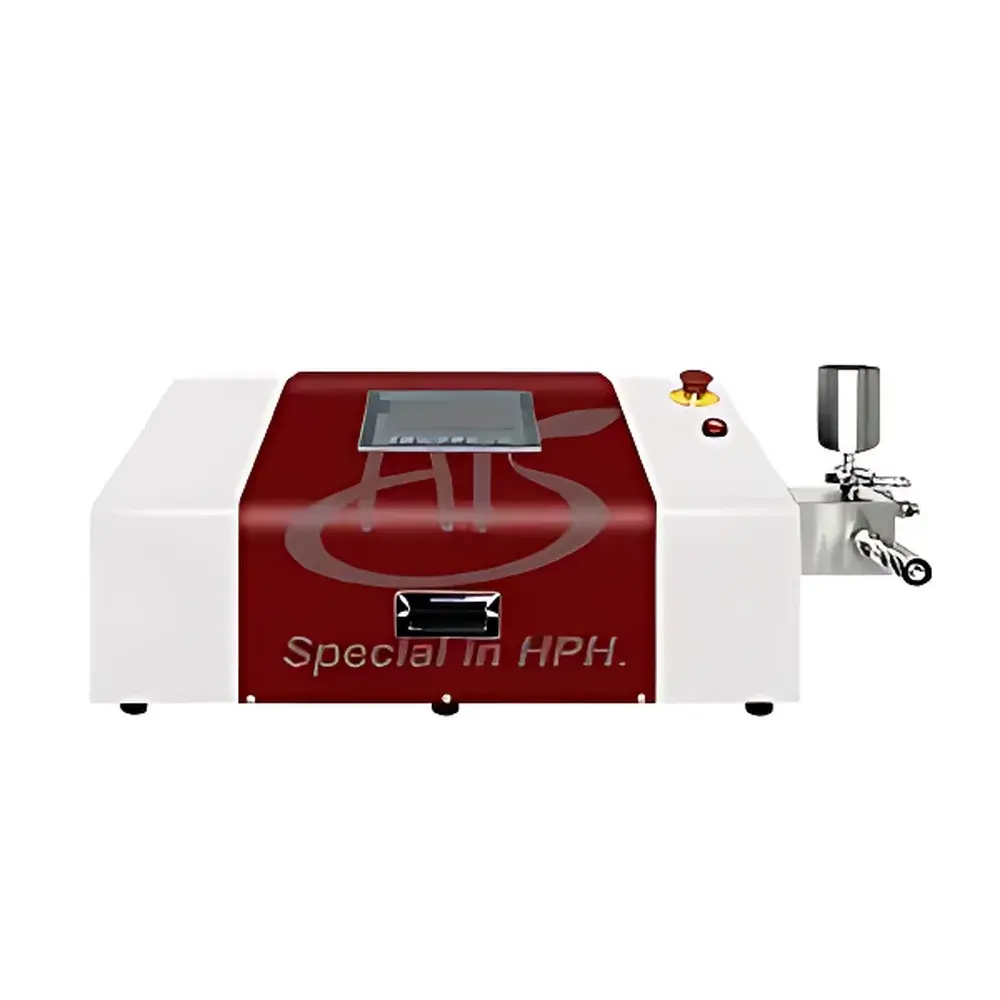
ATS AMH-NANO Microfluidic High-Pressure Homogenizer
| Brand | ATS |
|---|---|
| Origin | Jiangsu, China |
| Manufacturer Type | Direct Manufacturer |
| Country of Origin | China |
| Model | AMH-NANO |
| Price | Upon Request |
| Operating Pressure | 0–2200 bar |
| Flow Rate | 5–10 L/h |
| Minimum Sample Volume | 10 mL |
| Voltage | 380 V, 3-phase 4-wire |
| Power | 2.5 kW |
| Interaction Chamber Configuration | 300 µm Diamond Y/Z-Type Primary Chamber + 100 µm Diamond Secondary Chamber |
| Drive System | Servo Motor–Driven Electro-Hydraulic Cylinder |
| Control System | Siemens PLC + Emerson Servo Motion Control |
| Dimensions (W×D×H) | 950 × 460 × 360 mm |
| Weight | 50 kg |
Overview
The ATS AMH-NANO Microfluidic High-Pressure Homogenizer is an engineered solution for nanoscale particle size reduction, dispersion, and homogenization in R&D and pilot-scale applications. It operates on the principle of microfluidic interaction—where process fluid is pressurized to up to 2200 bar (32,000 psi) and forced through fixed-dimension diamond-based microchannels arranged in a Y- or Z-type geometry. This generates supersonic jet streams that collide with precise angular alignment, delivering intense, reproducible shear, cavitation, and impact forces. Unlike conventional valve-based high-pressure homogenizers, the AMH-NANO eliminates mechanical wear-induced variability by using non-adjustable, laser-machined diamond interaction chambers—ensuring absolute consistency across repeated runs and enabling direct scalability from lab to production without re-optimization.
Key Features
- Fixed-Dimension Diamond Interaction Chambers: Equipped with a primary 100 µm Y/Z-type diamond chamber and a secondary 300 µm diamond chamber, both fabricated from single-crystal synthetic diamond for extreme hardness, chemical inertness, and thermal stability—critical for GMP-compliant processing of sensitive biologics and nanomaterials.
- Servo-Electrohydraulic Drive Architecture: A closed-loop servo-controlled electro-hydraulic cylinder delivers constant force and pressure stability, eliminating the pulsation and mechanical fatigue associated with traditional crankshaft-driven systems—resulting in >99.7% uptime over 5,000 operational hours.
- Linear Scale-Up Capability: Process parameters—including pressure, flow rate, and chamber geometry—are intrinsically preserved during scale-up via parallel microchannel array design, allowing seamless transition from AMH-NANO (10 mL–10 L/h) to industrial microfluidizers (up to 200 L/h) without reformulation or revalidation.
- Integrated Industrial Control Platform: Siemens S7-1200 PLC paired with Emerson servo motion controllers enables programmable multi-step pressure ramping, real-time torque/pressure feedback, and audit-trail–ready event logging compliant with FDA 21 CFR Part 11 requirements.
- Compact Footprint & Low Maintenance Design: At 950 × 460 × 360 mm and 50 kg, the system fits standard fume hoods or ISO Class 5 cleanroom carts. The absence of sealing rings, adjustable valves, or high-frequency moving parts reduces scheduled maintenance intervals to once per 1,000 operating hours.
Sample Compatibility & Compliance
The AMH-NANO accommodates aqueous, organic, and viscous suspensions—including lipid nanoparticles (LNPs), protein formulations, polymer colloids, ceramic precursors, and conductive nanomaterial dispersions (e.g., graphene oxide, CNTs, nano-cellulose). Its all-diamond wetted path resists corrosion from aggressive solvents (e.g., chloroform, DMSO, ethanol/water blends) and alkaline buffers (pH 2–12). Validated for use under ISO 22412 (dynamic light scattering), USP <729> (liposome particle size), and ASTM E2492 (nanomaterial dispersion stability) test protocols. Optional IQ/OQ documentation packages support GLP and GMP environment deployment.
Software & Data Management
Control software provides full parameter scripting (pressure setpoint, dwell time, number of passes), automated pass counting, and export of timestamped CSV logs containing pressure, temperature, flow rate, and motor current. All data entries are digitally signed and immutable post-acquisition. Role-based user access (Operator, Technician, Administrator) enforces procedural integrity. Integration with LabVantage LIMS and Empower CDS is supported via OPC UA and Modbus TCP protocols—enabling traceability across analytical workflows and regulatory submissions.
Applications
- Pharmaceutical & Biotechnology: LNP encapsulation for mRNA delivery, cell lysis for subcellular fractionation, nanoemulsion preparation for IV/IN dosage forms, and sterile filtration bypass for heat-labile APIs.
- Cosmetics & Nutraceuticals: Transparent nanoemulsions for topical delivery, lipid-soluble vitamin dispersion (e.g., Vit D3, CoQ10), and stable pigment nanodispersions for color cosmetics.
- Food & Beverage: Cold-process milk homogenization, plant-based dairy alternatives (e.g., oat, almond), nanoencapsulated flavors, and fat crystal engineering for zero-trans margarines.
- Advanced Materials: Exfoliation and stabilization of 2D materials (graphene, MoS₂), dispersion of silicon anode slurries for Li-ion batteries, and uniform distribution of catalyst nanoparticles in PEM fuel cell membranes.
FAQ
What distinguishes microfluidic homogenization from conventional valve-based homogenization?
Microfluidic homogenizers use fixed-geometry diamond microchannels to generate repeatable hydrodynamic stress fields, whereas valve-based systems rely on adjustable mechanical gaps prone to erosion, drift, and batch-to-batch inconsistency.
Can the AMH-NANO be used for sterile processing?
Yes—when coupled with pre-sterilized, single-use diamond chambers and aseptic tubing kits, it supports ISO 13408-1 compliant processes for parenteral nanomedicine manufacturing.
Is pressure calibration traceable to NIST standards?
All factory-installed pressure transducers are calibrated against NIST-traceable deadweight testers, with calibration certificates provided upon delivery and annually thereafter.
What maintenance is required for long-term operation?
Routine checks include hydraulic oil level verification every 200 hours and chamber inspection every 500 hours; no lubrication or valve adjustments are necessary due to the solid-state drive architecture.
Does ATS provide application support for method development?
Yes—ATS offers remote and on-site technical support, including DOE-based parameter optimization, particle size correlation studies, and scalability assessments aligned with ICH Q5A and Q5C guidelines.
Related Products



