
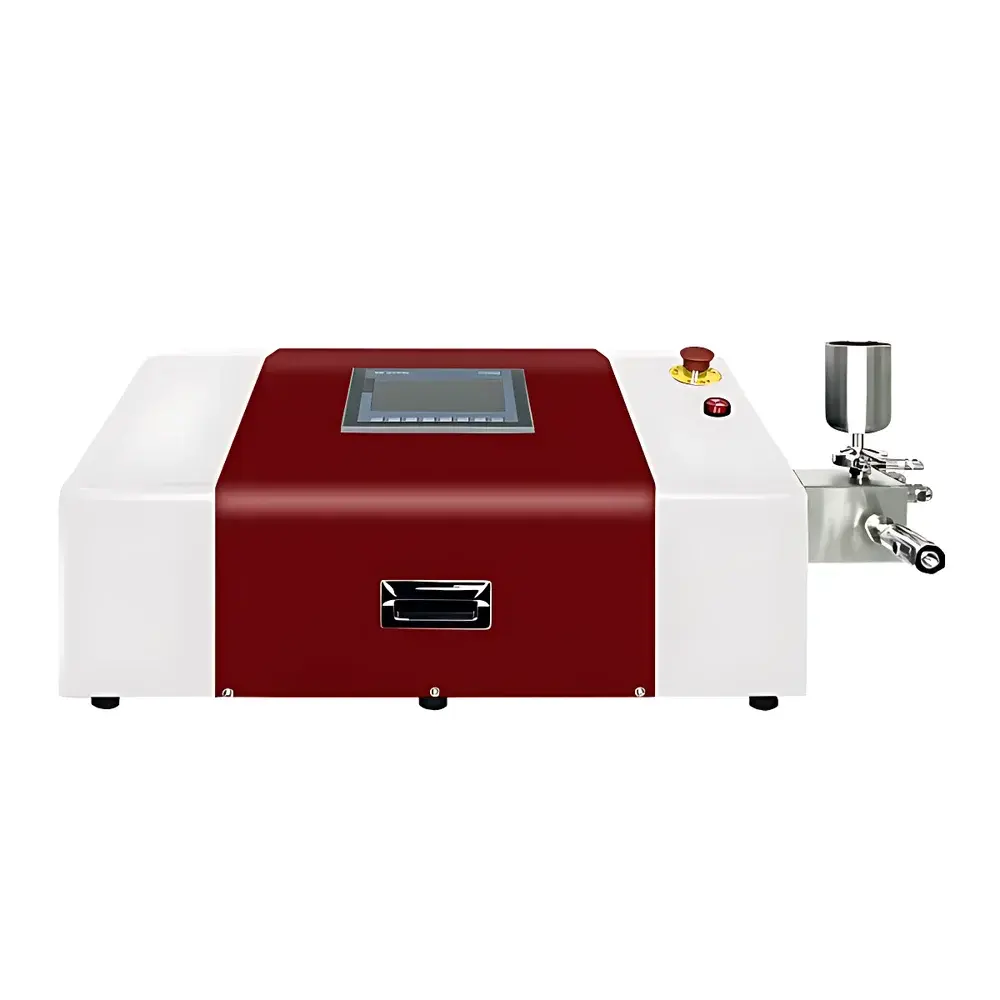
ATS AMH-NANO Microfluidic Homogenizer
| Brand | ATS |
|---|---|
| Origin | Jiangsu, China |
| Manufacturer Type | Authorized Distributor |
| Product Category | Domestic |
| Model | AMH-NANO |
| Instrument Type | Microfluidic Homogenizer |
| Dimensions (W×D×H) | 986×442×385 mm |
| Throughput | 5–10 L/h |
| Operating Pressure | 0–2200 bar |
| Minimum Sample Volume | 10 mL |
| Power Supply | 380 V AC, 3-phase 4-wire |
| Power Consumption | 2.5 kW |
| Chamber Configuration | 300 µm Diamond Fixed-Geometry Interaction Chamber (pre-chamber) + 100 µm Diamond Y/Z-Type Interaction Chamber (main chamber) |
| Drive System | Servo-electric direct-drive cylinder |
| Control System | Siemens PLC + Emerson servo motion control |
| Weight | 50 kg |
Overview
The ATS AMH-NANO Microfluidic Homogenizer is an engineered solution for high-pressure, high-reproducibility nanoscale particle size reduction and homogenization in laboratory-scale R&D environments. It operates on the principle of microfluidic interaction—where pressurized fluid is forced at supersonic velocities through fixed-geometry, micron-scale diamond channels (100 µm and 300 µm), generating intense shear, cavitation, and collision forces within a precisely controlled laminar flow regime. Unlike conventional valve-based high-pressure homogenizers that rely on adjustable gap geometry and turbulent impingement, the AMH-NANO employs a deterministic, geometry-defined interaction mechanism—ensuring intrinsic process consistency across repeated runs. This architecture delivers narrow particle size distributions (PSD), exceptional batch-to-batch repeatability, and scalable process transfer from lab to pilot or production—critical for applications governed by regulatory frameworks such as USP , ICH Q5A, and FDA 21 CFR Part 11-compliant data integrity requirements.
Key Features
- Fixed-geometry diamond interaction chambers (100 µm Y/Z-type main chamber + 300 µm pre-chamber) eliminate mechanical wear-induced variability and ensure absolute geometric reproducibility across thousands of cycles.
- Servo-electric direct-drive hydraulic intensification system delivers stable, pulse-free pressure output up to 2200 bar with sub-bar pressure resolution and real-time closed-loop feedback control.
- Siemens S7-1200 PLC integrated with Emerson servo motion controllers enables deterministic actuation timing, programmable multi-step pressure ramps, and full audit trail logging compliant with GLP/GMP documentation standards.
- Compact footprint (986 × 442 × 385 mm) and modular chamber design support rapid interchange between chamber configurations without recalibration—ideal for formulation screening across diverse material classes.
- Low thermal load design minimizes sample temperature rise (<3 °C per pass at 1000 bar), preserving thermolabile biologics, liposomes, and protein conjugates during processing.
Sample Compatibility & Compliance
The AMH-NANO accommodates aqueous suspensions, oil-in-water and water-in-oil emulsions, colloidal dispersions, cell lysates, and viscous polymer solutions—with demonstrated compatibility across viscosities up to 500 mPa·s (at 25 °C). Its all-wetted-path components are constructed from 316L stainless steel, ceramic-coated pistons, and single-crystal diamond microchannels—meeting ASTM F86 surface finish specifications and ISO 10993-5 cytocompatibility criteria for pharmaceutical-grade processing. The system supports IQ/OQ protocols and integrates seamlessly into validated workflows requiring traceable parameter logging, electronic signatures, and 21 CFR Part 11-compliant user access controls.
Software & Data Management
The embedded HMI interface provides intuitive operation via a 7-inch touchscreen with dual-language (English/Chinese) support and configurable recipe storage (≥100 protocols). All process parameters—including pressure setpoint, dwell time, total passes, inlet temperature, and real-time pressure/flow transients—are timestamped and exported in CSV or PDF format. Optional Ethernet/IP connectivity enables remote monitoring via SCADA systems and synchronization with LIMS platforms using OPC UA protocol. Audit trails include operator ID, timestamp, parameter changes, and system alarms—fully aligned with ALCOA+ data integrity principles.
Applications
- Pharmaceutical & Biotechnology: Liposomal drug encapsulation (e.g., doxorubicin, mRNA-LNPs), nanoemulsion IV formulations, viral vector purification, and Gram-negative bacterial cell disruption for inclusion body recovery.
- Cosmeceuticals & Nutraceuticals: Stable lipid nanoparticles for topical retinoid delivery, transparent hyaluronic acid micelles, and cold-processed botanical extracts with enhanced bioavailability.
- Advanced Materials: Exfoliation of graphene oxide and transition metal dichalcogenides (TMDs), dispersion of carbon nanotubes in epoxy matrices, and deagglomeration of silicon anode slurries for solid-state battery R&D.
- Food Science: Cold homogenization of plant-based dairy alternatives, stabilization of omega-3 enriched beverages, and enzymatic activity preservation in functional ingredient emulsions.
FAQ
What distinguishes microfluidic homogenization from conventional high-pressure homogenization?
Microfluidic homogenizers use fixed-geometry diamond interaction chambers to generate repeatable, laminar microjet collisions—whereas valve-based systems rely on variable-gap turbulent impingement, introducing inherent mechanical drift and broader PSD.
Can the AMH-NANO be used for sterile processing?
Yes—the system supports SIP-compatible chamber sterilization (121 °C, 20 min) and can be integrated with aseptic sampling manifolds and sterile filtration modules for GMP-compliant operations.
Is process scalability supported?
Absolutely—the linear scale-up principle—maintaining identical channel geometry while increasing parallel channel count and pump displacement—is validated from AMH-NANO (lab) to AMH-PRO series (pilot/production), preserving Dv50 and PDI values within ±5% across scales.
What maintenance intervals are recommended for diamond chambers?
Under standard operating conditions (≤1500 bar, aqueous buffers), diamond chambers exceed 500 operational hours before requiring inspection; wear is monitored via pressure decay rate and PSD shift analysis—not scheduled replacement.
Does the system comply with electrical safety standards for international laboratories?
Yes—it carries CE marking per EN 61000-6-2/6-4 and meets UL 61010-1 requirements for laboratory equipment, including reinforced insulation, emergency stop circuitry, and IP54-rated enclosure protection.



