
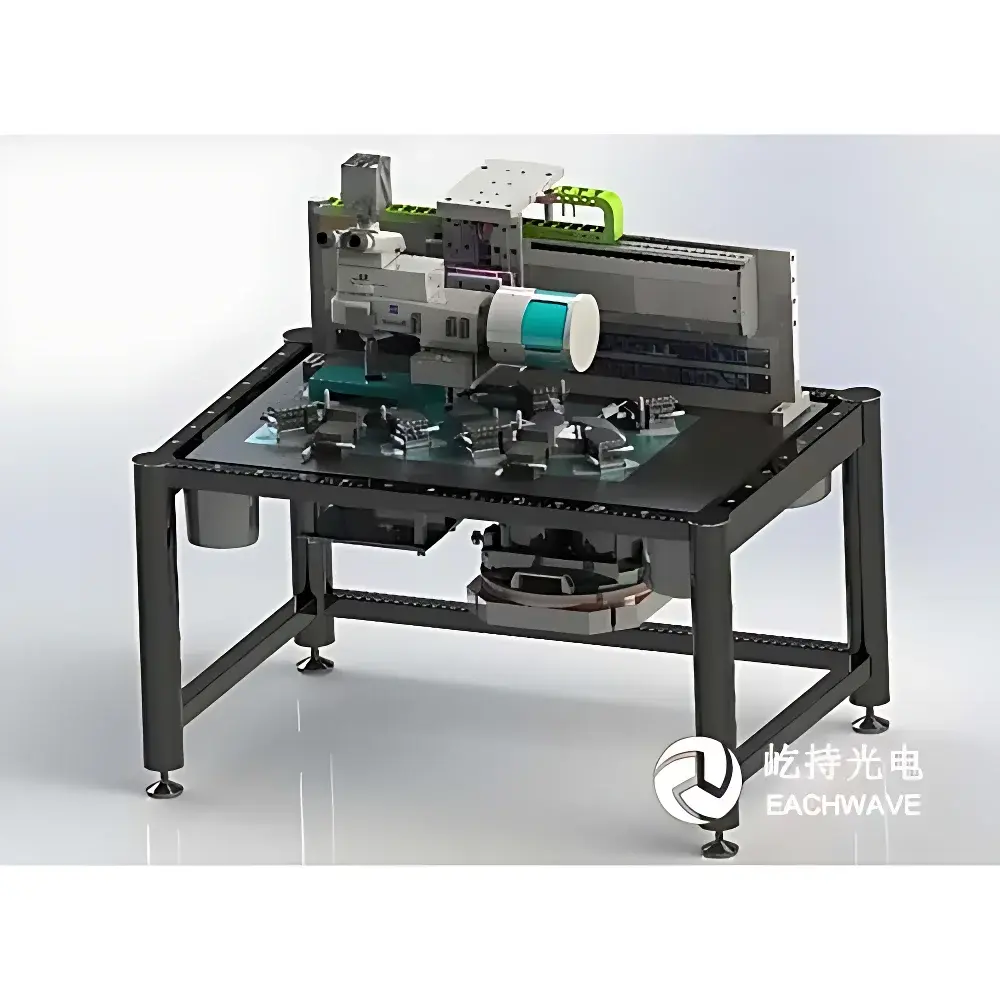
ATS Kerr Microscope Platform for Magneto-Optic Kerr Effect (MOKE) Characterization
| Brand | ATS |
|---|---|
| Origin | Singapore |
| Manufacturer Type | Authorized Distributor |
| Origin Category | Imported |
| Model | Kerr Microscope |
| Price Range | USD 68,000 – 136,000 |
| Magnetic Field | Up to 1.2 T (perpendicular), up to 0.8 T (in-plane) |
| Optical Resolution | Sub-micron (dependent on objective lens) |
| Wavelength Range | 405–1550 nm (configurable) |
| Imaging Frame Rate | Up to 100 fps (full FOV), real-time video acquisition |
| Sample Stage | Motorized XYZ + tilt, vacuum-compatible option available |
| Environmental Control | Temperature-stabilized optical platform, RH < 60 % recommended |
| Power Supply | 220 V, 50 Hz |
Overview
The ATS Kerr Microscope Platform is a precision-engineered magneto-optic Kerr effect (MOKE) characterization system designed for quantitative, spatially resolved investigation of magnetization dynamics in thin-film and 2D magnetic materials. Based on the polar, longitudinal, and transverse MOKE configurations—each governed by the interaction between linearly polarized incident light and the magnetization-induced dielectric tensor perturbation—the platform enables direct, non-contact, nanosecond-to-second scale visualization of domain nucleation, wall motion, and switching pathways under controlled magnetic, electrical, and optical stimuli. Unlike single-point hysteresis loop analyzers, this system captures full-field magnetization vector evolution across >1 million pixels per frame, delivering time-resolved domain maps with sub-micron spatial fidelity. Its modular architecture supports integration into cleanroom-compatible labs or university spintronics facilities, meeting the technical demands of both fundamental research (e.g., skyrmion dynamics, interfacial Dzyaloshinskii-Moriya interaction mapping) and industrial process development (e.g., MRAM stack qualification, spin-orbit torque efficiency benchmarking).
Key Features
- High-fidelity MOKE imaging using a Carl Zeiss microscope optical train, featuring interchangeable eyepiece/camera observation paths and an automated high-precision analyzer module with <±0.05° angular resolution.
- Multi-stimulus excitation capability: programmable DC/AC magnetic fields (vertical up to 1.2 T, in-plane up to 0.8 T), synchronized current injection (via Keithley 6221/2400 source-measure units), and optional microwave excitation (Tetronics RF sources) for ST-FMR and spin-torque ferromagnetic resonance studies.
- Intelligent multi-wavelength illumination system with independent control over incidence angle, spectral band (405 nm to 1550 nm), intensity, and modulation frequency—enabling wavelength-dependent contrast optimization and pump-probe MOKE spectroscopy.
- Air-bearing optical vibration isolation platform compliant with ISO 20816-1 Class A requirements for high-sensitivity differential polarization detection.
- Motorized XYZ sample stage with ±5° tilt adjustment, compatible with cryogenic and ultra-high vacuum (UHV) upgrade paths for low-temperature (<4 K) and surface-sensitive measurements.
Sample Compatibility & Compliance
The platform accommodates standard 10 mm × 10 mm to 50 mm × 50 mm planar samples—including sputtered/perovskite oxide heterostructures, CoFeB/MgO multilayers, CrI3, Fe3GeTe2, and topological insulator-based heterojunctions. All electrical interfaces conform to IEC 61000-4-5 surge immunity standards; magnetic field coils are thermally stabilized and include integrated Hall sensor feedback for closed-loop field calibration traceable to NIST standards. The system architecture supports GLP-compliant operation: audit trails for instrument configuration changes, user access logs, and timestamped raw image metadata are automatically generated and exportable in HDF5 format per IEEE 1857.1 recommendations.
Software & Data Management
Control and analysis are executed via MOKE Studio™ v4.x—a Python-based, modular application framework supporting real-time image acquisition, dynamic domain tracking (using GPU-accelerated optical flow algorithms), and quantitative magnetization vector reconstruction. All measurement protocols—including field sweeps, current pulses, and laser-triggered sequences—are scriptable via JSON-defined experiment templates. Raw data files include embedded EXIF-style metadata (field amplitude, current density, wavelength, exposure time, analyzer angle). Export options include TIFF (16-bit), CSV (domain centroid trajectories), and MATLAB .mat formats. The software complies with FDA 21 CFR Part 11 requirements for electronic records and signatures when deployed with network authentication and role-based permissions enabled.
Applications
- Current-induced domain wall velocity quantification in Pt/Co/Ta stacks under varying spin-Hall angle conditions.
- Vector-domain imaging of chiral magnetic textures (skyrmions, antiskyrmions) under in-plane field rotation, enabling DMI constant extraction via symmetry analysis.
- Time-resolved MOKE studies of ultrafast demagnetization in ferrimagnetic GdFeCo following femtosecond laser excitation (when upgraded with integrated pump-probe optics).
- Spin-orbit torque efficiency (ξDL) mapping across wafer-scale magnetic tunnel junction test structures using pixel-wise harmonic lock-in analysis.
- Interfacial exchange bias characterization in IrMn/CoFe bilayers via temperature-dependent MOKE hysteresis loop series (with cryogenic upgrade).
FAQ
What magnetic field configurations does the base system support?
The standard configuration includes independent perpendicular (z-axis) and in-plane (x/y-axis) electromagnets, each with closed-loop Hall sensor feedback and programmable ramp rates from 0.01 T/s to 10 T/s.
Can the system perform time-resolved measurements at nanosecond resolution?
Yes—when equipped with the optional high-speed CMOS camera (12-bit, 1024 × 1024 @ 1,000 fps) and synchronized pulsed current/magnetic field triggers, temporal resolution down to 10 ns is achievable for transient switching studies.
Is vacuum or cryogenic operation supported out-of-the-box?
No—these are optional upgrades. The base system operates in ambient air; the cryo-vacuum module includes a 4 K closed-cycle cryostat, UHV chamber (10−9 mbar base pressure), and in-chamber electrical feedthroughs rated to 100 mA DC.
Does the software support automated protocol execution for unattended overnight runs?
Yes—MOKE Studio™ includes scheduler functionality with failure recovery, email alerts, and automatic dataset versioning to prevent overwrite during long-duration hysteresis or temperature sweep experiments.
Are calibration certificates provided for magnetic field and optical intensity?
Each delivered system includes factory calibration reports traceable to national metrology institutes (NMI Singapore and PTB Germany) for field strength, analyzer angular position, and relative spectral irradiance—valid for 12 months from commissioning.





