
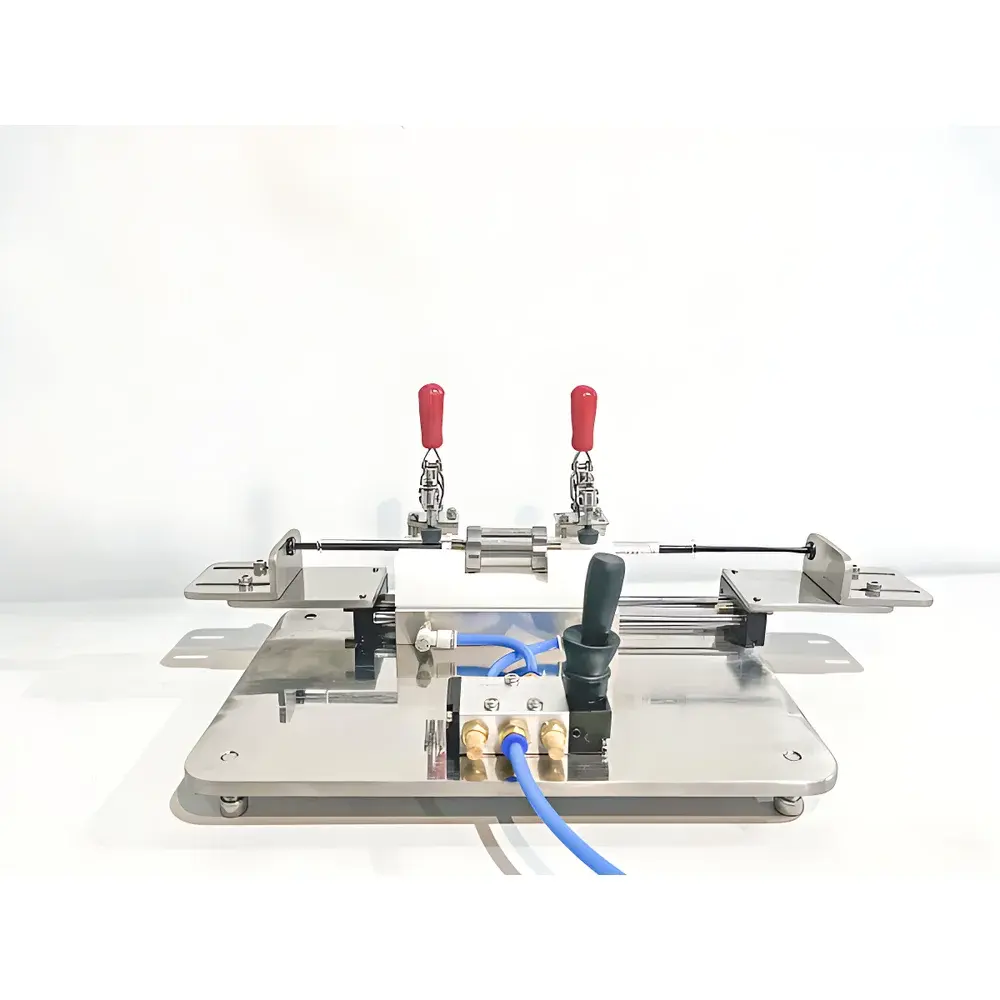
ATS LF-1 Pneumatic Liposome Extruder Stand
| Brand | ATS |
|---|---|
| Origin | Jiangsu, China |
| Manufacturer Type | Direct Manufacturer |
| Product Category | Domestic |
| Model | LF-1 Pneumatic Stand |
| Carrier Type | Liposomes |
| Construction Material | Anodized Aluminum Alloy |
| Actuation Method | Pneumatically Driven Linear Force Application |
| Compatibility | Designed exclusively for ATS LF-1 Liposome Extrusion Devices |
Overview
The ATS LF-1 Pneumatic Liposome Extruder Stand is an engineered mechanical support system designed to replace manual force application during liposome extrusion using the widely adopted ATS LF-1 extrusion platform. It operates on a controlled pneumatic actuation principle, converting regulated compressed air into consistent linear displacement and force delivery to the extruder’s plunger assembly. This eliminates operator-dependent variability in extrusion pressure and stroke velocity—two critical parameters influencing vesicle size distribution, polydispersity index (PDI), and batch-to-batch reproducibility in nanoliposomal formulation development. Unlike hand-operated extrusion stands, the LF-1 Pneumatic Stand delivers repeatable force profiles across multiple extrusion cycles, supporting both research-scale optimization and early-stage process transfer toward GMP-aligned nanomedicine manufacturing.
Key Features
- Pneumatic force transmission with adjustable pressure regulation (0–6 bar typical operating range), enabling precise control over extrusion force without manual fatigue or inconsistency.
- Anodized aluminum alloy construction ensures structural rigidity, corrosion resistance, and lightweight portability—critical for shared core facilities and cleanroom-compatible workflows.
- Direct mechanical coupling to the ATS LF-1 extruder body maintains original alignment tolerances and seal integrity, preserving the device’s validated extrusion performance with polycarbonate or track-etched membranes (e.g., 50 nm, 100 nm, 200 nm pore sizes).
- Integrated pressure gauge and fine-tuning valve allow real-time monitoring and incremental adjustment of applied force, facilitating method development under defined mechanical stress conditions.
- Modular mounting interface supports integration with laboratory-grade air supply systems compliant with ISO 8573-1 Class 3/4 purity standards for oil-free, particle-controlled compressed air.
Sample Compatibility & Compliance
The LF-1 Pneumatic Stand is validated for use with aqueous lipid dispersions, including DOPC, DSPC, cholesterol, and PEGylated lipid formulations, across standard extrusion temperatures (4–25 °C). It maintains compatibility with all membrane types certified for the LF-1 platform—including sterile-filtered, low-binding polycarbonate membranes meeting USP particulate matter requirements. While the stand itself is not a medical device, its design aligns with principles outlined in ICH Q5A(R2) and Q5B for consistent physical processing of biopharmaceutical nanocarriers. Documentation packages support GLP-compliant recordkeeping, including calibration logs for pressure regulators and maintenance records for pneumatic components.
Software & Data Management
The LF-1 Pneumatic Stand operates as a hardware-only module without embedded electronics or digital connectivity. However, it is fully compatible with third-party data acquisition systems via analog pressure transducer outputs (0–10 V or 4–20 mA optional add-on). Users may integrate pressure and cycle count data into LIMS or ELN platforms using standard industrial protocols (Modbus RTU, OPC UA). For audit-trail compliance under FDA 21 CFR Part 11, laboratories are advised to pair the stand with validated electronic lab notebooks that capture timestamped extrusion parameters—including applied pressure, number of passes, ambient temperature, and membrane lot numbers—as part of standardized SOPs.
Applications
- Preclinical liposome formulation development requiring narrow size distribution (e.g., <120 nm target diameter with PDI <0.15).
- Scale-down modeling for extrusion process validation in nanoparticle manufacturing, supporting Quality-by-Design (QbD) frameworks per ICH Q8(R2).
- Stability studies involving repeated extrusion cycles under identical mechanical conditions to assess vesicle fusion or aggregation kinetics.
- Training environments where standardized extrusion technique must be taught without inter-operator variability.
- High-throughput screening of lipid composition effects on extrusion efficiency and final particle morphology.
FAQ
Is the LF-1 Pneumatic Stand compatible with extruders from other manufacturers?
No—it is mechanically and dimensionally engineered only for the ATS LF-1 extruder body and plunger assembly.
Does the stand include a compressed air source?
No—users must provide a clean, dry, oil-free compressed air supply meeting ISO 8573-1 Class 3 specifications.
Can extrusion pressure be logged automatically?
Not natively; however, analog output options enable integration with external DAQ systems for continuous pressure logging.
What maintenance is required for long-term reliability?
Quarterly inspection of O-rings, lubrication of linear guide rails with silicone-free grease, and annual calibration of the integrated pressure gauge.
Is the stand suitable for use in ISO Class 5 cleanrooms?
Yes—when paired with appropriate air filtration and operated with non-shedding gloves, its anodized aluminum surface meets ISO 14644-1 cleanliness requirements for Class 5 environments.



