
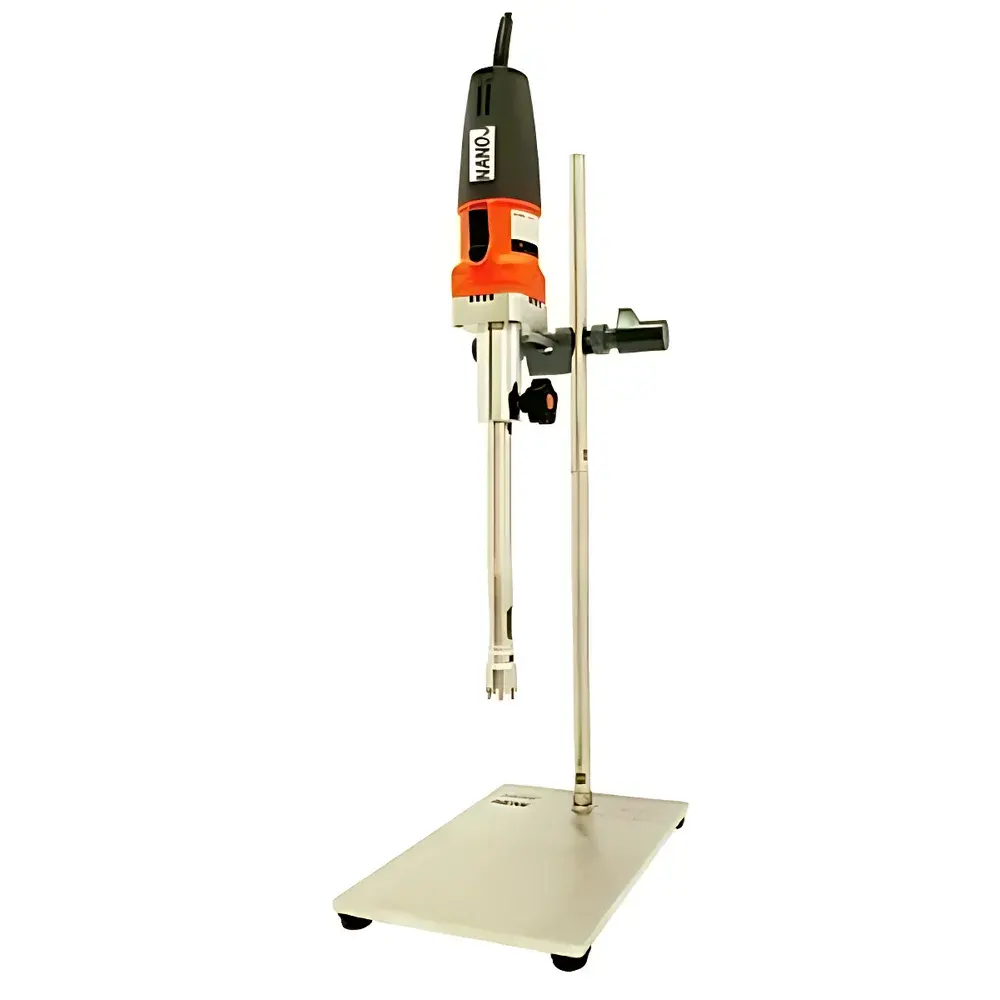
ATS NANOJ-H10 High-Shear Homogenizer
| Brand | ATS |
|---|---|
| Origin | Canada |
| Manufacturer Type | Direct Manufacturer |
| Origin Category | Imported |
| Model | NANOJ-H10 |
| Instrument Type | High-Pressure Rotor-Stator Homogenizer |
| Dimensions (W×D×H) | 280 × 450 × 260 mm |
| Processing Volume Range | 100–5000 mL |
| Input Power | 500 W |
| Output Power | 320 W |
| Power Supply | 220 V / 50 Hz |
| Speed Range | 10,000–28,000 rpm |
Overview
The ATS NANOJ-H10 High-Shear Homogenizer is a precision-engineered rotor-stator homogenization system designed for laboratory-scale dispersion, emulsification, and particle size reduction across demanding scientific and industrial applications. Operating on the principle of high-velocity mechanical shear generated within a precisely engineered stator-rotor gap, the NANOJ-H10 subjects fluid samples to intense hydrodynamic cavitation, turbulent mixing, and extensional flow—enabling rapid and reproducible breakdown of aggregates, stabilization of oil-in-water or water-in-oil emulsions, and uniform dispersion of nanoparticles, polymers, or biological suspensions. Its compact benchtop architecture integrates a high-efficiency brushless motor with thermal overload protection and an optimized gear-driven transmission, delivering consistent torque across the full 10,000–28,000 rpm operating range. Engineered for reliability in regulated environments, the unit complies with IEC 61000-6-2 (EMC immunity) and IEC 61000-6-4 (EMC emission) standards, and its electrical insulation meets double-insulation Class II safety requirements per IEC 61140.
Key Features
- Robust German-derived mechanical platform with original high-precision rotor-stator assemblies ensuring long service life and minimal maintenance intervals
- Dual-layer electrical insulation system compliant with IEC 61140 Class II safety standards for operator protection in wet or humid lab environments
- Modular interchangeable work heads—including conical, flat-blade, and high-turbulence configurations—to accommodate viscosity ranges from 5,000 mPa·s (polymer melts or pastes)
- Ergonomic lightweight chassis (net weight: ~12.5 kg) supporting both fixed mounting on universal lab stands and handheld operation for flexible workflow integration
- Quick-release coupling mechanism enabling tool-free disassembly of the entire drive shaft and work head assembly in under 30 seconds for cleaning or sterilization
- Chemically resistant stainless-steel (AISI 316) wetted parts compatible with aqueous, organic, and mildly corrosive solvents; fully autoclavable at 121°C for GMP-compliant bioprocessing use
Sample Compatibility & Compliance
The NANOJ-H10 accommodates heterogeneous samples spanning pharmaceutical suspensions (e.g., bacterial cell resuspension, primary emulsion preparation), nanostructured formulations (liposomes, polymeric nanoparticles, quantum dot dispersions), food-grade emulsions (mayonnaise analogs, plant-protein beverages), and industrial colloids (latexes, pigment dispersions, functional coatings). All contact surfaces meet ISO 8573-1:2010 purity class 4 for compressed air–assisted cleaning validation and are certified non-pyrogenic per USP . The device supports GLP/GMP documentation workflows through optional traceable calibration logs (speed verification via calibrated tachometer) and is suitable for IQ/OQ protocols under FDA 21 CFR Part 11–enabled software environments when integrated with validated data acquisition systems.
Software & Data Management
While the NANOJ-H10 operates as a stand-alone analog-controlled instrument, its speed control interface features a 0–10 V analog input port compatible with third-party PID controllers, PLCs, or LabVIEW-based automation platforms. For audit-trail compliance, users may integrate the unit into validated SCADA or LIMS ecosystems using external digital tachometers and programmable logic relays. Optional firmware-upgradable digital speed controllers (sold separately) provide RS-485 Modbus RTU communication, real-time RPM logging, and password-protected parameter locking—supporting electronic record retention per ALCOA+ principles and facilitating 21 CFR Part 11 compliance when paired with qualified electronic signature modules.
Applications
- Pharmaceutical development: Preparation of submicron emulsions for parenteral delivery, homogenization of monoclonal antibody formulations, and reconstitution of lyophilized microbial cultures
- Nanomaterial synthesis: Exfoliation of 2D materials (graphene oxide, MXenes), stabilization of metal-organic frameworks (MOFs), and size-controlled dispersion of TiO₂ or SiO₂ nanoparticles
- Food science: Production of cold-process dairy alternatives, uniform fat globule distribution in plant-based creams, and enzymatic reaction homogenization
- Industrial R&D: Viscosity-controlled dispersion of carbon black in rubber compounds, asphalt emulsification for road surfacing, and rheological conditioning of water-based adhesives
- Academic research: Shear-rate-dependent viscosity profiling, emulsion stability screening (creaming/sedimentation kinetics), and high-throughput formulation optimization
FAQ
What is the maximum recommended continuous operating time per cycle?
For optimal thermal management and bearing longevity, continuous operation should not exceed 3 minutes at speeds above 22,000 rpm; intermittent duty cycles (e.g., 2 min ON / 1 min OFF) are advised for extended processing.
Can the NANOJ-H10 be used for sterile processing in aseptic environments?
Yes—provided all wetted components are pre-sterilized via autoclaving (121°C, 20 min) and the unit is operated within ISO Class 5 laminar flow hoods using validated aseptic techniques.
Is speed calibration traceable to national metrology institutes?
Calibration certificates (NIST-traceable tachometer verification) are available upon request and must be performed annually or after 500 operational hours, whichever occurs first.
Does the device support explosion-proof operation in solvent-rich environments?
The standard NANOJ-H10 is not ATEX-certified; however, an intrinsically safe version with Ex d IIB T4 rating can be commissioned as a custom configuration.
What maintenance schedule is recommended for routine use?
Lubrication-free magnetic coupling design eliminates routine grease servicing; quarterly inspection of rotor concentricity and stator gap tolerance (±0.02 mm) using optical alignment tools is advised.



