
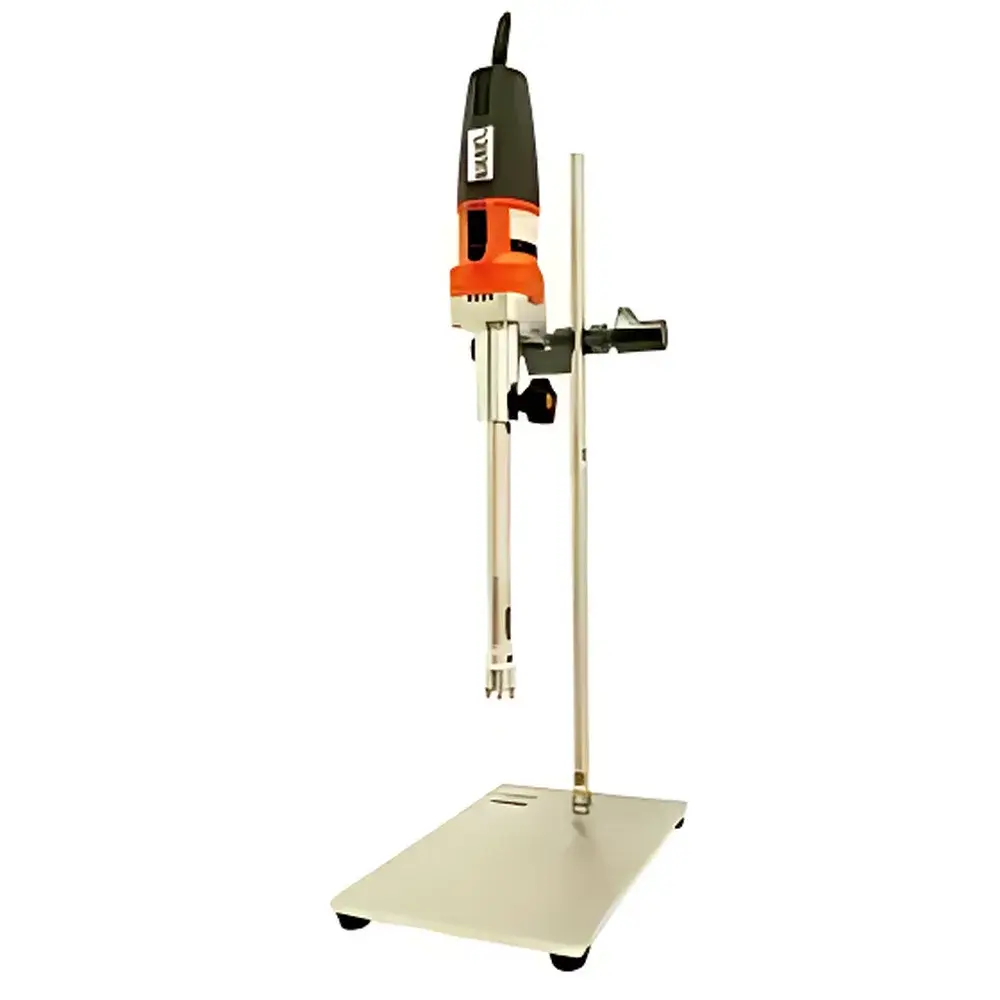
ATS NANOJ H10 High-Speed Shear Homogenizer
| Brand | ATS |
|---|---|
| Origin | Canada |
| Manufacturer | ATS (Original Equipment Manufacturer) |
| Product Type | Imported |
| Model | H10 |
| Instrument Category | High-Shear Cell Disruptor |
| Motor | German-sourced, industrial-grade |
| Bearing | SKF |
| Power | 0.5 kW |
| Voltage | 220 V, 50 Hz |
| Speed Range | 10,000–28,000 rpm (7-step infinitely variable control) |
| Tip Linear Velocity | up to 28.5 m/s |
| Net Weight | 9 kg |
| Batch Volume | 100–5,000 mL (tested in water |
| Protection Rating | IP55 |
| Insulation Class | F |
| Explosion-Proof | No |
| Rotor/Stator Material | Stainless Steel SUS304 or optional SUS316L |
Overview
The ATS NANOJ H10 is a high-speed shear homogenizer engineered for precise mechanical disruption, emulsification, and nano-scale dispersion in research and production environments. Operating on the principle of rotor-stator high-shear hydrodynamic cavitation, the device subjects fluid samples to intense localized shear gradients, turbulent flow, and controlled cavitation—enabling efficient cell lysis, particle size reduction, and stable emulsion formation. Designed for benchtop flexibility, the unit features vertical mounting on an adjustable stainless-steel stand (with optional handheld operation), supporting both downward suction and lateral upward discharge to ensure complete sample turnover and minimal dead volume. Its compact footprint, modular construction, and robust thermal management allow sustained operation under demanding process conditions—particularly where reproducible sub-micron dispersion or rapid microbial cell disruption is required.
Key Features
- German-sourced industrial motor with Class F insulation and integrated thermal protection, rated for continuous duty at speeds up to 28,000 rpm
- SKF precision bearings ensuring long-term rotational stability and low-vibration performance across all speed ranges
- Seven-step infinitely variable speed control (10,000–28,000 rpm) with digital tachometer feedback for process repeatability
- Maximum tip linear velocity of 28.5 m/s, generating shear rates exceeding 10⁵ s⁻¹ in standard configurations—sufficient for Gram-positive bacterial lysis and liposome extrusion
- Interchangeable rotor-stator heads in SUS304 (standard) or corrosion-resistant SUS316L (optional), compatible with CIP/SIP protocols
- IP55-rated enclosure providing protection against dust ingress and low-pressure water jets—suitable for shared lab environments with routine wet cleaning
- Low-inertia drive train and balanced impeller assembly minimizing mechanical resonance during high-speed operation
Sample Compatibility & Compliance
The NANOJ H10 accommodates a broad range of sample types—including viscous suspensions (e.g., yeast pastes), heat-sensitive biologics (e.g., plasmid-containing lysates), and non-aqueous systems (e.g., silicone oil emulsions). Batch volumes span 100–5,000 mL depending on formulation rheology; optimal performance is achieved with Newtonian or mildly pseudoplastic fluids (viscosity < 5,000 mPa·s at 25°C). The system complies with IEC 61000-6-2 (immunity) and IEC 61000-6-4 (emission) standards. While not intrinsically explosion-proof, its non-sparking construction and grounding provisions meet general laboratory safety requirements per CSA Z305 and ANSI/ASSP Z10. Documentation supports GLP-compliant validation per ASTM E2500 and ISO/IEC 17025 traceability frameworks.
Software & Data Management
The NANOJ H10 operates as a standalone analog-controlled instrument without embedded firmware or network connectivity. All operational parameters—including speed setpoint, runtime, and manual start/stop—are managed via front-panel controls. For regulated environments, users may integrate external data loggers (e.g., Omega OM-DAQPRO-5300) to record real-time RPM and motor current. Audit trails, electronic signatures, and 21 CFR Part 11 compliance are achievable only through third-party SCADA or LIMS integration—no native software or USB interface is provided. Calibration certificates for speed accuracy (±1.5% full scale) and torque response are supplied with each unit.
Applications
- Pharmaceutical development: Bacterial cell disruption for inclusion body recovery; pre-emulsion preparation for nanostructured lipid carriers (NLCs)
- Biotechnology: Rapid lysis of E. coli, Bacillus, and yeast strains prior to chromatographic purification
- Nanomaterial synthesis: Exfoliation of graphene oxide dispersions; stabilization of metal-organic framework (MOF) colloids
- Food science: Homogenization of plant-based dairy alternatives and functional ingredient emulsions
- Industrial chemistry: Preparation of stable pesticide suspensions (SC formulations) and asphalt emulsions for road surfacing
- Academic research: Method development for scalable nanoemulsion generation under defined shear history
FAQ
What is the recommended maintenance interval for the rotor-stator assembly?
Inspect the rotor-stator gap and surface finish every 200 operating hours; replace if radial runout exceeds 0.05 mm or visible pitting is observed.
Can the NANOJ H10 be used for sterile processing?
Yes—SUS316L heads and autoclavable components support sterilization at 121°C for 20 minutes; validate sterility assurance level (SAL) per ISO 11138-3 when used in aseptic workflows.
Is there a validated method for correlating rpm to energy input (kWh/L)?
No universal correlation exists due to fluid-dependent power draw; users must perform calorimetric calibration using a reference fluid (e.g., glycerol/water mixtures) per ISO 14577 Annex D.
Does ATS provide IQ/OQ documentation templates?
Yes—qualified installation and operational qualification protocols compliant with EU GMP Annex 15 and USP are available upon request with purchase.
What is the maximum allowable solid content for continuous processing?
For batch operation, solids loading should not exceed 30% w/w in low-viscosity media; above this threshold, progressive clogging of the stator slots may occur without periodic flushing.






