
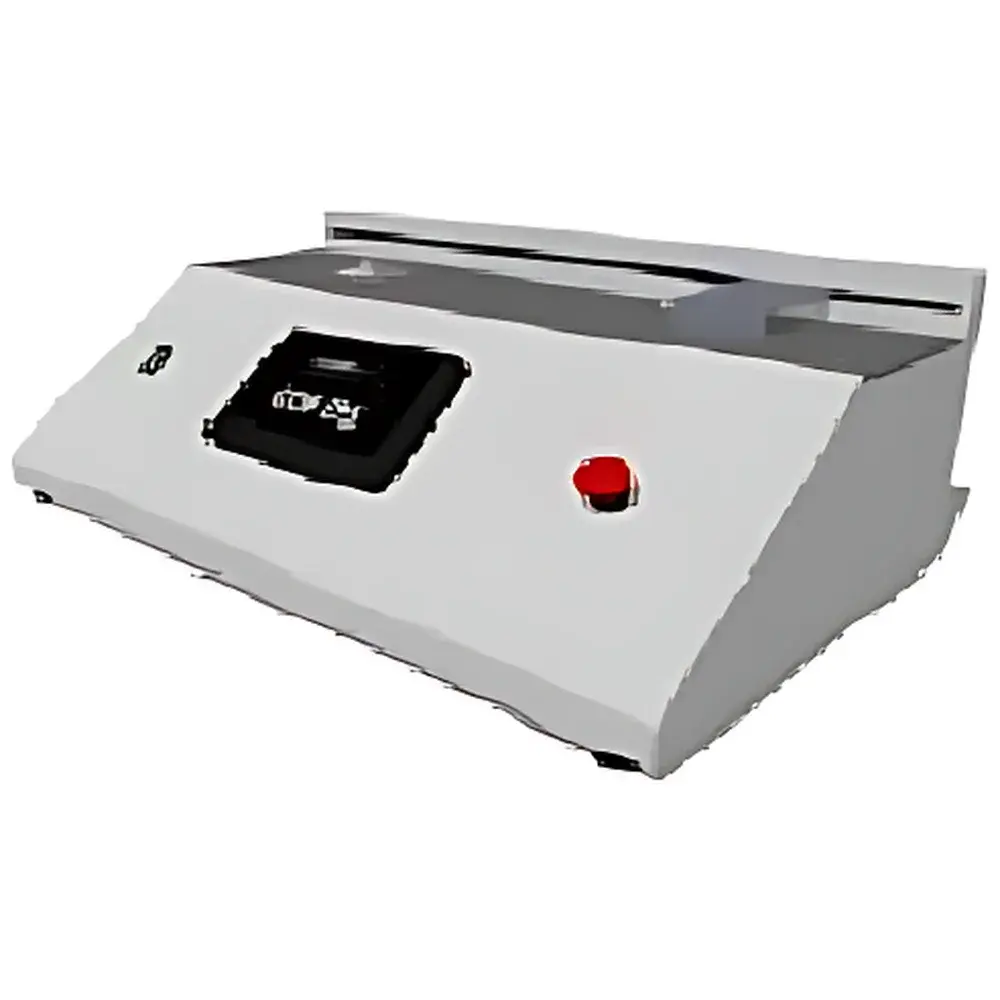
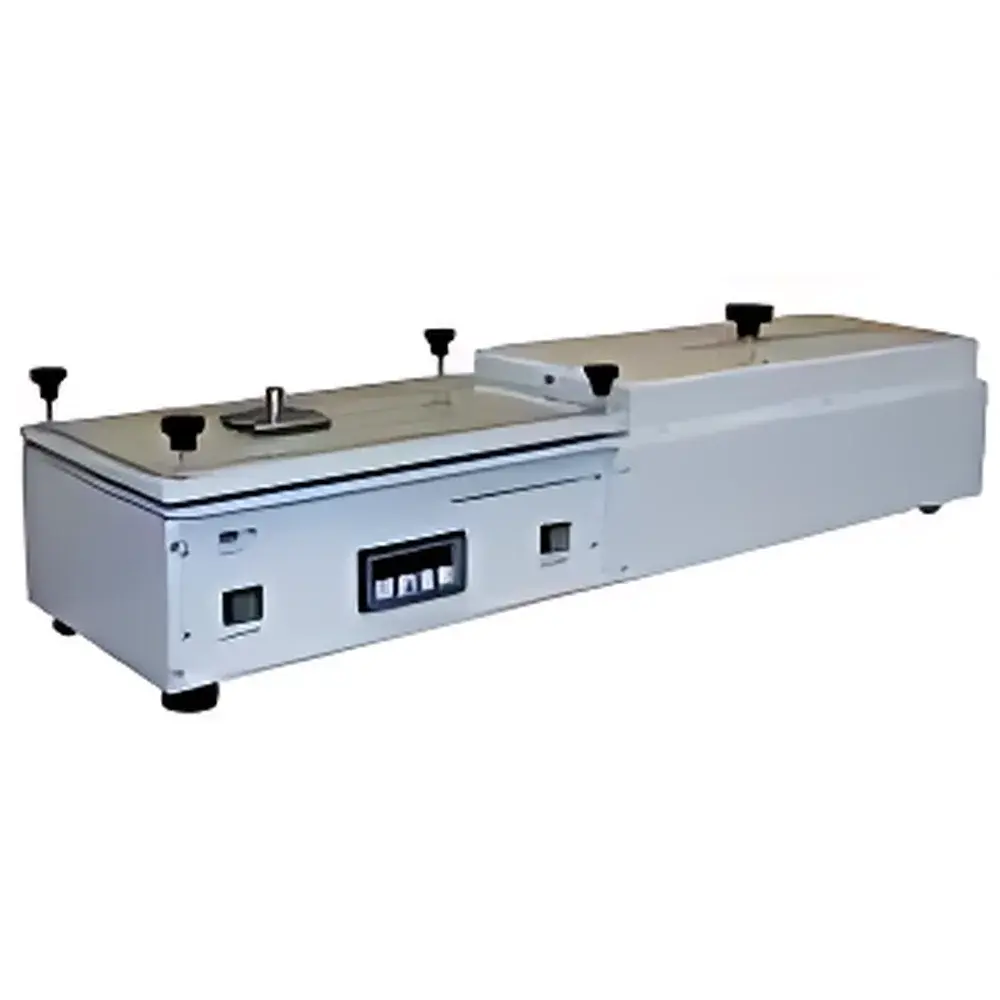
ATSFAAR 00100112 Static and Dynamic Coefficient of Friction Tester
| Brand | ATSFAAR |
|---|---|
| Origin | Italy |
| Model | 00100112 |
| Load Cell Capacity | 2000 g |
| Slider Dimensions | 63.5 × 63.5 mm |
| Standard Slider Mass | 200 g |
| Test Speed Range | 1–900 mm/min |
| Total Slider Travel | 400 mm |
| Test Area | 200 × 400 mm |
| Temperature Control Option | 0–120 °C |
| Data Output | USB interface |
| Compliance Standards | ASTM D1894 (Method B), ISO 8295, DIN 53375 |
Overview
The ATSFAAR 00100112 Static and Dynamic Coefficient of Friction Tester is an electromechanical precision instrument engineered for the quantitative determination of static (μs) and kinetic (μk) coefficients of friction between two solid surfaces under controlled normal load and relative motion. It operates on the fundamental principle of measuring the tangential force required to initiate or sustain sliding motion between a standardized slider and a flat test specimen, normalized against the applied normal force. Designed specifically for packaging material evaluation, this tester delivers high reproducibility in assessing surface interaction behavior critical to high-speed converting, printing, filling, and sealing processes. Its architecture integrates a microprocessor-controlled motorized drive system, digital force transduction, and real-time displacement tracking—enabling traceable, repeatable measurements aligned with internationally recognized metrological practices.
Key Features
- Compliance with core international standards including ASTM D1894 (Method B), ISO 8295, and DIN 53375—ensuring methodological equivalence across global laboratories and regulatory submissions.
- Dual-mode measurement capability: simultaneous acquisition of static friction onset (peak force) and dynamic friction (average sustained force during steady-state sliding).
- High-resolution 2000 g capacity load cell with digital signal conditioning, optimized for low-noise detection of sub-gram-level force transitions typical in polymer film testing.
- Motor-driven linear translation stage with programmable speed control from 1 to 900 mm/min, supporting both low-velocity creep analysis and high-speed process simulation.
- Standard 63.5 × 63.5 mm stainless-steel slider (200 g), with optional 500 g and 1000 g variants available to accommodate varying substrate stiffness and industry-specific test protocols.
- Integrated 7-inch color capacitive touchscreen interface enabling intuitive parameter configuration, real-time curve visualization, and on-device result review without external software dependency.
- Modular thermal chamber option (0–120 °C) with PID-controlled heating and integrated temperature sensor—essential for evaluating temperature-dependent friction behavior in heat-sealable films or thermoformed trays.
Sample Compatibility & Compliance
The instrument accommodates flat, flexible, and semi-rigid specimens up to 200 mm wide × 400 mm long—including biaxially oriented polypropylene (BOPP), polyester (PET), polyethylene (PE), metallized films, laminated structures, coated papers, and corrugated board facing layers. Specimen clamping ensures uniform tension-free mounting without edge distortion. All mechanical and electronic subsystems are calibrated per ISO/IEC 17025 requirements, and raw data logs include timestamped metadata compliant with GLP documentation standards. When used with validated software modules, the system supports audit trails, user access control, and electronic signatures meeting FDA 21 CFR Part 11 criteria for regulated environments.
Software & Data Management
A dedicated Windows-based software suite is available as an optional module, providing comprehensive post-test analysis capabilities: automatic μs/μk calculation with statistical summary (mean, SD, CV%), real-time force–displacement curve rendering, overlay comparison of multiple runs, and export to CSV, PDF, or XML formats. Raw USB-streamed data includes synchronized time-force-position triplets at ≥100 Hz sampling rate. Software validation documentation (IQ/OQ/PQ templates) and configuration change control logs are provided for quality assurance departments conducting instrument qualification.
Applications
- Quality control of roll-to-roll converted packaging webs prior to printing or lamination.
- Evaluation of anti-block additive efficacy in polyolefin films.
- Development of low-friction slip agents and high-grip functional coatings.
- Validation of seal integrity and peel performance in pouch manufacturing.
- Comparative assessment of surface treatment effects (e.g., corona, plasma, flame) on frictional response.
- Temperature-accelerated aging studies correlating thermal exposure with interfacial adhesion loss.
FAQ
What standards does this instrument directly support?
ASTM D1894 (Method B), ISO 8295, and DIN 53375 are fully implemented in both hardware design and default test routines.
Can the system measure friction at elevated temperatures?
Yes—when equipped with the optional temperature-controlled test bed (0–120 °C), it enables thermally resolved COF profiling per ASTM F88 Annex A3 guidelines.
Is calibration traceable to national standards?
Load cell calibration is performed using NIST-traceable deadweight standards; annual recalibration services include certificate of conformance with uncertainty budget.
How is data integrity ensured during long-duration tests?
Internal non-volatile memory buffers all measurements in case of power interruption; USB output includes checksum-verified binary streams compatible with third-party LIMS ingestion.
Are custom slider geometries supported?
While standard sliders follow ISO-defined dimensions, ATSFAAR provides engineering consultation for application-specific slider fabrication (e.g., curved, segmented, or textured interfaces) under NDA.






