
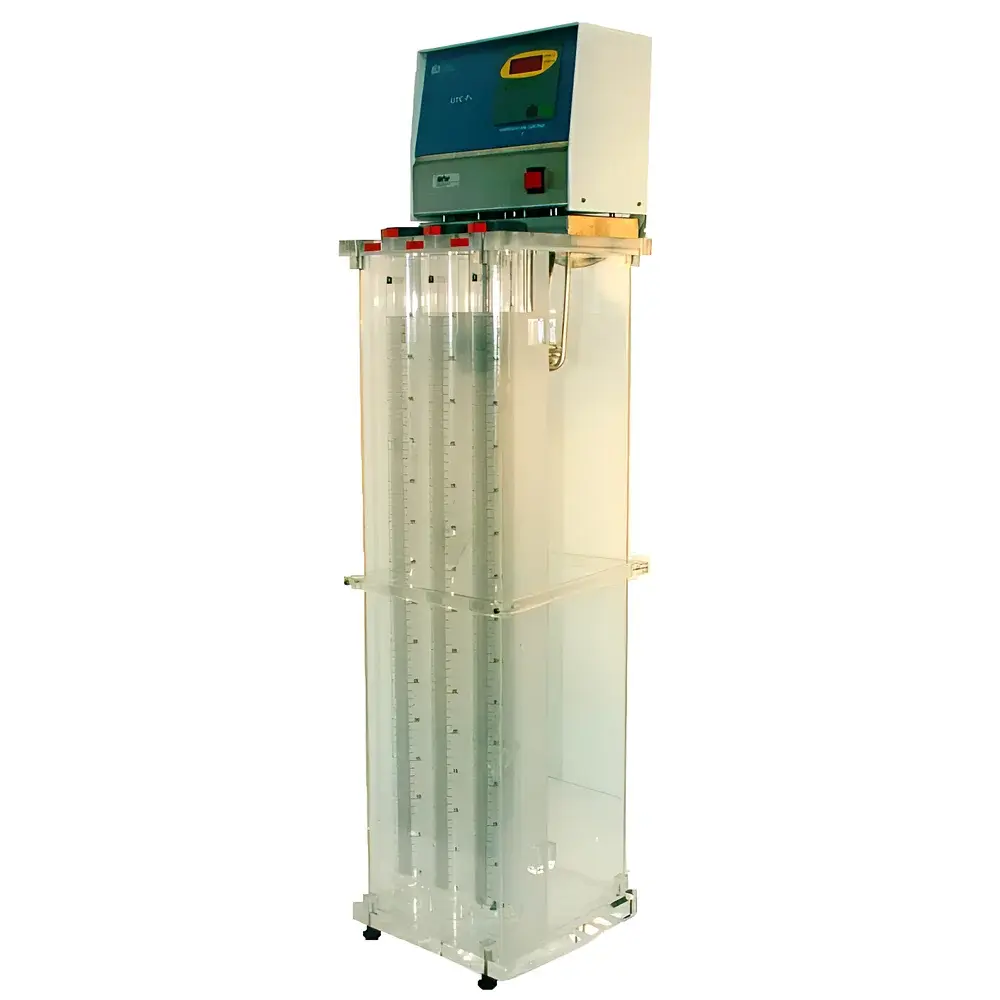
ATSFAAR 2/3 Column Gradient Tube Densimeter
| Brand | ATSFAAR |
|---|---|
| Origin | Italy |
| Manufacturer Status | Authorized Distributor |
| Origin Category | Imported |
| Model | 2/3 Column |
| Density Range | 0.8–3.3 g/cm³ (dependent on selected gradient liquid mixture and calibrated sinkers) |
| Accuracy | ±0.0001 g/cm³ at 23.0 ± 0.1 °C |
| Temperature Control | Digital, 5–50 °C ±0.1 °C |
| Bath Volume | ~45 L (transparent acrylic) |
| Cooling | External coil heat exchanger |
| Agitation | Integrated circulation pump |
| Sample Handling | Motorized lift system for sinkers and specimens |
| Gradient Column | Calibrated glass tube, 850 mm total length |
| Accessories | Precision column filling system, NIST-traceable calibrated sinkers |
Overview
The ATSFAAR 2/3 Column Gradient Tube Densimeter is a precision laboratory instrument engineered for the absolute density determination of solid materials—including granules, flakes, thin films, irregularly shaped particles, and small-volume polymer samples—using the principle of density gradient column analysis. This method relies on establishing a stable, linear vertical density gradient within a transparent column filled with immiscible or partially miscible liquid mixtures (e.g., aqueous cesium chloride, sodium iodide, or organic solvent blends). When introduced into the column, a solid sample reaches neutral buoyancy at the level where its intrinsic density matches that of the surrounding liquid medium. By referencing calibrated sinkers of known density placed at defined positions along the column, the sample’s density is interpolated with traceable accuracy. Designed for metrological rigor, the system operates under tightly controlled thermal conditions (±0.1 °C), minimizing convection-induced gradient distortion and ensuring long-term stability of the density profile.
Key Features
- Modular column configuration supporting either two or three independent gradient tubes—enabling parallel measurement of multiple samples or comparative analysis across different gradient media.
- Digital temperature control system maintaining bath setpoints from 5 °C to 50 °C with ±0.1 °C stability; integrated external cooling coil ensures consistent thermal management during extended operation.
- 45-liter transparent acrylic water bath provides uniform thermal distribution and optical clarity for precise visual or camera-assisted position detection.
- Motorized lift mechanism enables reproducible, vibration-free insertion and retrieval of sinkers and specimens—critical for minimizing mechanical disturbance to the established gradient.
- High-precision 850 mm calibrated glass column with engraved scale markings (0.1 mm resolution) facilitates accurate buoyancy-level reading under magnification or automated imaging systems.
- Included column filling system ensures repeatable, bubble-free gradient formation via controlled sequential layering—essential for achieving linearity and minimizing interfacial diffusion over time.
Sample Compatibility & Compliance
The instrument accommodates solids ranging from 1 mm³ polymer chips to 5 mm diameter ceramic spheres, provided surface contamination is removed and samples are non-reactive with selected gradient liquids. It complies with core principles outlined in ASTM D1505 (Standard Test Method for Density of Plastics by the Density-Gradient Technique) and ISO 1183-2 (Plastics — Methods of Determination of Density — Part 2: Density Gradient Column Method). All calibrated sinkers are supplied with NIST-traceable certification, supporting GLP/GMP documentation requirements. The temperature control system meets criteria for thermometric traceability per ISO/IEC 17025:2017 Annex A.3. The absence of moving parts within the column itself ensures long-term calibration integrity without periodic recalibration of the gradient geometry.
Software & Data Management
While the base configuration operates manually via visual interpolation, optional digital imaging integration allows semi-automated analysis using machine vision software. The system supports timestamped image capture synchronized with temperature logs, enabling full audit trails required under FDA 21 CFR Part 11 when configured with electronic signature capability. Raw positional data (mm), temperature readings (°C), and sinker density values can be exported in CSV format for statistical process control (SPC) or LIMS integration. All calibration records—including sinker certificates, gradient validation reports, and temperature uniformity maps—are structured to align with internal quality management systems compliant with ISO 9001 and ICH Q7.
Applications
This densimeter is routinely deployed in polymer R&D laboratories for batch-to-batch density verification of HDPE, LDPE, PP, and fluoropolymers; in recycling facilities to sort mixed plastic streams based on compositional density differences; in geological labs for mineral grain separation and identification; and in pharmaceutical development for characterizing excipient density distributions in composite dosage forms. Its high resolution (0.0001 g/cm³) makes it suitable for detecting subtle crystallinity changes in semicrystalline polymers or monitoring density drift in aged elastomers. The dual/triple column design also supports method development studies comparing gradient stability across solvent systems or evaluating temperature-dependent density shifts in thermosensitive biomaterials.
FAQ
What gradient liquids are compatible with this system?
Commonly used media include aqueous cesium chloride (CsCl), sodium iodide (NaI), and methylene iodide–toluene mixtures. Selection depends on target density range, chemical compatibility with samples, and desired gradient linearity. ATSFAAR provides application notes and safety-compliant handling protocols for each recommended system.
How often must the gradient column be re-prepared?
Under stable temperature conditions and with minimal sample insertion frequency, a well-prepared gradient remains valid for up to 72 hours. For GLP-regulated environments, daily validation using reference sinkers is recommended.
Is operator training included with purchase?
Yes—on-site or remote installation qualification (IQ) and operational qualification (OQ) support is provided, including hands-on training in gradient preparation, sinker calibration verification, measurement uncertainty estimation, and maintenance procedures.
Can the system be validated for regulatory submissions?
Absolutely—the instrument’s architecture, documented calibration hierarchy, and temperature traceability framework fully support validation protocols aligned with ASTM D1505, USP , and EMA Guideline on Plastic Packaging Materials.



