
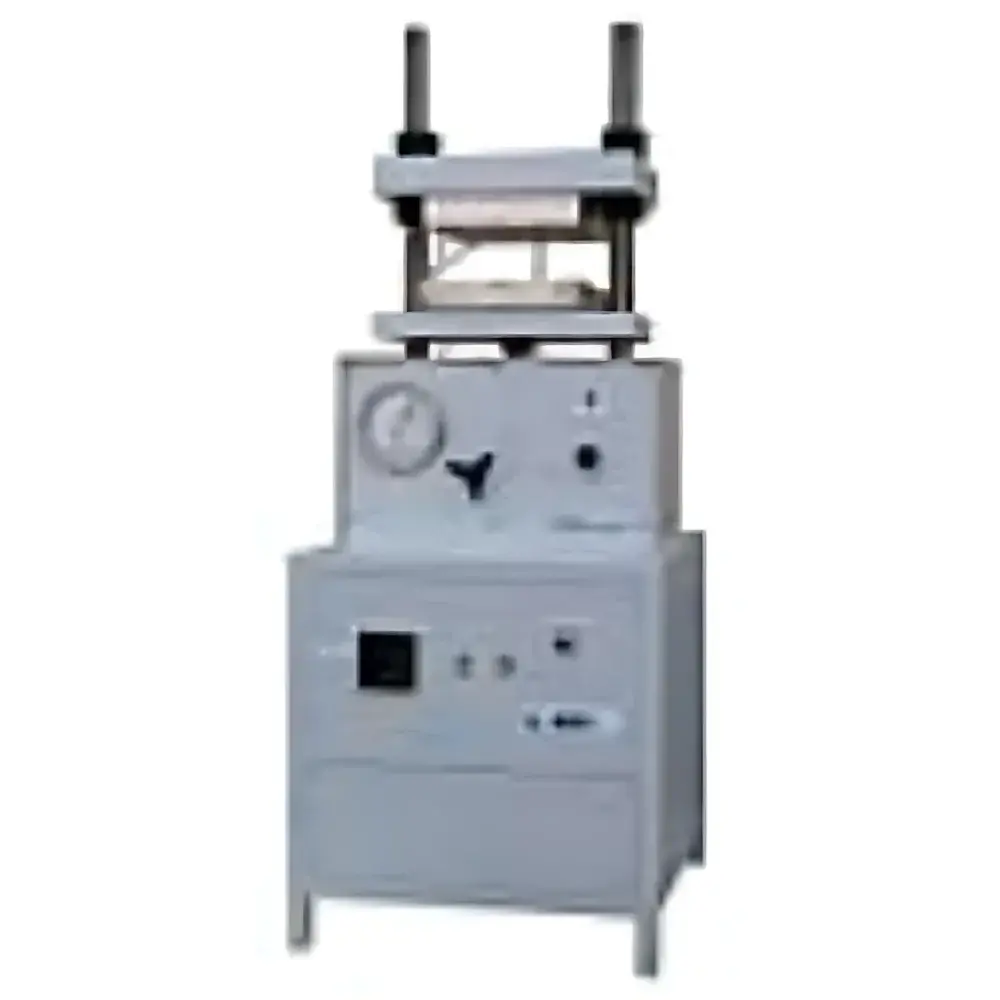
ATSFAAR A1026110 30-Ton Laboratory Hydraulic Pellet Press
| Brand | ATSFAAR |
|---|---|
| Origin | Italy |
| Manufacturer Type | Authorized Distributor |
| Origin Category | Imported |
| Model | A1026110 |
| Instrument Type | Fully Automatic Pellet Press |
| Maximum Force | 265 kN (27,000 kgf) |
| Platen Area | 300 × 300 mm |
| Stroke Adjustment Range | 0–200 mm |
| Max Operating Temperature | 300 °C |
| Cooling Method | Integrated cooling channels in heated platens (air or recirculating water) |
| Control Option | Microprocessor-based digital programmable controller |
Overview
The ATSFAAR A1026110 is a high-capacity, fully automatic laboratory hydraulic pellet press engineered for reproducible, high-precision sample preparation in analytical, materials science, and quality control laboratories. Designed around a multi-stage pneumatic-hydraulic force amplification system, it delivers controlled compressive loads up to 265 kN (equivalent to 27,000 kgf) with exceptional stability and minimal pressure drift during dwell cycles. Unlike mechanical or single-stage hydraulic presses, this system ensures consistent force transmission across the full platen surface—critical for uniform density distribution in pressed pellets used in X-ray fluorescence (XRF), Fourier-transform infrared (FTIR), and near-infrared (NIR) spectroscopy. The unit operates within a temperature-controlled environment, supporting hot-pressing protocols from ambient up to 300 °C, enabling thermoplastic binder activation, polymer sintering, and ceramic green-body densification. Its floor-standing architecture integrates structural rigidity with ergonomic access, accommodating large-format dies and custom tooling without compromising alignment integrity.
Key Features
- Fully automatic operation with programmable pressure ramping, dwell time, and thermal cycling profiles
- Robust 300 × 300 mm parallel platens with precision-ground surfaces and ±2.5 µm flatness tolerance
- Multi-stage pneumatic-hydraulic actuation system delivering 265 kN maximum force with <±0.5% full-scale repeatability
- Integrated heating plates with embedded cooling channels—compatible with forced-air or closed-loop recirculating water systems for rapid thermal equilibration
- Digital microprocessor controller (optional standard) featuring ISO/IEC 17025-compliant audit trail logging, user-level access control, and real-time force/temperature/position monitoring
- Adjustable stroke range of 0–200 mm accommodates diverse die heights and multi-layer pressing configurations
- Modular tooling interface supporting interchangeable dies—including standard 13 mm, 32 mm, and custom-dimensioned molds—and thickness-variable spacers for controlled pellet thickness calibration
Sample Compatibility & Compliance
The A1026110 is validated for use with inorganic powders (e.g., metal oxides, geological samples, catalysts), polymeric matrices, pharmaceutical excipients, and composite feedstocks requiring consolidation under elevated temperature and pressure. It complies with mechanical safety requirements per EN 692:2009 (mechanical presses) and electrical safety per IEC 61000-6-2/6-4. When equipped with the microprocessor controller, the system supports 21 CFR Part 11 compliance through electronic signature capability, secure data storage, and immutable audit logs—making it suitable for GLP and GMP-regulated environments. All thermal and pressure calibration procedures align with ASTM E4 and ISO 7500-1 traceability standards.
Software & Data Management
The optional digital control module runs on a real-time embedded OS with a 7-inch capacitive touchscreen HMI. It enables creation and recall of method templates—including multi-step pressure ramps, hold durations, heating/cooling rates, and endpoint criteria (e.g., “hold at 265 kN until temperature stabilizes at 280 °C ±2 K”). All process parameters and sensor outputs are timestamped and exportable in CSV or XML formats. Data integrity safeguards include cyclic redundancy checking (CRC), automatic backup to internal flash memory and external USB drives, and configurable retention policies. Integration with LIMS via OPC UA or Modbus TCP is supported for centralized lab data orchestration.
Applications
- Preparation of homogeneous, binder-free pellets for quantitative XRF analysis of ores, slags, and environmental solids
- Hot-pressing of KBr or polyethylene matrices for FTIR transmission discs with minimized scattering artifacts
- Densification of battery cathode/anode precursor powders prior to electrochemical testing
- Consolidation of ceramic green bodies for sintering trials under controlled thermal-mechanical history
- Development and validation of tablet formulations in pre-formulation studies, aligned with USP & Ph. Eur. monographs
- Calibration standard production for handheld analyzers requiring certified reference materials (CRMs) in disk format
FAQ
What is the maximum recommended operating temperature for continuous use?
The heated platens are rated for sustained operation at 300 °C; however, prolonged exposure above 250 °C requires periodic verification of gasket integrity and thermal sensor calibration.
Can the press be integrated into an automated sample prep line?
Yes—the system offers dry-contact I/O signals and RS-485/Modbus RTU as standard; optional Ethernet/IP and PROFINET interfaces are available for PLC synchronization.
Is force calibration traceable to national standards?
Factory calibration is performed using NIST-traceable load cells; users may perform in-house verification using Class M1 or higher test weights per ISO 376 guidelines.
What maintenance intervals are recommended for the hydraulic circuit?
Hydraulic fluid and filter replacement is advised every 12 months or 1,000 operating hours—whichever occurs first—using ISO VG 46 anti-wear mineral oil meeting DIN 51524 Part 2 specifications.



