
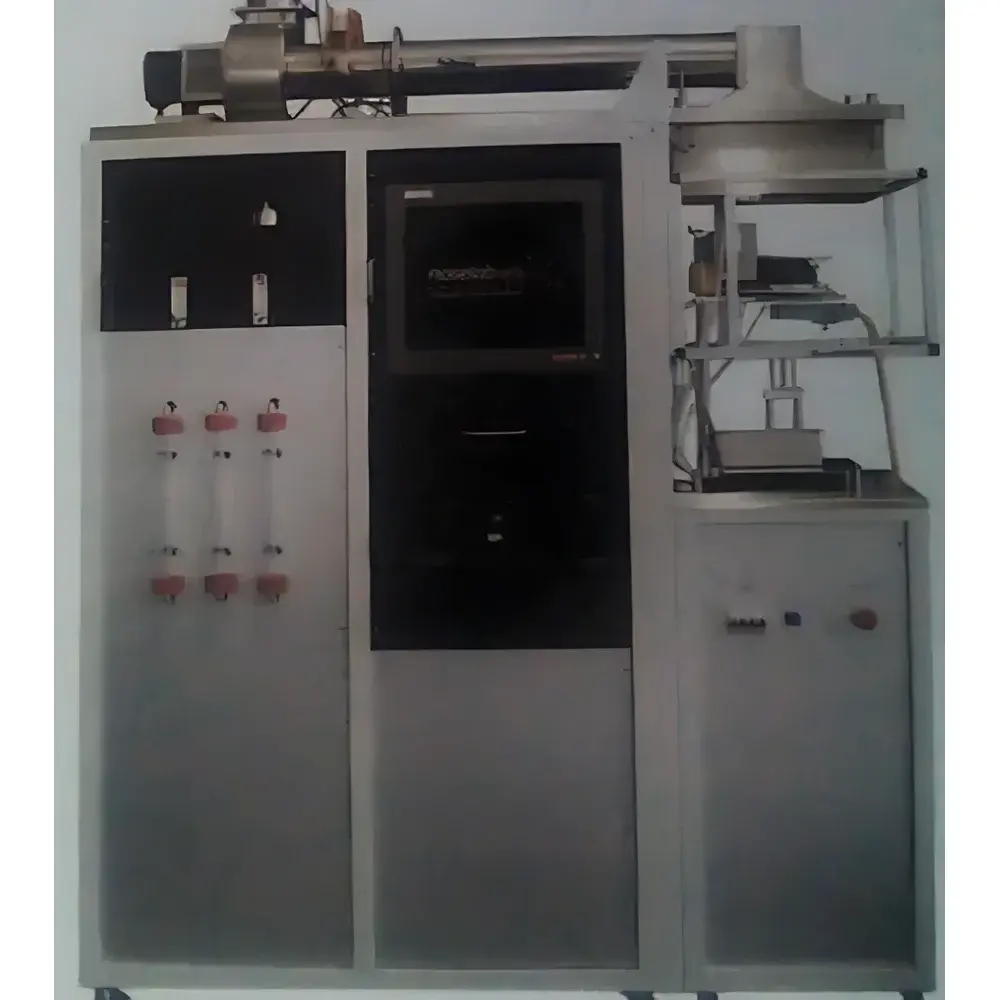
ATSFAAR Cone Calorimeter Model 10097101
| Brand | ATSFAAR |
|---|---|
| Origin | Italy |
| Manufacturer Authorization Status | Authorized Distributor |
| Import Status | Imported |
| Model No. | 10097101 |
| Power Supply | 400 V AC, 50 Hz, 3-phase, 32 A |
| Fuel Gas | Methane |
| Display | 17-inch integrated touchscreen |
| Standards Compliance | ISO 5660-1, ASTM E1354, BS EN ISO 5660-1, NFPA 271 |
| Key Measured Parameters | Heat Release Rate (HRR), Time to Ignition (TTI), Mass Loss Rate (MLR), Effective Heat of Combustion (EHC), Smoke Production Rate (SPR), CO/CO₂ Yield, Oxygen Consumption |
Overview
The ATSFAAR Cone Calorimeter Model 10097101 is a precision-engineered bench-scale fire testing instrument designed for quantitative analysis of material combustion behavior under controlled radiant heat exposure. Based on the oxygen consumption calorimetry principle—first standardized by the U.S. National Institute of Standards and Technology (NIST)—this instrument measures heat release rate (HRR) by calculating the enthalpy change associated with oxygen depletion in the exhaust gas stream. The test method conforms rigorously to ISO 5660-1, ASTM E1354, and BS EN ISO 5660-1, enabling direct correlation between small-scale laboratory data and real-fire performance predictions. The cone-shaped radiant heater delivers uniform, adjustable incident heat flux (typically 0–100 kW/m²) to the specimen surface, initiating pyrolysis and subsequent flame spread under well-defined boundary conditions. Unlike open-flame ignition methods, this system employs an electric spark igniter to ignite evolved pyrolyzates—ensuring reproducible ignition timing and eliminating operator-dependent variability. The specimen is mounted horizontally within a stainless-steel holder, fully wrapped in aluminum foil to suppress lateral heat loss and retain molten residues, thereby maintaining consistent thermal feedback during sustained combustion.
Key Features
- Integrated 17-inch industrial-grade touchscreen HMI for real-time visualization and manual control of all critical parameters: O₂ concentration (% vol), exhaust duct temperature (°C), specimen mass (g), volumetric flow rate (L/min), methane supply pressure and flow (L/min), CO and CO₂ concentrations (ppm), and calculated HRR (kW/m²)
- Automated calibration protocol executed at system startup and user-initiated intervals; validates weight transducer linearity, gas analyzer zero/span stability, radiation flux uniformity across the cone aperture, and smoke obscuration detector sensitivity
- Modular gas analysis subsystem featuring paramagnetic O₂ sensor, NDIR CO/CO₂ detectors, and mass flow controllers calibrated per ISO 17025-accredited procedures
- Radiant cone assembly constructed from high-purity quartz and Inconel elements, delivering stable, spatially uniform flux profiles traceable to NIST reference standards
- Robust mechanical architecture with water-cooled exhaust duct, double-walled sample holder, and fail-safe interlocks for overtemperature, gas leak, and power anomaly detection
- Comprehensive safety integration including methane leak detection, automatic fuel shutoff valve, and emergency ventilation override
Sample Compatibility & Compliance
The Model 10097101 accommodates standard specimens measuring 100 mm × 100 mm × variable thickness (up to 50 mm), compatible with rigid polymers, composites, foams, textiles, coatings, and intumescent systems. Specimen mounting follows strict dimensional and surface preparation requirements defined in ISO 5660-1 Annex A. All measurement outputs—including peak HRR, time to sustained flaming, total heat released (THR), smoke production rate (SPR), and specific extinction area (SEA)—are computed in accordance with normative algorithms embedded in firmware. The system supports full audit trail generation required for GLP-compliant laboratories and satisfies data integrity criteria outlined in FDA 21 CFR Part 11 when operated with validated software configuration. Calibration certificates and uncertainty budgets are provided for each sensor channel, traceable to national metrology institutes (INRIM, Italy).
Software & Data Management
Data acquisition and analysis are managed via proprietary ATSFAAR FireLab™ software, compliant with IEC 62443-3-3 for industrial cybersecurity. The software provides synchronized time-series logging at 1 Hz resolution, with optional high-speed capture (10 Hz) for transient ignition events. Raw sensor data undergoes real-time correction for buoyancy effects, humidity compensation, and stoichiometric O₂ consumption conversion using default or user-defined combustion equations. Export formats include CSV, XML, and PDF reports conforming to ASTM E1354 Annex B templates. Experimental metadata—operator ID, ambient conditions, calibration history, and instrument configuration—is embedded in every dataset file. Role-based access control (RBAC) enforces separation of duties between operators, reviewers, and administrators, supporting ALCOA+ principles (Attributable, Legible, Contemporaneous, Original, Accurate, Complete, Consistent, Enduring, Available).
Applications
- Quantitative ranking of flame retardancy efficacy across halogen-free, phosphorus-based, and mineral-filled formulations
- Correlation studies linking cone calorimetry outputs (e.g., FIGRA = HRRpeak/TTI) to large-scale tests such as room-corner (ISO 9705) and SBI (EN 13823)
- Development of fire hazard models for building materials, aerospace composites, and electric vehicle battery enclosures
- Regulatory submission support for CE marking (EN 13501-1), UL 94, and FAA AC 20-135 compliance documentation
- Fundamental research into char formation kinetics, flame inhibition mechanisms, and smoke toxicity pathways (via coupled FTIR or GC-MS exhaust sampling interfaces)
FAQ
What standards does this cone calorimeter comply with?
It meets ISO 5660-1:2015, ASTM E1354-22, BS EN ISO 5660-1, and NFPA 271 for heat release rate, smoke production, and mass loss measurements.
Is methane the only fuel option for the pilot igniter?
Yes—the system is configured exclusively for methane (CH₄) as specified in ISO 5660-1; propane or butane substitution requires hardware modification and recalibration.
Can the instrument operate unattended during long-duration tests?
Yes—fully automated test sequences, including pre-test stabilization, ignition trigger, and post-test purge, are supported with continuous monitoring and alarm escalation.
How is calibration traceability maintained?
Each sensor module ships with a manufacturer’s calibration certificate referencing INRIM (Italy) or PTB (Germany) standards; annual third-party verification is recommended.
Does the software support multi-user environments with electronic signatures?
Yes—FireLab™ implements 21 CFR Part 11-compliant electronic signatures, audit trails, and secure user authentication via LDAP or local database.



