
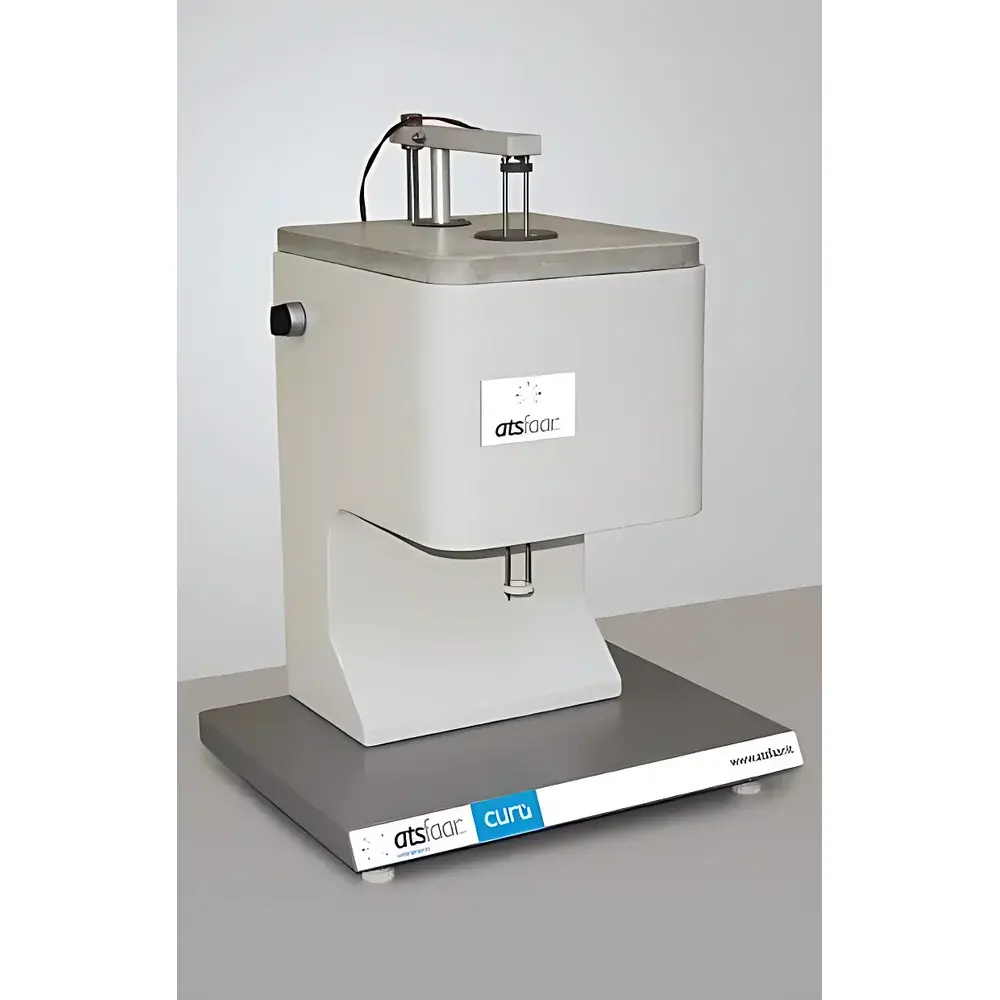
ATSFAAR Curing Resins Thermal Cure Monitoring System
| Brand | ATSFAAR |
|---|---|
| Origin | Italy |
| Manufacturer Status | Authorized Distributor |
| Origin Category | Imported |
| Model | Curing Resins |
| Pricing | Upon Request |
Overview
The ATSFAAR Curing Resins Thermal Cure Monitoring System is a dedicated benchtop instrument engineered for real-time, in-situ characterization of thermosetting resin cure kinetics under controlled thermal conditions. It operates on the principle of dynamic dielectric analysis (DDA), measuring changes in complex permittivity—specifically relative permittivity (ε′) and loss factor (tan δ)—as a function of temperature and time. These dielectric parameters correlate directly with molecular mobility, crosslink density evolution, solvent volatilization, and network formation during polymerization. Unlike conventional DSC or TMA methods, this system provides continuous, non-invasive monitoring of the entire curing process—from initial low-viscosity state through gelation to final vitrification—enabling quantitative derivation of gel point, vitrification temperature (Tv), degree of cure (α), and network conversion. Its design targets R&D laboratories and QC environments where precise correlation between dielectric response and structural development is critical for formulation optimization, process validation, and shelf-life prediction.
Key Features
- Integrated high-frequency dielectric sensor (1–10 MHz range) with temperature-controlled parallel-plate electrode assembly for reproducible sample loading and minimal thermal lag
- Programmable multi-step thermal profiles (ramp, hold, isothermal, and custom sequences) compliant with ASTM E2070 and ISO 2139 standards for cure monitoring
- Simultaneous acquisition of four core parameters: storage modulus equivalent (via ε′), loss modulus equivalent (via ε″), tan δ, and absolute impedance magnitude (|Z|)
- Real-time calculation of degree of cure (α) using the Kamal–Sourour kinetic model, with user-definable reference points for baseline normalization
- Rugged stainless-steel thermal chamber with forced-air convection and ±0.5 °C temperature uniformity across the measurement zone
- Modular sample holder accommodating standard 25 mm diameter discs (0.5–3.0 mm thickness) or custom geometries per ISO 25386
Sample Compatibility & Compliance
The system supports a broad spectrum of thermosetting systems including epoxies, phenolics, polyurethanes, unsaturated polyesters, and cyanate esters—whether neat, filled, or fiber-reinforced. It accommodates both solvent-containing and solvent-free formulations, enabling tracking of volatile release kinetics via characteristic shifts in dielectric loss peaks. All measurement protocols adhere to GLP-compliant data integrity requirements: full audit trail logging, electronic signature support, and secure user access levels (admin/operator/observer). Data export formats comply with FDA 21 CFR Part 11 for regulated environments, including CSV, XML, and proprietary .crd binary files with embedded metadata (timestamp, operator ID, calibration status, environmental conditions).
Software & Data Management
The bundled ATSFAAR CureStudio™ v4.2 software provides a validated, Windows-based platform for instrument control, real-time visualization, and advanced post-processing. Key capabilities include automated gel point detection (via inflection analysis of tan δ vs. time), vitrification onset identification (using ε′ curvature thresholding), and comparative overlay of multiple cure curves with statistical confidence bands. Raw data are stored in an encrypted local database with optional synchronization to networked file servers or LIMS interfaces via OPC UA. Software validation documentation (IQ/OQ/PQ templates) and electronic record retention policies are provided to support GMP and aerospace qualification workflows (e.g., Nadcap AC7108).
Applications
- Optimization of autoclave and oven cure cycles for aerospace composite pre-pregs
- Accelerated aging studies correlating dielectric relaxation behavior with long-term Tg stability
- Validation of out-of-autoclave (OOA) processing parameters for thermoset matrix composites
- Quality control of batch-to-batch resin consistency using normalized cure index (CI) metrics
- Development of low-VOC formulations by quantifying solvent evaporation onset and rate relative to crosslink initiation
- Support for ISO 11357-6 and ASTM D7028 rheological cure modeling inputs
FAQ
What sample preparation is required prior to measurement?
Standard samples are compression-molded or cast into 25 mm diameter discs with thickness between 0.8–2.0 mm; surface flatness must be within ±5 µm. No electrode coating or metallization is needed.
Can the system measure partially cured or pre-gelled resins?
Yes—its wide impedance range (102–1010 Ω) and adaptive signal conditioning allow stable acquisition from highly conductive uncured states through insulating fully cured networks.
Is calibration traceable to national standards?
Dielectric calibration is performed using NIST-traceable liquid standards (ethanol/water mixtures); thermal calibration follows EURAMET cg-18 guidelines with dual-point verification at 25 °C and 150 °C.
How does this system differ from conventional DSC-based cure analyzers?
DSC measures enthalpy change only; this system tracks molecular-level structural evolution continuously without sample mass limitation or thermal inertia artifacts, offering superior sensitivity to early-stage network formation and solvent dynamics.
Does the software support automated report generation for regulatory submissions?
Yes—CureStudio™ includes configurable report templates aligned with ASTM E2921 and ISO/IEC 17025 requirements, with embedded digital signatures, revision history, and raw-data appendices.



