
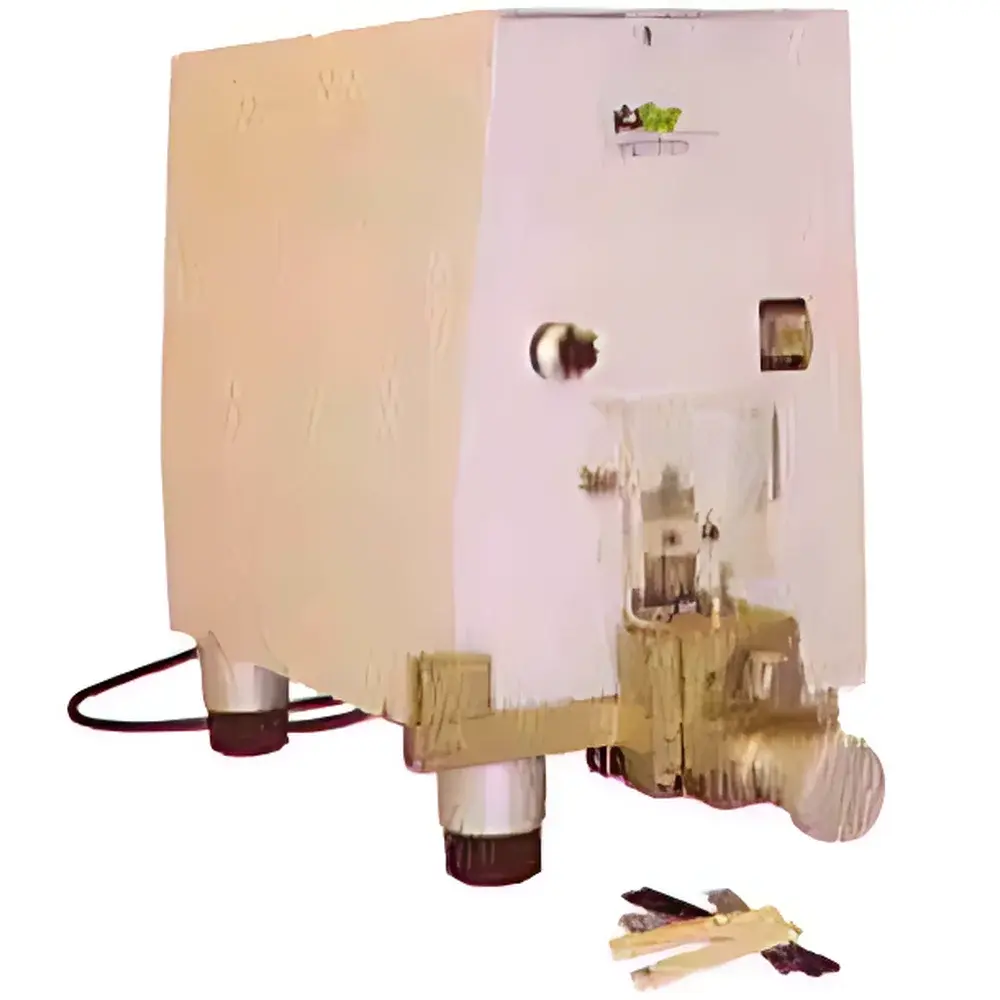
ATSFAAR easy2818 Motorized Notched Specimen Preparation Machine for Izod & Charpy Impact Testing
| Brand | ATSFAAR |
|---|---|
| Origin | Italy |
| Model | easy2818 |
| Cutting Speed | 0–20 m/min |
| Stroke Length | 30 mm |
| Notch Types | V-notch, U-notch |
| Feed Increment | 0.01 mm |
| Sample Clamp Height | 26 mm |
| Sample Clamp Width | 15 mm |
| Maximum Sample Thickness | 4 mm |
| Safety Enclosure | Polycarbonate Interlocked Guard |
| Compliance | ISO 179-1, ISO 180, ASTM D256, ASTM E23, EN ISO 8256 |
Overview
The ATSFAAR easy2818 is a precision-engineered motorized notching machine designed exclusively for the reproducible preparation of standardized notches in polymeric and composite specimens used in pendulum impact testing—specifically Izod (cantilever-beam) and Charpy (simply-supported-beam) configurations. It operates on a linear servo-controlled cutting principle, where a carbide-tipped or hardened steel cutting tool traverses a fixed 30 mm stroke under programmable feed control. The system employs closed-loop electronic positioning to ensure sub-micron repeatability in notch depth, critical for achieving consistent stress concentration at the crack tip during impact evaluation. Unlike manual or pneumatic notching tools, the easy2818 eliminates operator-induced variability in notch geometry—particularly in root radius, depth tolerance, and flank angle—thereby directly supporting compliance with international test standards that mandate strict geometric tolerances (e.g., ISO 179-1:2020 specifies ±0.05 mm depth tolerance for standard V-notches in 10 mm × 10 mm bars).
Key Features
- Motorized linear actuation with digital speed control (0–20 m/min), enabling optimized cutting rates for brittle thermoplastics, elastomers, and fiber-reinforced composites without thermal degradation or micro-cracking.
- High-resolution feed adjustment (0.01 mm increments) displayed in real time on an integrated LED interface, allowing precise alignment to ISO 2818/ISO 179-defined notch depths (e.g., 2.0 mm or 2.5 mm for standard V-notches).
- Interlocked polycarbonate safety enclosure: automatically de-energizes the drive motor and spindle when the access door is opened—meeting EN 60204-1 machinery safety requirements.
- Modular tooling platform compatible with certified V-notch (60°, 45°, or 90° included angle) and U-notch cutters per ASTM D256 Annex A1 and ISO 180 Annex B specifications.
- Dedicated specimen clamping system: 26 mm vertical clearance and 15 mm jaw width accommodate common bar geometries (e.g., 80 × 10 × 4 mm, 63.5 × 12.7 × 3.2 mm) while maintaining lateral rigidity during high-force cutting.
- Batch processing capability: simultaneous alignment and sequential notching of up to eight 3 mm-thick specimens or six 4 mm-thick specimens per setup—reducing inter-sample handling error and throughput time.
Sample Compatibility & Compliance
The easy2818 supports rigid and semi-crystalline polymer specimens including but not limited to ABS, PC, PP, PA6/66, PBT, and CFRP laminates. It accommodates standard test bar dimensions defined in ISO 179-1 (Izod), ISO 180 (Charpy), ASTM D256 (Izod), and ASTM E23 (metallic Charpy). All notch geometries are traceable to NIST-traceable calibration artifacts and verified using certified optical profilometry or tactile stylus measurement systems (e.g., Mitutoyo SJ-410). The machine’s mechanical design and operational parameters conform to GLP-aligned laboratory practice requirements, with documented maintenance logs, tool wear tracking, and calibration verification procedures recommended for ISO/IEC 17025-accredited testing laboratories.
Software & Data Management
While the easy2818 operates via embedded firmware without external PC dependency, its digital control unit records all critical process parameters—including actual feed position, cutting speed, and cycle count—for local audit trail generation. Optional RS-232 or USB-C output enables integration into LIMS environments for automated logging of specimen IDs, notch type, depth setting, and timestamp. Full compliance with FDA 21 CFR Part 11 is achievable when paired with validated third-party data acquisition software supporting electronic signatures, audit trails, and user access controls.
Applications
- Preparation of standardized notches for Izod and Charpy impact testing in quality control labs serving automotive, aerospace, and medical device manufacturers.
- Research-grade specimen conditioning for fracture mechanics studies requiring high-fidelity notch root geometry (e.g., KIC pre-cracking support).
- Method validation and interlaboratory comparison exercises under ISO/IEC 17043 proficiency testing schemes.
- Supporting ASTM D790 flexural testing where controlled notch initiation is required for toughness assessment of structural thermosets.
- Training platforms in university materials science laboratories emphasizing metrological rigor in mechanical test specimen preparation.
FAQ
What standards does the easy2818 comply with for notch geometry verification?
It supports full alignment with ISO 179-1, ISO 180, ASTM D256, and EN ISO 8256—each specifying dimensional tolerances for V-notch depth (±0.05 mm), root radius (0.25 ± 0.05 mm), and flank angle (60° ± 1°).
Can the machine be calibrated in-house?
Yes—using certified gauge blocks and optical comparators; ATSFAAR provides a calibration certificate template and traceability documentation upon request.
Is tool change required when switching between V- and U-notch configurations?
Yes—cutting tools are physically interchangeable and supplied as optional accessories; each cutter is individually certified for geometry and hardness.
Does the system support custom notch angles beyond standard 45° or 60°?
Only with OEM-supplied tooling; non-standard angles require prior engineering review and cannot be achieved via software modification.
What maintenance intervals are recommended for continuous operation?
Lubrication of linear guides every 500 operating hours; spindle bearing inspection every 2,000 hours; annual verification of feed encoder linearity and positional accuracy.
Related Products



