
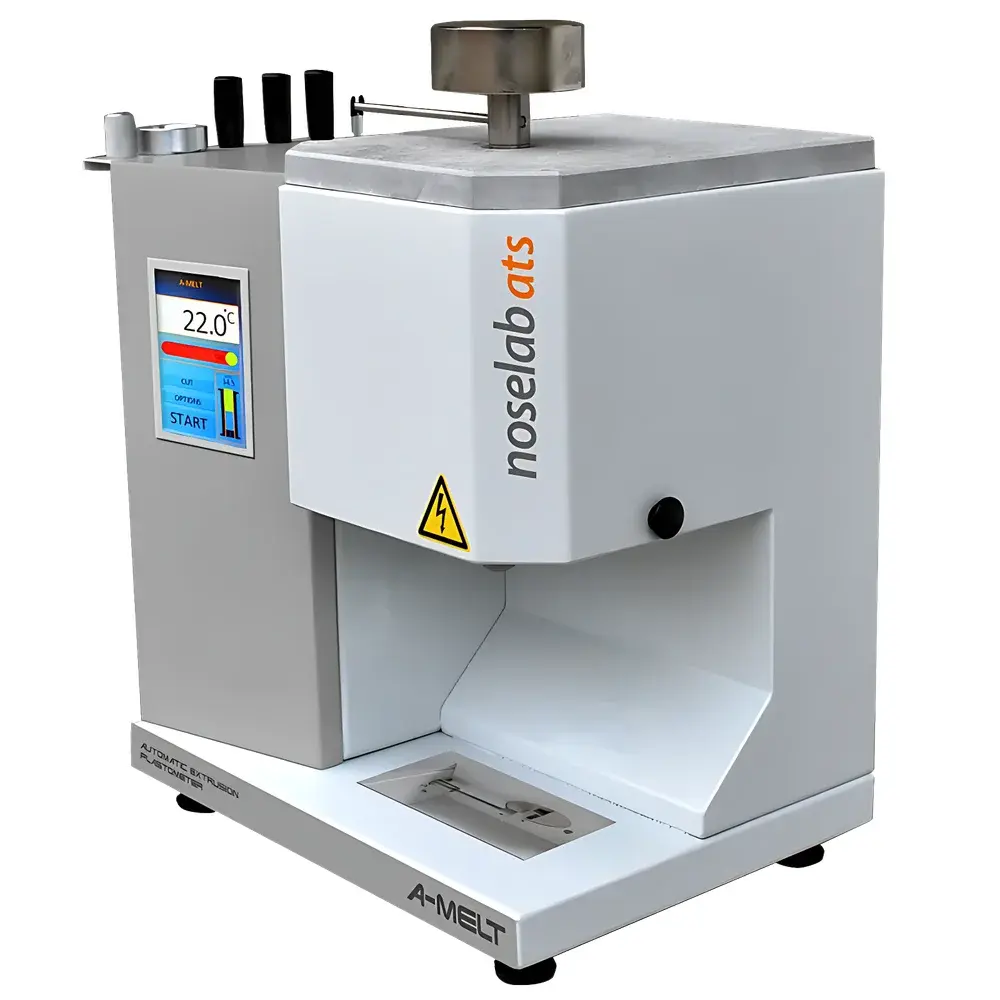
ATSFAAR A-Melt Advanced Melt Flow Indexer
| Brand | ATSFAAR |
|---|---|
| Origin | Italy |
| Manufacturer Type | Authorized Distributor |
| Origin Category | Imported |
| Model | A-Melt |
| Temperature Range | 50–400 °C |
| Temperature Resolution | 0.1 °C |
| Temperature Stability | ±0.2 °C (barrel zone) |
| Barrel ID | 9.55 ±0.007 mm |
| Barrel Material | Nitrided steel, hardness 52–55 HRC |
| Maximum Plunger Travel | 80 mm |
| Cutting Interval | 3–300 s (touch-configurable) |
| Data Points per Test | Up to 100 |
| Display | 5-inch capacitive touchscreen |
| Interface | USB for optional PC software and data export |
| Compliance | ASTM D1238, ISO 1133, GB/T 3682 |
Overview
The ATSFAAR A-Melt Advanced Melt Flow Indexer is a precision-engineered instrument designed for the quantitative determination of melt volume rate (MVR) and melt flow rate (MFR) of thermoplastic polymers under standardized load and temperature conditions. It operates on the volumetric flow principle defined in ASTM D1238 (Method B, MVI—Melt Volume Index) and ISO 1133-1, utilizing high-resolution linear displacement sensing to measure plunger travel over precisely timed intervals. Unlike gravimetric systems that require manual specimen collection and weighing, the A-Melt directly calculates MVI by correlating calibrated plunger displacement with known barrel geometry and melt density—enabling rapid, operator-independent evaluation of polymer rheological behavior during extrusion. Its architecture integrates a thermally optimized barrel assembly, dual-loop PID digital temperature control, and real-time microprocessor-based data acquisition—making it suitable for routine QC testing in compounding facilities, R&D laboratories, and certification bodies requiring traceable, repeatable melt index characterization.
Key Features
- 5-inch high-brightness capacitive touchscreen interface with intuitive icon-driven navigation for full parameter configuration—including temperature setpoint (50–400 °C), cutting interval (3–300 s), plunger travel distance (up to 80 mm), applied load, and material density.
- Dual-channel PID temperature controller delivering ±0.2 °C thermal stability across the entire heating zone, verified per ISO 1133 Annex C; displayed via 4-digit LED readout with 0.1 °C resolution.
- Precision-machined nitrided steel barrel (ID: 9.55 ±0.007 mm, hardness 52–55 HRC) ensuring dimensional integrity, wear resistance, and long-term calibration retention under repeated high-temperature operation.
- Linear displacement sensor with sub-micron resolution captures up to 100 synchronized position/time data points per test, enabling robust statistical evaluation of MVI trends and detection of non-Newtonian anomalies.
- Integrated preheat timer and real-time status feedback—including thermal soak completion, plunger motion tracking, and automatic pass/fail flagging based on user-defined repeatability thresholds.
- USB host port supporting optional Windows-compatible software for raw data logging, GLP-compliant audit trail generation, statistical process control (SPC) charting, and report export in CSV/PDF formats.
Sample Compatibility & Compliance
The A-Melt accommodates standard cylindrical polymer specimens (e.g., granules, pellets, or pre-dried powders) conforming to ASTM D1238 and ISO 1133 sample preparation guidelines. It supports both MFR (mass-based, Method A) and MVI (volume-based, Method B) protocols through selectable measurement modes. The system meets essential requirements for regulatory environments: temperature calibration traceability to NIST-traceable references, mechanical verification per ISO 1133 Annex D, and software functionality aligned with FDA 21 CFR Part 11 principles when used with validated PC software (electronic signatures, audit trails, and data integrity controls). Optional accessories—including motorized weight lifters and certified reference materials—facilitate GMP-aligned validation protocols per ICH Q5C and ISO/IEC 17025.
Software & Data Management
The optional A-Melt PC Suite provides secure, timestamped storage of all test metadata—including operator ID, environmental conditions, calibration logs, and raw displacement/time arrays—in encrypted binary archives. Each dataset retains full traceability to instrument firmware version, sensor calibration certificate, and temperature profile history. Reporting modules support customizable templates compliant with internal SOPs or external accreditation standards (e.g., CNAS, UKAS). Audit trails record all user actions—parameter changes, result overrides, and software updates—with immutable timestamps and login attribution. Data export functions include direct integration with LIMS platforms via ODBC drivers and automated backup to network drives or cloud repositories with configurable retention policies.
Applications
- Quality control of polyolefins (PP, PE), engineering resins (PA, PC, POM), and biopolymers (PLA, PHA) during incoming raw material inspection and final product release.
- Rheological screening of polymer blends and filled compounds (e.g., glass fiber, mineral filler, flame retardants) to assess dispersion homogeneity and processing window shifts.
- Accelerated aging studies evaluating thermal degradation-induced MFR/MVI drift after multiple extrusion passes or oven exposure.
- Supporting ISO 9001:2015 clause 8.5.1 (control of production and service provision) and ISO 14001:2015 environmental performance monitoring through consistent melt index trending.
- Academic research on structure–property relationships in branched vs. linear polyethylenes, where MVI sensitivity to shear history informs molecular weight distribution modeling.
FAQ
What standards does the A-Melt comply with?
ASTM D1238 (Methods A and B), ISO 1133-1 and -2, GB/T 3682-2018, and JIS K 7210.
Can the instrument perform both MFR and MVI measurements?
Yes—user-selectable mode switching between gravimetric MFR (requires external balance) and volumetric MVI (fully automated via displacement sensor).
Is temperature calibration performed internally or externally?
Internal verification uses embedded PT100 sensors; full calibration requires traceable external reference thermometers per ISO 1133 Annex C procedures.
How is data integrity ensured during USB transfer to PC?
The firmware implements CRC-32 checksum validation for all transmitted datasets; the PC software logs transmission success/failure with timestamped event records.
What maintenance is required for the barrel and piston assembly?
Daily cleaning with brass brushes and solvent wipe; quarterly dimensional verification using certified plug gauges; annual hardness re-certification of the nitrided barrel surface.






