
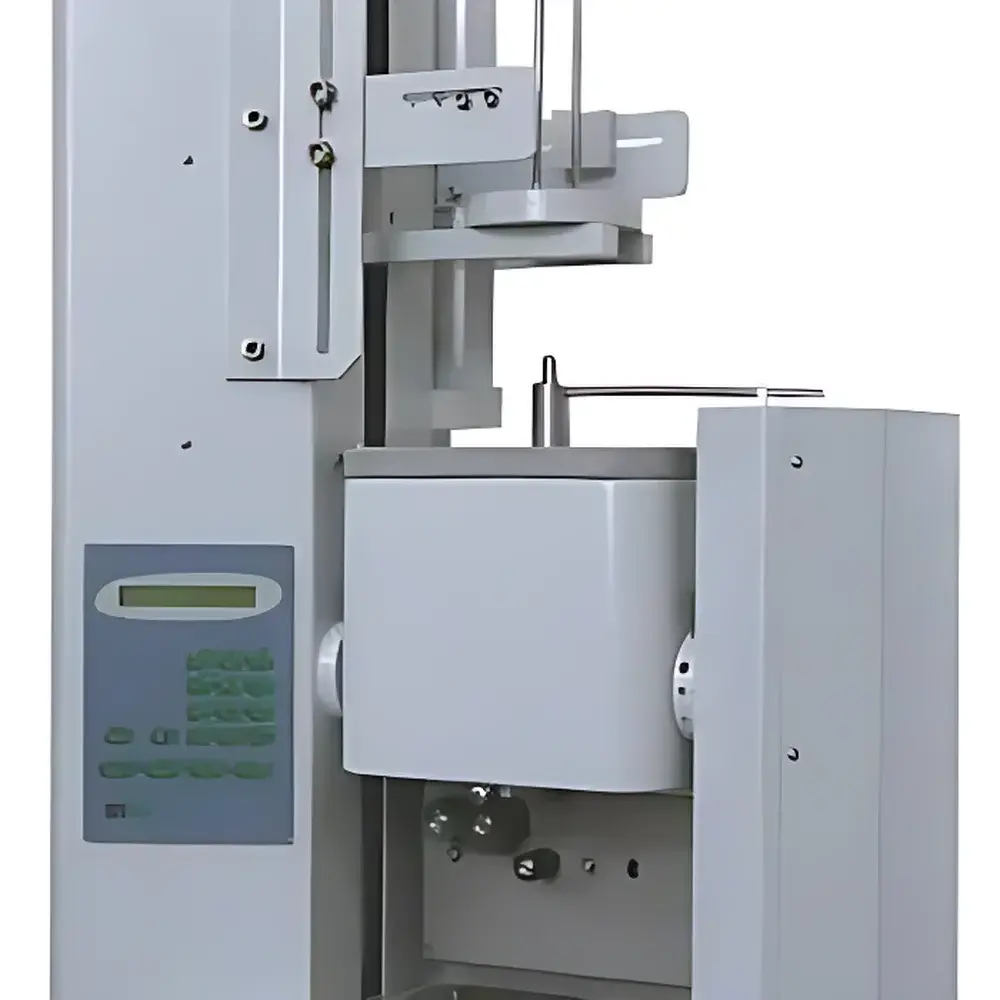
ATSFAAR MELTS Advanced Melt Strength & Flow Indexer
| Brand | ATSFAAR |
|---|---|
| Origin | Italy |
| Manufacturer Status | Authorized Distributor |
| Origin Category | Imported |
| Model | MELTS |
| Pricing | Upon Request |
Overview
The ATSFAAR MELTS Advanced Melt Strength & Flow Indexer is an integrated, PC-controlled rheological testing platform engineered for polymer melt characterization in rubber and plastic manufacturing environments. Unlike conventional melt flow indexers (MFIs) compliant only with ASTM D1238 and ISO 1133, the MELTS system extends functionality to quantify melt strength—a critical viscoelastic property reflecting a polymer’s resistance to extensional deformation under molten conditions. It operates on the principle of controlled capillary extrusion combined with real-time tensile force measurement during melt filament stretching. A precision-driven piston assembly extrudes molten polymer through a standardized die (typically 2.095 mm diameter × 8 mm L/D), while a motorized draw-down unit applies programmable strain rates beneath the die exit. Simultaneously, high-resolution displacement sensing (0.01 mm resolution over 40 data points) captures filament elongation behavior up to break point, enabling calculation of melt strength (in cN), drawability (elongation at break, %), and time-dependent thermal degradation onset—measured via temperature-stabilized melt residence monitoring at 100 mm above the die exit.
Key Features
- Integrated dual-mode operation: fully compliant melt flow rate (MFR) and melt volume rate (MVR) measurement per ASTM D1238/ISO 1133, plus extensional rheology capability for melt strength and elongation analysis
- Motorized vertical sample loading and automatic die alignment ensures repeatable extrusion geometry and eliminates operator-induced variability
- 90° rotating furnace chamber facilitates rapid die cleaning and residue removal without disassembly—critical for multi-polymer labs handling PVC, PP, PE, and engineering thermoplastics
- Four standard calibration weights included (2.16 kg, 5.0 kg, 10.0 kg, 21.6 kg) covering the full range of test conditions specified in ISO 1133-1 Annex A and ASTM D1238 Condition J–L
- Real-time thermal stability assessment: integrated thermocouple array monitors melt temperature profile at fixed axial position (100 mm above die exit) to detect early-stage thermo-oxidative degradation during extended dwell tests
- PC-based control architecture with deterministic timing resolution supports GLP-compliant audit trails, including timestamped parameter logs, user authentication, and electronic signature-ready reporting
Sample Compatibility & Compliance
The MELTS system accommodates granular, pelletized, or powdered thermoplastic resins—including polyolefins (HDPE, LDPE, PP), styrenics (PS, ABS), engineering polymers (PA6, PC, POM), and thermoplastic elastomers (TPEs). It meets mechanical and procedural requirements of ISO 1133-1:2011 (determination of MFR/MVR), ISO 1133-2:2011 (determination of MFR for thermally unstable materials), and ASTM D1238 (standard test method for melt flow rates of thermoplastics). For regulated environments, the embedded software architecture supports 21 CFR Part 11 compliance when deployed with validated IT infrastructure, providing role-based access control, immutable raw data storage, and full electronic record retention for GMP/QA audits.
Software & Data Management
The supplied English-language software suite provides closed-loop instrument control, synchronized acquisition of load cell, displacement, and temperature signals, and automated derivation of key indices: MFR (g/10 min), MVR (cm³/10 min), melt strength (cN), elongation at break (%), and thermal degradation onset time (min). Data export formats include CSV, XLSX, and PDF reports with embedded metadata (test condition, operator ID, calibration certificate traceability). All measurement sequences are pre-configurable via template-based workflows, reducing setup errors and ensuring inter-lab reproducibility. Raw datasets retain full temporal resolution (≥10 Hz sampling) for post-hoc analysis of transient extensional viscosity profiles.
Applications
- Pre-production raw material qualification: screening resin lots for batch-to-batch consistency in melt elasticity and processability
- Blending optimization: evaluating synergistic or antagonistic effects in polymer blends (e.g., PP/EPDM, PA6/ABS) on extensional response
- Stabilizer package development: quantifying thermal degradation kinetics under shear-free extensional stress vs. conventional capillary pressure drop
- Extrusion and blow molding R&D: correlating melt strength values with parison sag, bubble stability, and wall thickness uniformity
- Regulatory documentation: generating ISO/ASTM-compliant certificates for customer technical dossiers and quality agreements
FAQ
Does the MELTS system comply with ISO 1133-2 for thermally unstable materials?
Yes—the instrument’s temperature-controlled residence zone and programmable dwell times enable full adherence to ISO 1133-2 Annex B procedures.
Can melt strength data be correlated to actual processing performance?
Empirical correlations exist between melt strength and blow ratio stability in film extrusion; ATSFAAR provides application notes with case studies across HDPE and LLDPE grades.
Is firmware update support available remotely?
Firmware updates are delivered via secure download portal with version-controlled release notes and validation protocols for regulated users.
What is the maximum operating temperature range?
The furnace is rated to 400 °C with ±0.5 °C stability over 30-minute equilibration, verified per ISO 1133 Annex C.
How is calibration traceability maintained?
Each system ships with NIST-traceable weight calibration certificates and factory-verified displacement sensor linearity reports, valid for 12 months from commissioning date.







