
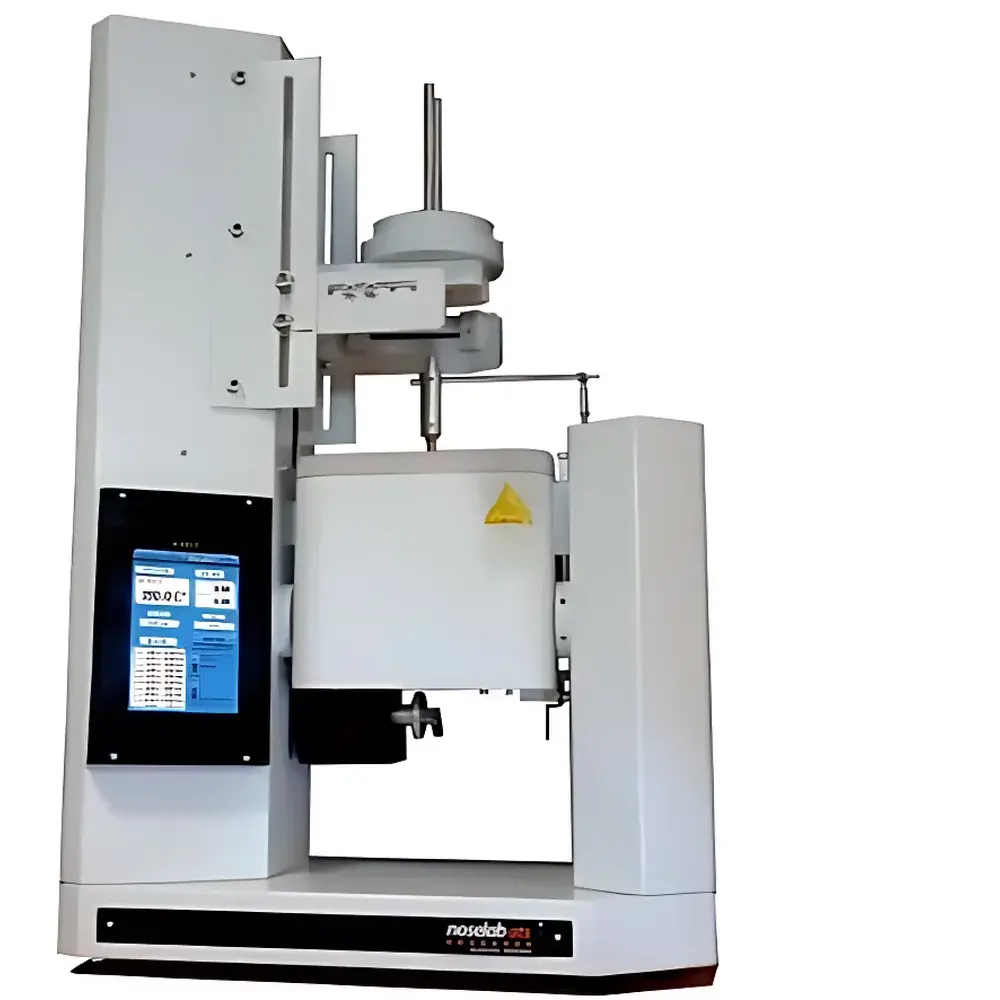
ATSFAAR A-MeP Advanced Automatic Melt Flow Indexer
| Brand | ATSFAAR |
|---|---|
| Origin | Italy |
| Manufacturer Type | Authorized Distributor |
| Origin Category | Imported |
| Model | A-MeP |
| Pricing | Upon Request |
Overview
The ATSFAAR A-MeP Advanced Automatic Melt Flow Indexer is a precision-engineered instrument designed for the quantitative determination of melt flow rate (MFR) and melt volume rate (MVR) of thermoplastic polymers in accordance with ISO 1133-1, ISO 1133-2, ASTM D1238, and GB/T 3682. It operates on the principle of volumetric extrusion under standardized thermal and mechanical conditions: molten polymer is forced through a calibrated capillary die under a defined load and temperature, and the extrudate volume or mass is measured over a specified time interval. Unlike conventional manual or semi-automatic indexers, the A-MeP integrates a linear displacement sensor system to directly track piston movement, enabling high-accuracy MVR calculation without reliance on manual cutting or gravimetric weighing. Its microprocessor-controlled architecture ensures traceable, repeatable, and auditable test execution—critical for laboratories operating under GLP, ISO/IEC 17025, or regulated quality systems.
Key Features
- Full automation of the entire MFR/MVR test cycle—including automatic weight selection, piston positioning, timed extrudate cutting, and real-time volumetric calculation via high-resolution linear encoder
- Rotatable furnace assembly with motorized cleaning tool option—enabling rapid, residue-free barrel maintenance without disassembly
- Touchscreen HMI with 7-inch color LCD display; intuitive navigation across 28 pre-programmed test configurations optimized for routine QC and advanced research applications
- Dual-zone heating system with PID digital temperature control; 0.1 °C resolution, ±0.2 °C thermal stability across the 9.55 mm ±0.007 mm internal diameter barrel (hardened nitrided steel, 52–55 HRC)
- Four programmable dead-weight loading stations (standard configuration), compatible with optional additional weights for extended load ranges per ISO 1133-2 Annex B
- On-the-fly parameter adjustment: manual intervention permitted during active testing—including immediate stop, cut initiation, load modification, or temperature override—supporting method development and thermal degradation profiling
- Modular capillary die support: interchangeable dies (e.g., 2.095 mm, 1.18 mm, 0.5 mm nominal diameters) enable shear-rate-dependent characterization aligned with capillary rheometry principles
Sample Compatibility & Compliance
The A-MeP accommodates standard thermoplastic resins including polyethylene (PE), polypropylene (PP), polycarbonate (PC), ABS, PET, and engineering thermoplastics such as PEEK and PPS. It supports both single-point MFR determination and multi-load MVR profiling for non-Newtonian behavior analysis. All operational parameters—including temperature setpoints, dwell times, load sequences, and cut intervals—are fully configurable and stored with timestamped audit trails. The system complies with ISO/IEC 17025 documentation requirements and supports 21 CFR Part 11-compliant software modules (optional) featuring electronic signatures, user access levels, and immutable data archiving.
Software & Data Management
The optional ATSFAAR MeltFlow Suite provides comprehensive data acquisition, visualization, and post-processing capabilities. It enables real-time plotting of piston displacement vs. time, calculation of apparent shear rate (γ̇) and shear stress (σ) using Rabinowitsch correction, and derivation of apparent viscosity (η) curves across multiple loads and temperatures. Export formats include CSV, XML, and PDF reports compliant with internal QA templates or external regulatory submissions. Raw data files are stored locally on internal SSD storage or external USB drives; network connectivity allows integration into LIMS environments via TCP/IP or OPC UA protocols.
Applications
- Routine quality control of incoming raw materials and finished pellets in compounding and injection molding facilities
- Thermal stability assessment via sequential MVR measurements at fixed temperature and increasing load intervals
- Process simulation studies: correlating lab-scale MVR profiles with industrial extruder output rates and pressure drops
- Material formulation screening—quantifying the effect of additives (e.g., fillers, plasticizers, stabilizers) on melt rheology
- Research-grade characterization of shear-thinning behavior, activation energy of flow, and melt fracture onset
- Validation of rheological models (e.g., Cross, Carreau-Yasuda) using multi-condition datasets
FAQ
Does the A-MeP meet ISO 1133-2 requirements for MVR measurement?
Yes—the instrument implements direct volumetric measurement using a calibrated linear displacement transducer and conforms to all procedural and metrological clauses in ISO 1133-2:2019.
Can the system perform multi-load tests without manual intervention?
Yes—predefined multi-step load sequences can be executed automatically, with synchronized temperature stabilization and cut timing per step.
Is calibration traceable to national standards?
Temperature calibration is performed using NIST-traceable PT100 sensors; displacement calibration employs certified gauge blocks and laser interferometry protocols.
What capillary dies are supported out-of-the-box?
Standard delivery includes a 2.095 mm die per ISO 1133; optional 1.18 mm and 0.5 mm dies are available for high-shear characterization.
Is remote monitoring or LIMS integration possible?
Yes—via Ethernet interface and optional software add-ons supporting ASTM E1384, ASTM E1467, and HL7 messaging frameworks.




