
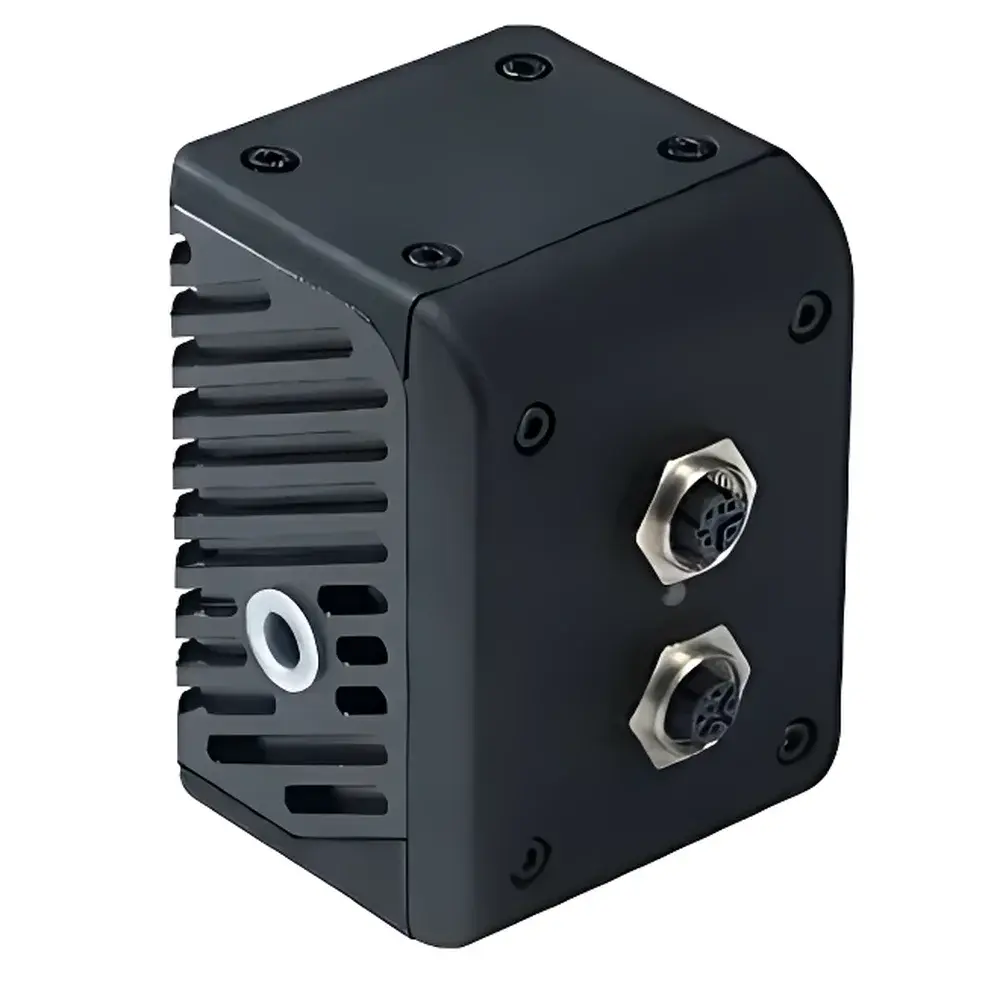
Atten2 C120 Online Oil Wear Particle Analyzer
| Brand | Atten2 |
|---|---|
| Origin | Spain |
| Model | C120 |
| Type | Online Instrument |
| Detection Target | Mechanical Contaminants (Wear Debris) |
| Particle Detection Threshold | ≥4 µm |
| Compliance | ISO 4406, NAS 1638 |
| Fluid Compatibility | Hydraulic Oil, Lubricating Oil, Fuel Oil, Mineral & Synthetic Oils, Coolants, Cutting Fluids, Cleaning Solutions |
| Data Transmission | Wired Ethernet Gateway / Wireless (Wi-Fi/LoRaWAN) |
| AI Engine | Trained on >500 Commercial Lubricant Models & Lab-Validated Ferrographic Image Database |
Overview
The Atten2 C120 Online Oil Wear Particle Analyzer is an industrial-grade, real-time lubricant health monitoring system engineered for predictive maintenance in mission-critical rotating and hydraulic equipment. It operates on a validated digital image analysis principle—capturing high-resolution microscopic video streams of flowing oil through an integrated flow cell, then applying proprietary computer vision algorithms to extract morphological, chromatic, and spatial features of suspended particles. Unlike conventional particle counters relying solely on light blockage or scattering, the C120 performs root-cause wear mode classification—including fatigue spalling, cutting abrasion, adhesive wear, and pitting—by correlating particle shape, edge sharpness, aspect ratio, surface texture, and grayscale distribution against a reference database built from over a decade of laboratory ferrography and accelerated aging studies. This enables not only quantitative contamination grading per ISO 4406 and NAS 1638 standards but also qualitative failure mode attribution directly at the sensor level.
Key Features
- Real-time, continuous monitoring without oil sampling or system shutdown—designed for permanent inline installation in pressurized lubrication circuits (up to 10 bar).
- AI-powered particle morphology classification engine trained on >500 commercial lubricant formulations, with expandable model library for customer-specific oils.
- Detection sensitivity down to 4 µm equivalent spherical diameter (ESD), with automated discrimination between solid wear debris, water droplets, air bubbles, and fiber contaminants.
- Multi-parameter oil health assessment: particle count & size distribution, color degradation index (CDI), turbidity trend analysis, and inferred additive depletion patterns via spectral shift modeling.
- Rugged IP67-rated housing with stainless steel wetted parts (316L), compatible with mineral, synthetic, and bio-based oils as well as aqueous coolants and cleaning fluids.
- Embedded data preprocessing unit supports local edge computing—reducing bandwidth requirements and enabling deterministic latency for alarm-triggered actions.
Sample Compatibility & Compliance
The C120 is validated for use across diverse fluid systems including turbine oils, gear oils, hydraulic fluids (ISO L-HM, L-HV), engine oils (API CK-4, FA-4), aviation lubricants (MIL-PRF-23699), and industrial coolants. Its optical design accommodates viscosities ranging from 2 cSt to 460 cSt at 40°C, with automatic flow-rate compensation across 0.5–15 L/min. All reported cleanliness metrics conform to ISO 4406:2017 (code format) and NAS 1638 Class Code definitions. The system architecture supports audit-ready data integrity: time-stamped raw image archives, immutable metadata logging (temperature, pressure, flow rate), and optional integration with GLP/GMP-compliant LIMS platforms. While not certified as medical or aerospace flight hardware, it meets CE, RoHS, and ATEX Zone 2/22 (optional) directives for industrial deployment.
Software & Data Management
The Atten2 Insight™ software suite provides browser-based configuration, visualization, and diagnostic reporting. Each C120 node transmits structured JSON payloads containing particle event logs, cleanliness codes, wear mode probability scores (e.g., “Fatigue: 87%, Cutting: 12%, Pitting: <1%”), and trend charts aligned to ISO 4406 delta-change thresholds. Data ingestion supports MQTT, OPC UA, and RESTful API protocols for seamless integration into existing CMMS (e.g., IBM Maximo, SAP PM), SCADA, or IIoT platforms such as Siemens MindSphere or PTC ThingWorx. Audit trails include full change history, user access logs, and electronic signatures compliant with FDA 21 CFR Part 11 requirements when deployed with validated identity management. Firmware updates are delivered over-the-air with cryptographic signature verification and rollback capability.
Applications
- Power Generation: Wind turbine gearboxes, hydroelectric thrust bearings, steam turbine lube systems—enabling >98% uptime extension by detecting incipient micropitting before vibration signatures emerge.
- Mining & Heavy Equipment: Continuous monitoring of haul truck differentials, shovel swing motors, and conveyor gearbox sumps to prioritize field maintenance and avoid catastrophic bearing seizure.
- Rail Transport: Real-time health tracking of locomotive traction motor oils and bogie gearbox lubricants under variable load and thermal cycling conditions.
- Marine Propulsion: Main engine cylinder oil and reduction gear monitoring aboard container vessels and offshore support vessels, where lab turnaround delays are operationally prohibitive.
- Manufacturing Infrastructure: CNC machine tool hydraulic systems, extruder gearmotors, and robotic joint lubricants—supporting zero-defect production targets through proactive oil life optimization.
FAQ
How does the C120 differentiate wear particles from air bubbles or water droplets?
The system applies multi-spectral illumination and temporal coherence analysis: bubbles exhibit rapid Brownian motion and refractive index shifts under polarized light, while water droplets show characteristic meniscus curvature and lower contrast gradients—both rejected by the AI classifier using convolutional neural network (CNN) feature maps trained on labeled ferrographic ground truth data.
Can the C120 be installed on existing equipment without modifying the lubrication circuit?
Yes—it integrates via standard 1/2″ NPT or G1/2 threaded ports using a bypass loop configuration. No oil draining or system isolation is required during commissioning; flow calibration is performed automatically during initial startup.
Does the system require periodic recalibration or consumables?
No. The optical path is sealed and self-diagnosing; drift compensation is handled algorithmically using internal reference frames. There are no filters, lamps, or reagents to replace—only routine visual inspection of the flow cell window per OEM maintenance schedules.
Is raw image data stored locally or transmitted to the cloud?
Raw video clips (1–3 seconds per alarm event) are retained onboard for 72 hours; only processed metadata and summary statistics are transmitted unless configured for extended edge storage (optional SD card module). Customer retains full ownership and control of all imaging assets.
What validation documentation is provided for regulatory audits?
Each unit ships with a Factory Calibration Certificate traceable to NIST standards, ISO/IEC 17025-accredited test reports for particle sizing accuracy, and a Software Verification Protocol (SVP) documenting algorithm training datasets, validation metrics (precision/recall >92% for top-three wear modes), and cybersecurity hardening measures.




