
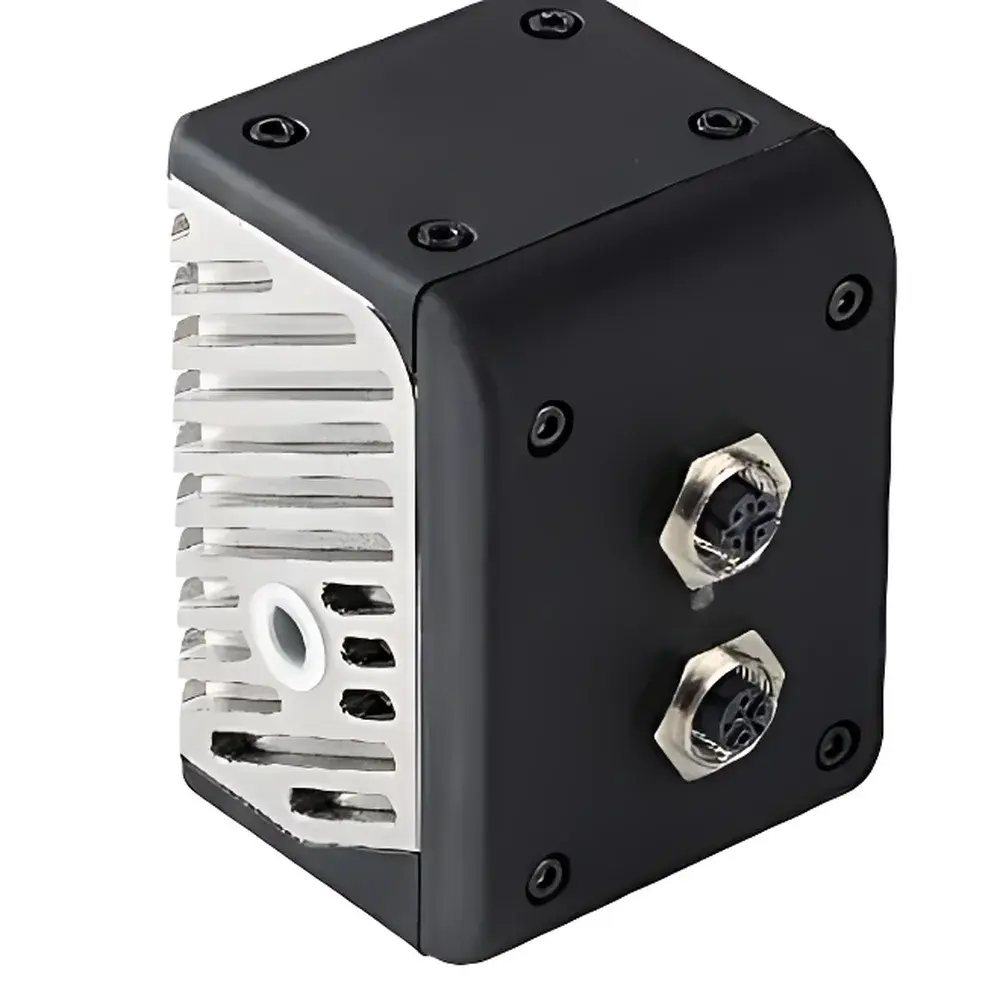
Atten2 EX S100 Intrinsically Safe Online Oil Cleanliness Sensor
| Brand | Atten2 |
|---|---|
| Origin | Spain |
| Model | EX S100 |
| Product Type | Online Instrument |
| Detection Parameter | Mechanical Contaminants |
| Compliance | ATEX/IECEx Certified for Hazardous Areas |
| Particle Detection Threshold | ≥4 µm |
| Output Standards | ISO 4406, NAS 1638 |
| Compatible Fluids | Hydraulic Oils, Lubricating Oils, Mineral & Synthetic Oils, Fuels, Coolants, Cutting Fluids, Aqueous Solutions |
Overview
The Atten2 EX S100 Intrinsically Safe Online Oil Cleanliness Sensor is an ATEX- and IECEx-certified inline monitoring system engineered for continuous, real-time assessment of particulate contamination in lubricating and hydraulic fluids within explosive atmospheres (Zone 1/21). Unlike conventional particle counters relying solely on light obscuration or pore-blockage principles, the EX S100 employs high-resolution digital imaging coupled with embedded AI-driven morphological analysis to characterize suspended particles at ≥4 µm. Its core measurement methodology integrates dynamic image capture of flowing oil through a precision flow cell, followed by pixel-level feature extraction—including particle size distribution, aspect ratio, convexity, edge texture, and grayscale intensity gradients—to infer wear mechanism origin (e.g., fatigue spalling, abrasive cutting, adhesive scuffing, or corrosion debris). This enables not only quantitative cleanliness grading per ISO 4406 and NAS 1638 but also root-cause attribution of contamination—critical for predictive maintenance in safety-critical infrastructure.
Key Features
- Intrinsically safe design certified to ATEX Directive 2014/34/EU (II 2G Ex db IIB T4 Gb / II 2D Ex tb IIIB T135°C Db) and IECEx Scheme (Ex db IIB T4 Gb / Ex tb IIIB T135°C Db), enabling direct installation in hazardous zones without explosion-proof enclosures.
- Real-time particle imaging at up to 60 fps with optical resolution sufficient to resolve features down to 4 µm; no sample dilution or offline filtration required.
- Proprietary AI engine trained on >12 million manually annotated ferrographic images across 500+ commercial lubricant formulations, including baseline degradation profiles for additive depletion, oxidation-induced color shift, water ingress (via refractive index anomaly detection), and viscosity-related flow dynamics.
- Automated distinction between solid particulates and entrained microbubbles using temporal coherence analysis and refractive boundary modeling—eliminating false positives common in optical sensors operating under turbulent flow.
- Modular hardware architecture supporting both fixed-mount integration into OEM lube systems and portable deployment via NPT 1/2″ threaded interface; compatible with DIN EN 14628-compliant sampling manifolds.
Sample Compatibility & Compliance
The EX S100 operates across a broad fluid matrix: mineral-based and PAO/PAG synthetic lubricants (ISO VG 10–680), turbine oils, compressor oils, diesel and jet fuels, water-glycol and polyalkylene glycol (PAG) coolants, alkaline cleaning solutions, and emulsified metalworking fluids. It maintains measurement integrity under fluid temperatures from −20 °C to +80 °C and pressures up to 10 bar. All firmware and data handling comply with ISO/IEC 17025:2017 traceability requirements for condition monitoring instrumentation. The sensor’s embedded audit trail meets GLP and GMP documentation standards, with timestamped event logs, configuration change records, and raw image archiving supporting FDA 21 CFR Part 11 electronic record integrity protocols where integrated with validated SCADA or CMMS platforms.
Software & Data Management
The EX S100 interfaces via Modbus TCP or OPC UA to centralized monitoring systems. Its native OilWear Analytics Suite provides browser-based visualization of real-time cleanliness class trends, particle morphology heatmaps, wear mode probability scoring (fatigue vs. abrasion vs. corrosion), and automated alerting based on configurable thresholds aligned with ISO 12171 (oil condition monitoring for rotating machinery). Raw image datasets are stored locally on encrypted industrial-grade microSD cards (optional cloud sync via TLS 1.3) and retain full metadata—including flow rate, temperature, pressure, and ambient humidity—for retrospective forensic analysis. Software updates follow IEC 62443-2-4 secure development lifecycle practices, with cryptographic signature verification enforced prior to firmware execution.
Applications
This sensor is deployed in mission-critical rotating equipment where unplanned downtime carries severe operational or safety consequences: wind turbine gearboxes (IEC 61400-25 compliance), coal mine conveyor drive trains, offshore platform hydraulic control systems, nuclear plant auxiliary lubrication circuits, marine main engine sump monitoring, rail traction motor gear oil loops, and tunnel boring machine (TBM) cutterhead bearing systems. In power generation, it supports ISO 55001-aligned asset management by correlating early-stage particle morphology shifts with vibration spectra anomalies—enabling targeted inspection before catastrophic failure. Case studies across European utility operators demonstrate 98% reduction in unscheduled outages when paired with proactive oil reclamation scheduling guided by AI-validated contamination source identification.
FAQ
Does the EX S100 require calibration against reference standards?
Yes—initial field calibration uses ISO MTD (Medium Test Dust) and ISO ACD (Air Cleaner Dust) slurries traceable to NIST SRM 2806; annual verification is recommended per ISO 4406 Annex B.
Can the system differentiate between wear debris and external contaminants like sand or rust?
Yes—its morphology classifier cross-references particle shape descriptors against a domain-specific database trained on >300,000 ferrography samples, assigning probabilistic origin labels with quantified confidence intervals.
Is wireless communication supported for remote hazardous-area installations?
Yes—optional integrated LoRaWAN or LTE-M modules enable secure telemetry transmission without breaching intrinsic safety barriers; all radio firmware is pre-certified under ETSI EN 300 328 and FCC Part 15.
How does the sensor handle high-viscosity oils such as gear oils?
It incorporates a thermostatically regulated flow cell with active shear-rate control (100–1000 s⁻¹) to ensure laminar flow conditions and uniform particle dispersion, validated per ASTM D7687 for viscous fluid imaging.
What cybersecurity measures are implemented in the embedded firmware?
Firmware employs hardware-enforced secure boot, runtime memory encryption, TLS 1.3 for all network endpoints, and role-based access control (RBAC) compliant with IEC 62443-3-3 SL2 requirements.





