
attoCFM I Cryogenic Confocal Microscope System with Dry Magnet and High-Field Capability
| Brand | attocube |
|---|---|
| Origin | Germany |
| Model | attoCFM I |
| Instrument Type | Magnetic Force Microscope (MFM) / Cryogenic Confocal Microscope |
| Positioning Noise | < 0.5 nm |
| Sample Size Capacity | Ø100 mm |
| Sample Stage Travel Range | 150 µm (fine scan) / 5 × 5 × 5 mm³ (coarse positioning) |
| Temperature Range | 1.8 K – 300 K |
| Magnetic Field | Up to 12 T (vector magnet optional) |
| Vacuum Operation | 1 × 10⁻⁶ mbar – 1 atm |
| Numerical Aperture (NA) | 0.82 |
| Optical Resolution | ~550 nm (@635 nm) |
| Working Distance (WD) | 0.7 mm |
| Confocal Scan Range | 30 × 30 µm² @4 K |
| Compatible Cryostats | attoDRY1000/2100, Quantum Design PPMS (1″/2″ bore) |
| Expandable Modules | AFM/MFM/PFM/KPFM/ct-AFM/cryo-Raman |
Overview
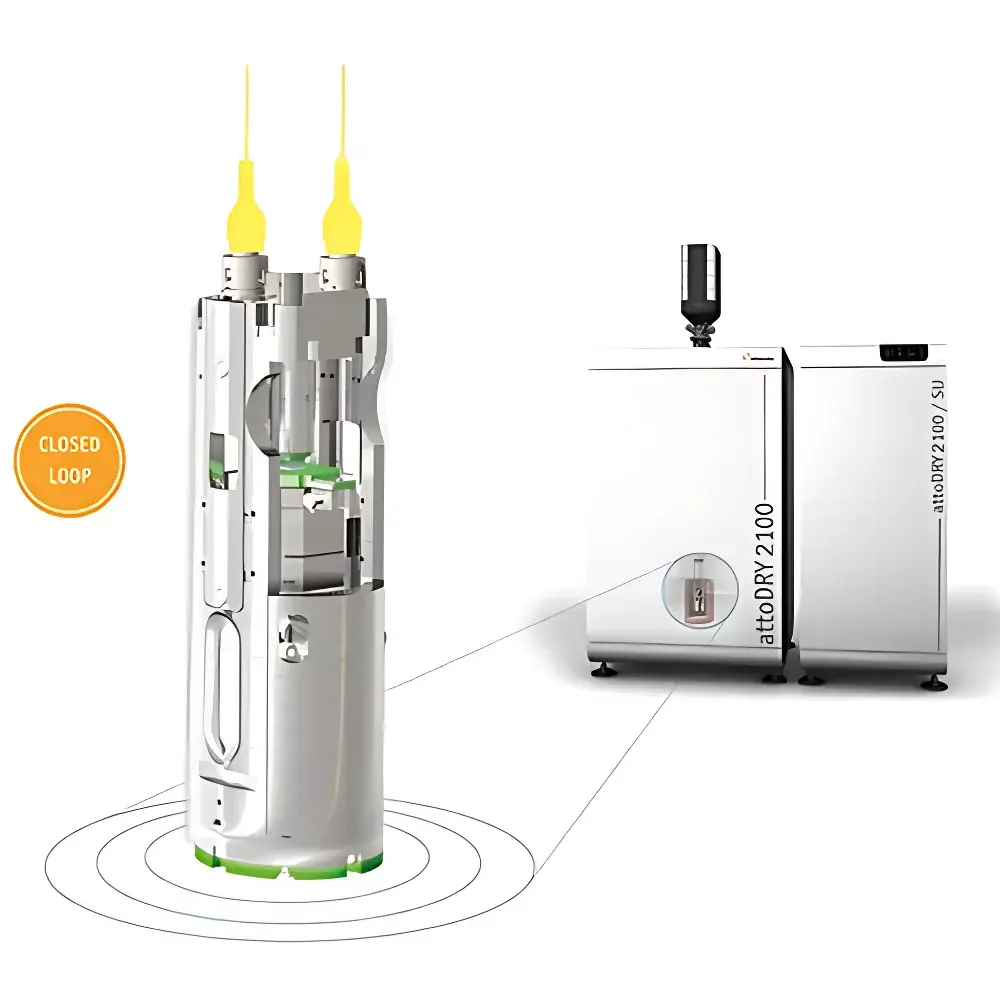
The attoCFM I is a fully integrated, helium-free cryogenic confocal microscope system engineered for nanoscale optical spectroscopy and magneto-optical characterization under extreme conditions. Operating on the principle of point-scanning confocal fluorescence detection, it combines high-spatial-resolution optical imaging with simultaneous control of temperature (1.8 K–300 K), magnetic field (up to 12 T), electric bias, and precise XYZ sample positioning. Its core architecture integrates the attoDRY series closed-cycle cryocooler, a high-stability scanning head (attoCFM-MC), and a purpose-built low-vibration optical breadboard platform. Unlike conventional liquid-helium-dependent systems, the attoCFM I eliminates cryogen logistics while maintaining sub-nanometer mechanical stability—enabling long-duration, high-reproducibility measurements essential for quantum emitter photophysics, spin-resolved luminescence, and coherent optical spectroscopy in condensed matter physics.
Key Features
- Helium-free operation via attoDRY1000/2100 closed-cycle cryostat—no liquid helium handling, refills, or boil-off losses
- Ultra-low vibration design: RMS displacement 1 h, validated for single-photon counting and lifetime mapping
- Multi-configurable optical head supporting up to three independent optical paths: excitation, collection, and optional auxiliary channel (e.g., Raman scattering or pump-probe)
- High-NA (0.82) cryogenic achromatic objective optimized for 400–1000 nm range; diffraction-limited spot size < 1 µm at 635 nm; working distance 0.7 mm
- Dual-stage positioning: coarse translation (5 × 5 × 5 mm³) with motorized piezo-driven fine scan (30 × 30 µm² @ 4 K; 50 × 50 µm² @ 300 K)
- Faraday and Voigt geometry compatibility—adjustable sample mount and objective orientation enable both perpendicular and in-plane magnetic field configurations
- Modular expansion interface supporting cryogenic atomic force microscopy (AFM), magnetic force microscopy (MFM), Kelvin probe force microscopy (KPFM), conductive AFM (ct-AFM), and cryo-Raman spectroscopy
- Integrated external CCD camera (75 µm field of view) for real-time low-temperature sample navigation and alignment
Sample Compatibility & Compliance
The attoCFM I accommodates planar solid-state samples up to Ø100 mm in diameter and ≤5 mm thickness, including semiconductor quantum dots, transition metal dichalcogenides (TMDs), graphene heterostructures, topological insulators, and superconducting thin films. Its vacuum-compatible chamber (1 × 10⁻⁶ mbar base pressure, operable up to ambient pressure) permits controlled gas environments for in situ optical studies. All electrical feedthroughs support 36-channel low-noise cabling with calibrated thermal anchoring and EMI shielding. The system complies with ISO 14644-1 Class 5 cleanroom requirements for optical path integrity and meets mechanical stability benchmarks defined in ASTM E2581 for high-resolution scanning probe instrumentation. For regulated laboratories, full audit trails—including temperature setpoint logs, magnetic field ramp profiles, and stage position timestamps—can be exported in CSV/JSON format for GLP/GMP documentation.
Software & Data Management
Control and data acquisition are managed through the proprietary attoDRY Control Suite v4.x, a deterministic real-time software platform built on LabVIEW Real-Time OS. It supports synchronized multi-parameter sweeps (e.g., B-field vs. emission wavelength vs. polarization angle) with sub-millisecond timing resolution. All raw photon counts, spectrometer frames, and stage coordinates are time-stamped with hardware-level precision using an onboard FPGA. Export formats include HDF5 (with metadata schema compliant with NeXus standards), TIFF stacks, and ASCII tables suitable for downstream analysis in Python (NumPy/SciPy), MATLAB, or Igor Pro. Optional integration with third-party spectral analysis tools (e.g., Horiba LabSpec, WITec Project) is available via TCP/IP API. Full 21 CFR Part 11 compliance—including electronic signatures, role-based access control, and immutable audit logs—is achievable with enterprise licensing.
Applications
The attoCFM I serves as a foundational platform for advanced quantum material characterization across multiple domains: (1) Spin-photon interface studies in color centers (NV⁻, SiV, GeV) under vector magnetic fields; (2) Valley-selective photoluminescence mapping in monolayer MoS₂ and WSe₂; (3) Magneto-Raman spectroscopy of phonon Zeeman splitting in 2D magnets (CrI₃, Fe₃GeTe₂); (4) Spatially resolved photocurrent imaging in van der Waals p–n junctions; (5) Coherent population trapping and optical Stark effect measurements in semiconductor quantum wells; (6) In situ correlation of topographic, electrostatic, and optical responses via hybrid AFM–CFM modes. Its modular architecture enables seamless transition from basic confocal PL to multimodal cryo-correlative microscopy.
FAQ
Does the attoCFM I require liquid nitrogen or liquid helium for operation?
No—the system operates exclusively with closed-cycle cryocoolers (attoDRY1000/2100). No cryogens are needed at any stage.
Can the system be upgraded to include AFM or MFM capabilities post-purchase?
Yes—hardware and software upgrade kits are available for retrofitting AFM, MFM, PFM, KPFM, ct-AFM, and cryo-Raman modules without disassembly.
What vacuum levels are supported, and is differential pumping possible?
The base vacuum is 1 × 10⁻⁶ mbar; optional differential pumping stages can extend operational range down to 1 × 10⁻⁹ mbar for ultra-high-vacuum optical experiments.
Is the system compatible with commercial PPMS platforms?
Yes—it supports direct integration with Quantum Design PPMS systems using standard 1″ and 2″ bore adapters and custom mounting flanges.
How is optical alignment maintained during cooldown from 300 K to 4 K?
The cryogenic achromatic objective is actively compensated for thermal drift via integrated strain-relief mechanics and zero-expansion glass elements, ensuring < 50 nm focal shift across the full temperature range.





