
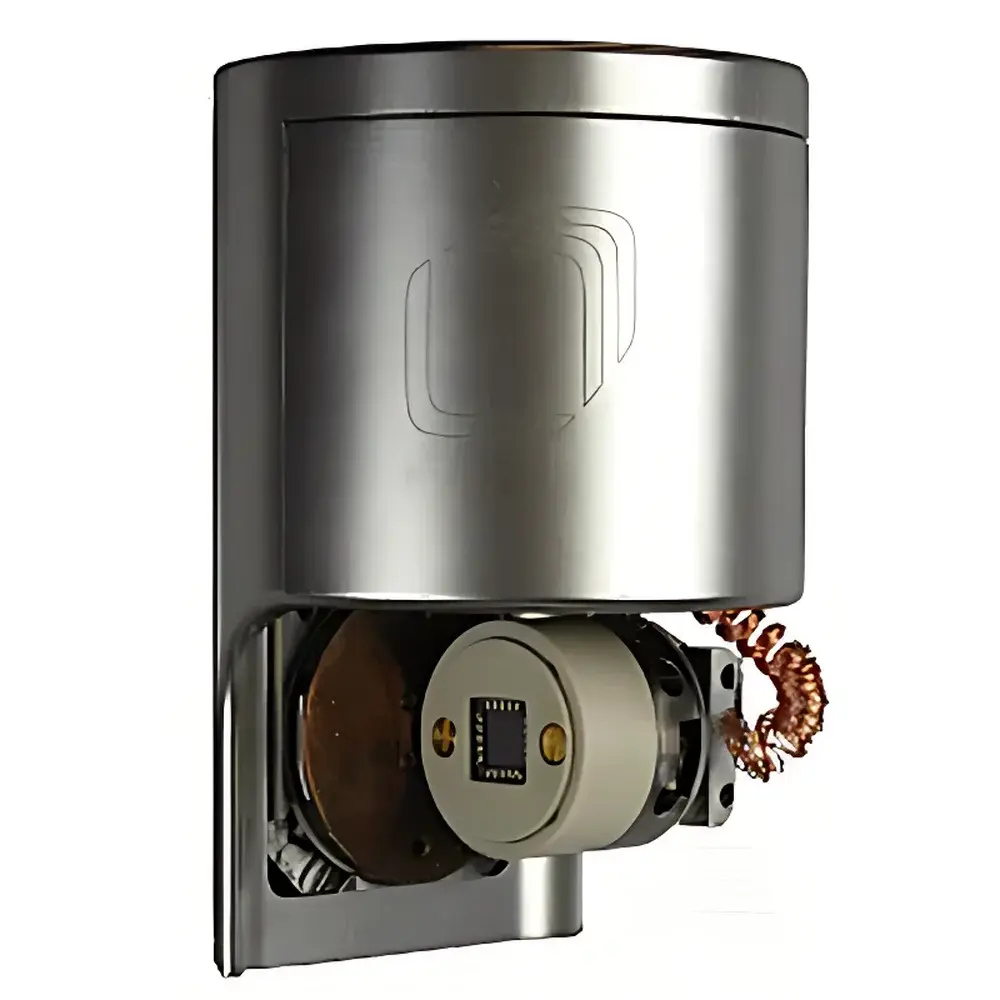
Attocube atto3DR Low-Temperature Dual-Axis Rotational Stage
| Brand | Attocube Systems AG |
|---|---|
| Origin | Germany |
| Product Type | Motorized Translation & Rotation Stage |
| Model | atto3DR |
| Sample Mounting Area | 4.9 mm × 4.9 mm × 1.2 mm |
| Electrical Contacts | 20-pin Chip Carrier Interface |
| Angular Range | ±90° per axis (mechanical reserve: ±10°) |
| Minimum Step Size | 1 m° @ 300 K |
| Max. Rotation Speed | ~30°/s @ 300 K |
| Feedback Sensor | Resistive Encoder |
| Encoder Resolution | ~6 m° |
| Repeatability | ~50 m° |
| Linearity Error | ~1% |
| Compatible Cryostat Environment | Dilution Refrigerators (down to <20 mK), He atmosphere |
| Plug-and-Play Integration | Yes |
| Control Interface | GUI & LabVIEW API |
Overview
The Attocube atto3DR is a cryogenically compatible, dual-axis rotational stage engineered for ultra-high-precision angular positioning of quantum devices under extreme low-temperature and high-magnetic-field conditions. Unlike conventional vector magnet systems—which are physically limited in maximum field magnitude across orthogonal axes—the atto3DR enables full 3D vector field synthesis by rotating a sample within a fixed high-field superconducting magnet (e.g., 9 T or 12 T vertical or horizontal bore). By decoupling field generation from field orientation, the atto3DR achieves effective 9 T–9 T–9 T vector field capability without requiring prohibitively complex or unavailable multi-coil vector magnets. Its core architecture relies on two orthogonal, independently controlled rotation axes: one enabling polar tilt (±90°) relative to the external field direction, and the other providing in-plane azimuthal rotation (±90°), thereby permitting arbitrary orientation of the sample crystallographic axes with respect to the applied magnetic field vector. Designed for integration into dilution refrigerators (including Leiden CF-CS81-600 and similar 81 mm cold-finger systems), the atto3DR operates reliably below 20 mK while maintaining sub-millidegree angular reproducibility and minimal heat load (<1 µW dissipation during operation at 60 V, 4 Hz, 300 nF).
Key Features
- True in situ dual-axis rotation with independent control of polar and azimuthal angles—enabling full Euler-angle manipulation of sample orientation inside static high-field magnets
- Integrated 20-pin chip carrier interface for simultaneous electrical access to nanoscale devices, supporting DC, low-frequency AC, and RF measurements without signal degradation
- Closed-loop operation via high-stability resistive encoders, delivering traceable angular feedback with ~6 m° resolution and ~50 m° repeatability at base temperature
- Plug-and-play mechanical and electrical integration with standard dilution refrigerator insert designs, including direct mounting onto 81 mm cold fingers using custom adapter plates
- LabVIEW-compatible driver suite and intuitive GUI for automated sequence programming, real-time position monitoring, and synchronization with data acquisition systems
- Optimized thermal design: low-power piezoelectric actuators, minimized Joule heating, and thermally anchored signal routing ensure stable operation at <20 mK without compromising refrigeration efficiency
Sample Compatibility & Compliance
The atto3DR accommodates samples up to 4.9 mm × 4.9 mm × 1.2 mm and is routinely deployed with epitaxial heterostructures (e.g., graphene/hBN moiré superlattices), semiconductor nanowires, topological insulator flakes, and quantum dot arrays. Its chip carrier supports both wire-bonded and flip-chip interconnects, with all 20 contacts routed through low-thermal-conductivity, non-magnetic coaxial lines that pass axially through the stage center. The system complies with international standards for cryogenic instrumentation, including IEC 61000-6-2 (immunity) and IEC 61000-6-4 (emission), and is compatible with GLP/GMP-aligned experimental workflows when paired with audit-trail-enabled LabVIEW applications. While not intrinsically certified for FDA 21 CFR Part 11, its deterministic motion control, encoder-based position logging, and scriptable automation support full traceability required for regulated materials characterization.
Software & Data Management
Attocube provides a native Windows-based GUI with real-time encoder readout, trajectory planning, and macro scripting capabilities. The accompanying LabVIEW driver package includes VIs for absolute positioning, relative stepping, continuous scanning, and trigger-synchronized movement—enabling tight coupling with lock-in amplifiers, source-measure units (SMUs), and time-of-flight digitizers. All position data—including timestamps, commanded vs. actual angle, encoder counts, and error flags—are logged in HDF5 format for post-acquisition alignment with transport, Hall, or magnetoresistance datasets. Optional Python bindings (via DLL wrappers) allow integration into Jupyter-based analysis pipelines. No cloud dependency or proprietary runtime is required; all software runs locally and supports offline operation in shielded laboratory environments.
Applications
The atto3DR serves as a foundational tool in quantum transport metrology where field-angle dependence is critical. It has been used to resolve Shubnikov–de Haas oscillations with <0.1° angular resolution in GaAs/AlGaAs heterostructures at 100 mK (Rev. Sci. Instrum. 90, 023905, 2019), map Berry curvature in twisted bilayer graphene, and isolate spin-valley locking signatures in transition metal dichalcogenides. Its ability to align van der Waals heterostructures precisely parallel or perpendicular to B enables definitive distinction between in-plane and out-of-plane superconducting pairing symmetries—as demonstrated in trilayer graphene moiré superlattices exhibiting tunable Mott-insulator-to-superconductor transitions (Nature 572, 215–219, 2019). Additional validated use cases include anisotropic magnetoresistance mapping in skyrmion-hosting chiral magnets, angular-dependent quantum Hall effect studies in topological crystalline insulators, and zero-field nuclear magnetic resonance (NMR) sample alignment in high-field dilution refrigerators.
FAQ
Can the atto3DR operate inside a 10 T vertical-bore superconducting magnet?
Yes—its non-magnetic titanium construction and piezoelectric actuation ensure full functionality in static fields up to 15 T without torque-induced drift or hysteresis.
What is the thermal load introduced by the atto3DR at base temperature?
Under typical operating conditions (60 V, 4 Hz, 300 nF), total dissipated power remains below 1 µW, preserving dilution refrigerator cooling power at <200 mK.
Is vacuum compatibility guaranteed?
The stage is rated for UHV (≤10⁻⁹ mbar) and bakeable to 80 °C; all internal cabling uses ceramic-insulated, low-outgassing conductors.
How is angular calibration performed?
Factory calibration uses laser interferometry against NIST-traceable angular standards; users may perform in situ verification using known crystallographic symmetry points in diffraction or transport data.
Does Attocube provide application-specific mounting solutions?
Yes—custom cold-finger adapters, radiation shields, and RF-tight shielding cans are available upon request and have been implemented in multiple Leiden, Bluefors, and Oxford Instruments installations worldwide.





