
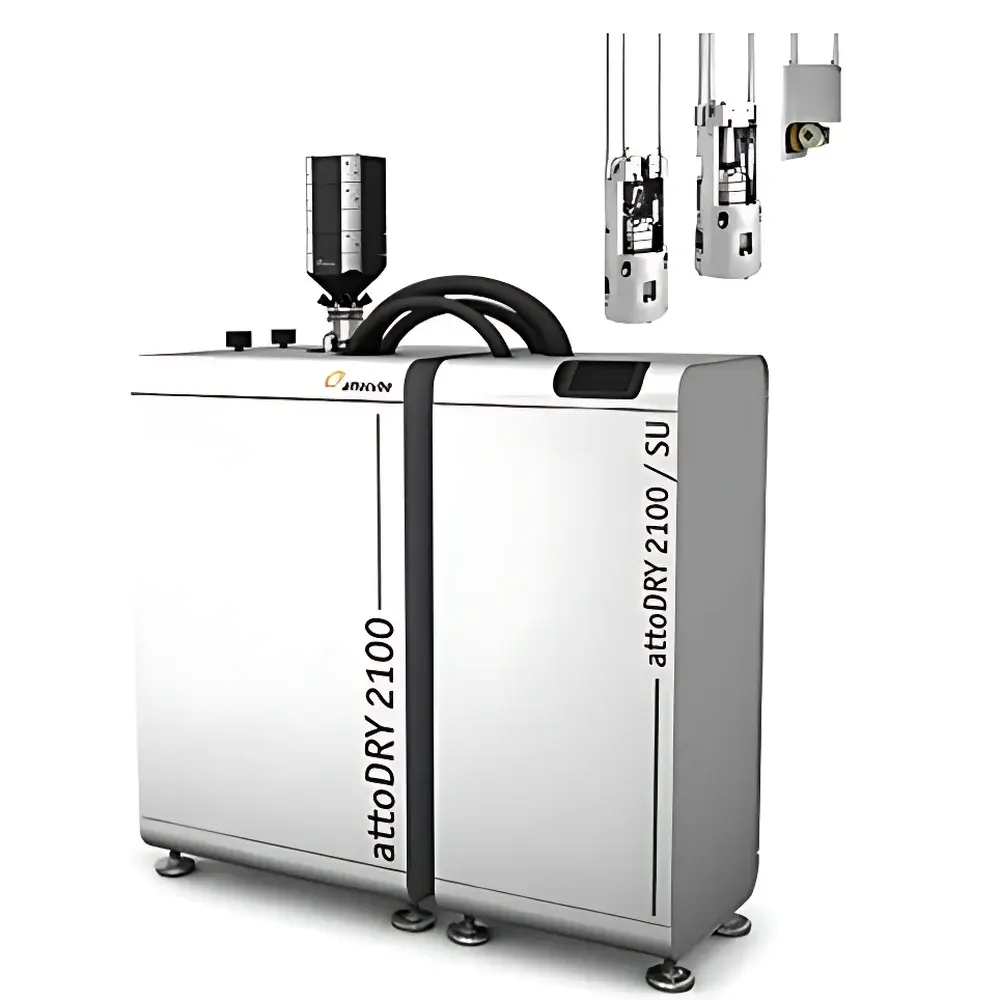
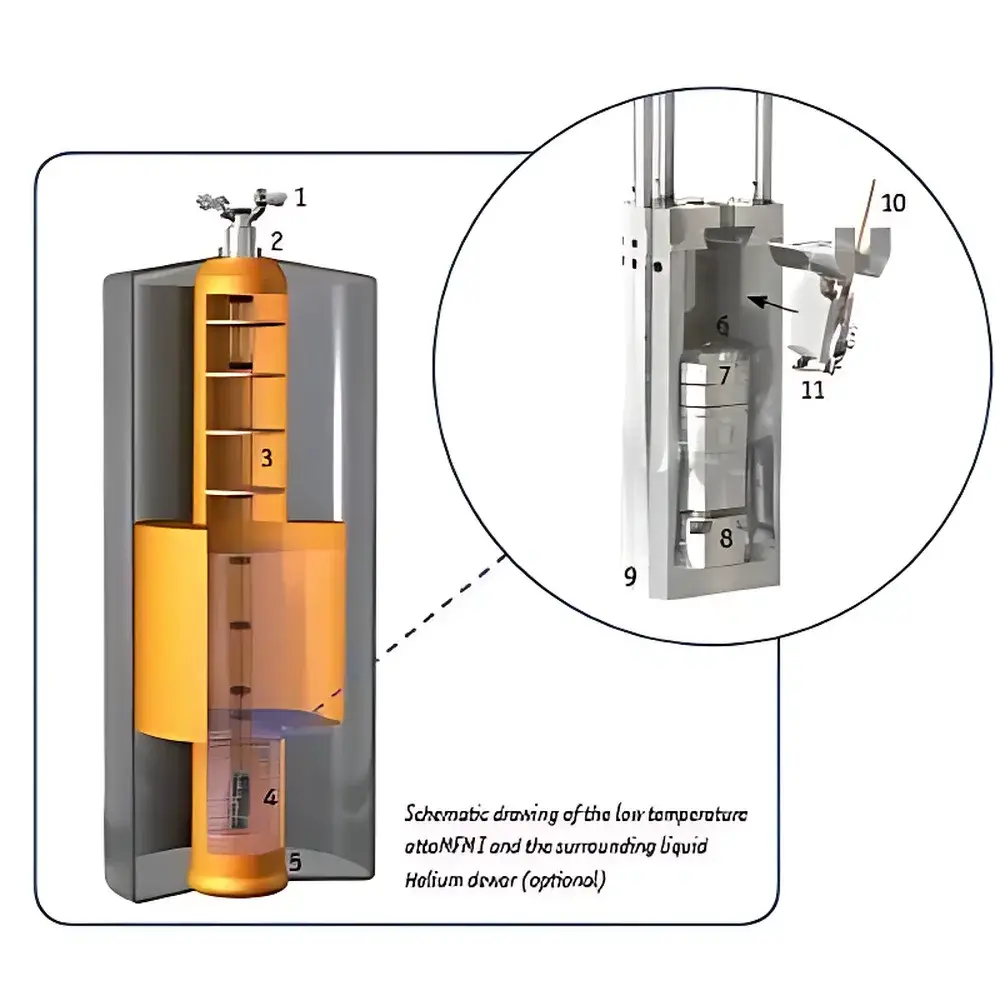
Attocube attoAFM/attoMFM/attoSHPM Low-Temperature High-Magnetic-Field Atomic Force, Magnetic Force, and Scanning Hall Probe Microscope
| Brand | Attocube Systems AG |
|---|---|
| Origin | Germany |
| Model | attoAFM/attoMFM/attoSHPM |
| Temperature Range | mK to 373 K |
| Magnetic Field Compatibility | up to 15 T |
| Scan Range (4 K) | 30 µm × 30 µm |
| Lateral Resolution (MFM) | < 11 nm |
| Lateral Resolution (SHPM) | 250 nm |
| Z-bit Resolution (4 K, full range) | 7.6 pm |
| Z-bit Resolution (4 K, scan range) | 0.12 pm |
| RMS Z-noise (4 K) | 0.05 nm |
| Vacuum/Atmosphere | 1×10⁻⁶ mbar to 1 bar (He exchange gas) |
| Compatible Cryostats/Magnets | Quantum Design PPMS (1″ & 2″ bore), custom dilution refrigerators |
Overview
The Attocube attoAFM/attoMFM/attoSHPM is a fully integrated, ultra-low-vibration scanning probe microscopy platform engineered for quantitative nanoscale magnetic, topographic, and electronic characterization under extreme cryogenic and high-magnetic-field conditions. Operating on the principles of piezoelectric sample scanning combined with optical beam deflection (AFM/MFM) or quantum Hall effect–based local field sensing (SHPM), this system enables correlative imaging across multiple modalities without mechanical reconfiguration. Its core architecture is built around a monolithic, interferometrically calibrated XYZ nanopositioning stage and a modular head design—allowing seamless transition between atomic force microscopy (AFM), magnetic force microscopy (MFM), and scanning Hall probe microscopy (SHPM) by swapping only the sensor head and associated optical path components. Designed for integration into 4 K closed-cycle cryostats, dilution refrigerators, and superconducting magnets (including Quantum Design PPMS systems with 1″ or 2″ bores), the platform supports operation from millikelvin temperatures up to 373 K and magnetic fields up to 15 Tesla—making it uniquely suited for probing vortex lattices in type-II superconductors, domain wall dynamics in frustrated magnets, and spin textures in skyrmionic materials.
Key Features
- Modular multimodal operation: Single-platform compatibility with AFM (contact, intermittent-contact, non-contact), MFM, conductive AFM (C-AFM), electrostatic force microscopy (EFM), SHPM, STM, SNOM, and confocal microscopy via interchangeable heads.
- Cryogenic-optimized mechanical design: Monolithic flexure-guided scanner with sub-picometer Z-bit resolution (0.12 pm over scan range at 4 K) and < 0.05 nm RMS Z-noise performance at base temperature.
- High-fidelity MFM implementation: Frequency-modulated (FM) or phase-locked loop (PLL)-driven resonance tracking ensures stable, closed-loop topography and magnetic gradient mapping with lateral resolution better than 11 nm.
- Quantitative SHPM capability: Molecular-beam-epitaxy (MBE)-grown GaAs/AlGaAs two-dimensional electron gas (2DEG) Hall sensors enable absolute, non-perturbative local Bz field measurement with 250 nm spatial resolution and sub-nanotesla sensitivity at mK temperatures.
- Full environmental flexibility: Compatible with ultra-high vacuum (1×10⁻⁶ mbar), high-pressure helium exchange gas (up to 1 bar), and inert atmospheres—enabling studies of air-sensitive quantum materials.
- Integrated real-time position monitoring: External CCD camera coupled to the sample stage provides visual feedback for precise alignment and navigation under cryogenic conditions.
Sample Compatibility & Compliance
The attoAFM/attoMFM/attoSHPM accommodates standard semiconductor wafers, exfoliated 2D crystals, epitaxial thin films, bulk single crystals, and mesoscopic device structures mounted on standard 10 mm × 10 mm substrates. Its 5 mm × 5 mm × 5 mm coarse positioning range (at 4 K) and sub-500 nm step resolution allow reliable targeting of specific device regions or crystallographic domains. The system complies with ISO/IEC 17025 requirements for measurement traceability when used with NIST-traceable calibration standards (e.g., Si grating reference samples, certified magnetic force standards). For regulated environments—including GLP-compliant materials development labs and GMP-aligned quantum device qualification workflows—the optional audit trail module logs all instrument parameters, user actions, and environmental metadata in accordance with FDA 21 CFR Part 11 requirements.
Software & Data Management
Control and data acquisition are managed via Attocube’s proprietary attoDRY software suite, built on a deterministic real-time Linux kernel and compatible with MATLAB® and Python APIs for custom algorithm integration. All raw sensor signals—including photodiode quadrants (AFM/MFM), Hall voltage time series (SHPM), and lock-in demodulated channels—are recorded with 24-bit resolution and timestamped to within 100 ns. Image reconstruction supports FFT-based deconvolution, vector field visualization (Bx, By, Bz), and hysteresis loop extraction synchronized to external field sweeps. Data export follows HDF5 format with embedded metadata (temperature, field, pressure, PID settings), ensuring FAIR (Findable, Accessible, Interoperable, Reusable) compliance for institutional data repositories.
Applications
- Vortex lattice imaging and pinning analysis in high-Tc and iron-based superconductors (e.g., YBCO, FeSe, NbSe2) at sub-500 mK and >9 T.
- Quantitative mapping of stray fields from magnetic skyrmions, domain walls, and antiferromagnetic order parameters in multiferroics and van der Waals magnets.
- In situ magnetotransport correlation: Simultaneous SHPM field mapping and four-probe resistivity measurements during field-cooled/zero-field-cooled protocols.
- Nanoscale current density profiling in topological insulator edge states and Josephson junction arrays using C-AFM + MFM co-imaging.
- Strain-mediated magnetoelectric coupling studies in heterostructures (e.g., PMN-PT/CoFeB) via temperature- and field-dependent domain evolution tracking.
FAQ
Can the same sample stage be used for both MFM and SHPM measurements?
Yes—the platform uses a common XYZ nanopositioner and sample holder; only the sensor head and optical path require physical replacement.
What is the minimum detectable magnetic field gradient in MFM mode at 100 mK?
Under optimized FM-MFM conditions with ultra-low-noise cantilevers, the system achieves < 100 nT/√Hz sensitivity for field gradients at 10 nm tip–sample separation.
Is SHPM capable of vector field reconstruction?
No—attoSHPM measures only the out-of-plane (Bz) component quantitatively; vector reconstruction requires complementary techniques such as NV-center magnetometry or Lorentz TEM.
Does the system support automated hysteresis loop acquisition across temperature and field sweeps?
Yes—via scripting interface, users can define nested loops over T, B, and scan parameters; all data are time-synchronized and stored with full experimental context.
Are calibration procedures traceable to international standards?
Yes—topography calibration uses NIST SRM 2158 (Si grating); magnetic calibration employs certified thin-film standards with known remanent moment (e.g., CoCrTa disks) and finite-element modeled field profiles.



