
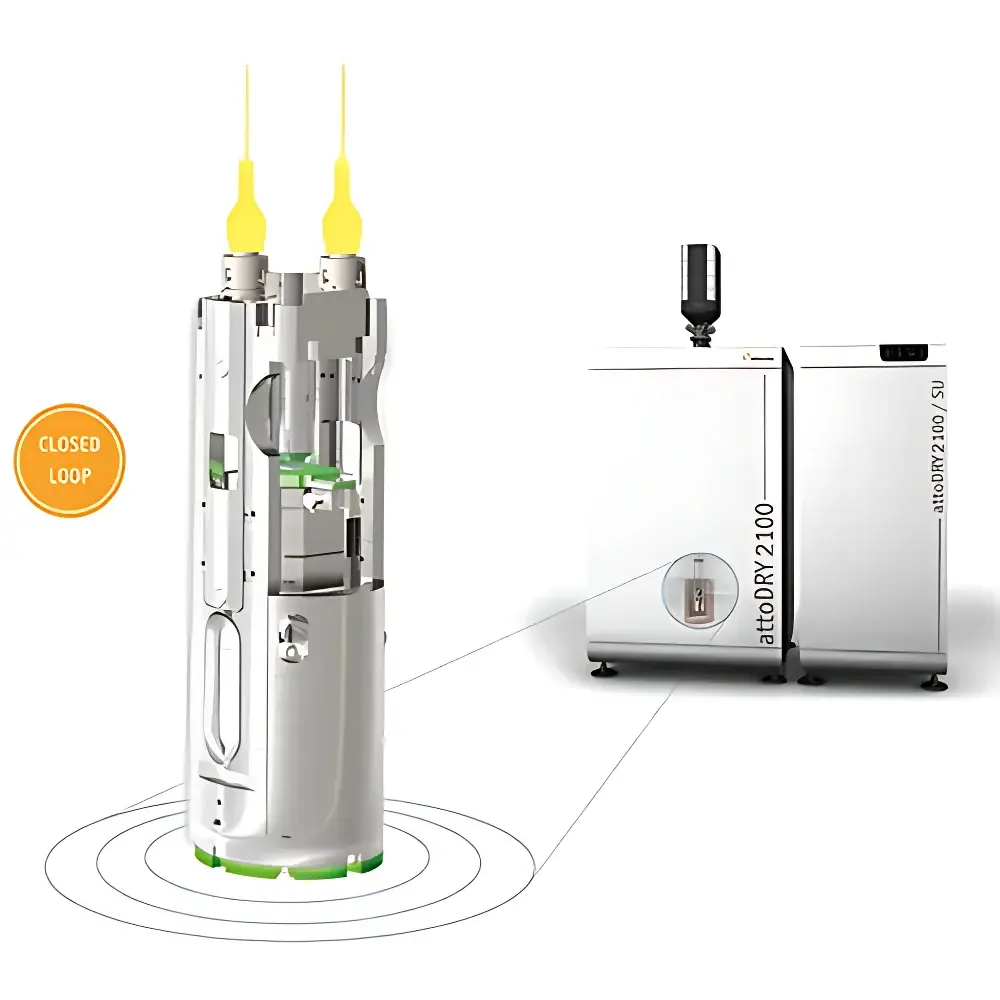
attocube attoCFM I Helium-Free Cryogenic High-Magnetic-Field Confocal Microscope
| Brand | attocube Systems AG |
|---|---|
| Origin | Germany |
| Model | attoCFM I |
| Instrument Type | Point-Scanning Confocal Microscope |
| Temperature Range | 1.8 K – 300 K |
| Magnetic Field | Up to 12 T (vector magnet optional) |
| Vacuum Range | 1×10⁻⁶ mbar – 1 atm |
| Numerical Aperture (NA) | 0.82 |
| Optical Resolution | ~550 nm (@635 nm) |
| Coarse Sample Positioning | 5 × 5 × 5 mm³ |
| Fine Scan Range | 30 × 30 µm² @ 4 K |
| Working Distance | 0.7 mm |
| Compatible Cryostats | attoDRY1000/2100, Quantum Design PPMS (1" & 2" bore) |
Overview
The attocube attoCFM I is a helium-free, cryogenic, high-magnetic-field point-scanning confocal microscope engineered for nanoscale optical spectroscopy and imaging under extreme experimental conditions. It integrates quantum-limited optical resolution with simultaneous control of temperature (1.8 K – 300 K), magnetic field (up to 12 T), electric bias, and sub-nanometer mechanical positioning—enabling correlative measurements of photoluminescence (PL), electroluminescence (EL), photocurrent, Raman scattering, and optoelectronic transport in quantum materials. Its operation relies on confocal laser scanning principles: excitation light is focused through a high-NA cryo-objective onto the sample, while emitted photons are collected via the same objective and spatially filtered by a pinhole before detection—ensuring axial sectioning, background suppression, and diffraction-limited lateral resolution (~550 nm at 635 nm). The system eliminates liquid helium dependency via the closed-cycle attoDRY cryostat platform, achieving ultra-low vibration (< 5 nm RMS) and long-term thermal stability—critical for time-resolved spectroscopy, spectral line narrowing, and single-emitter studies where signal-to-noise ratio and spectral fidelity are paramount.
Key Features
- Helium-free operation using the attoDRY1000/2100 closed-cycle cryostat with integrated superconducting magnet options (7 T, 9 T, or 12 T; vector configuration available)
- Modular optical head supporting up to three independent optical paths: one excitation channel, one detection channel, and one user-configurable auxiliary path—each with rapid, tool-free component exchange (e.g., filters, polarizers, beam splitters)
- Cryogenic apochromatic objective lens (NA = 0.82, WD = 0.7 mm) optimized for low-temperature, high-field environments—minimizing chromatic aberration, focal shift, and wavefront distortion down to 1.8 K
- Dual-stage sample positioning: coarse XYZ translation (5 × 5 × 5 mm³) with motorized precision drives and fine piezo-scanned range (30 × 30 µm² @ 4 K; 50 × 50 µm² @ 300 K)
- Faraday and Voigt geometry compatibility—achieved via interchangeable sample stages and objective mounting—enabling controlled alignment of magnetic field vectors relative to sample surface normal or in-plane orientation
- Integrated external CCD camera (75 µm field-of-view) for real-time low-temperature sample navigation and alignment, decoupled from the confocal detection path
- Expandable architecture supporting cryogenic AFM, MFM, PFM, KPFM, conductive-AFM (ct-AFM), and cryo-Raman modules without breaking vacuum or thermal cycle
Sample Compatibility & Compliance
The attoCFM I accommodates diverse solid-state quantum systems—including semiconductor quantum dots, 1D nanowires, graphene, transition metal dichalcogenides (TMDs), van der Waals heterostructures, topological insulators, and superconducting thin films. Sample mounting is compatible with standard electrical feedthroughs (36-channel wiring interface on optical probe rods), calibrated Pt100/Carbon thermometers, and resistive heaters for precise thermal management. The system meets fundamental requirements for GLP-compliant optical characterization: vacuum integrity (1×10⁻⁶ mbar base pressure), electromagnetic shielding (mu-metal optional), and mechanical stability verified per ISO 10360-2 for coordinate measuring instruments. All electronic controllers support IEEE-488 (GPIB) and Ethernet-based SCPI command sets, enabling traceable instrument control and audit-ready logging for regulated research environments.
Software & Data Management
Control and data acquisition are managed via the proprietary attoCONTROL software suite—designed for deterministic timing, hardware synchronization, and multi-parameter correlation. The software supports automated raster scanning, spectral acquisition (with grating monochromators or array detectors), time-resolved PL decay analysis (TCSPC-compatible), and lock-in detection for weak signal recovery. All raw datasets include embedded metadata (temperature, field, bias, position, laser power, integration time) compliant with HDF5 format and MIAME/MINSEQE standards. Export options include ASCII, MATLAB .mat, and Python-compatible .h5—facilitating integration into FAIR-aligned data pipelines. For regulatory compliance, optional 21 CFR Part 11–enabled audit trail mode logs all user actions, parameter changes, and instrument state transitions with digital signature and timestamp.
Applications
The attoCFM I serves as a foundational platform for quantum material characterization across multiple domains: magneto-optical spectroscopy of exciton valley polarization in MoS₂ under Voigt geometry; Zeeman splitting analysis of single quantum dot emission lines in Faraday configuration; photocurrent mapping of edge states in quantum anomalous Hall insulators; resonant Raman studies of phonon–magnon coupling in CrI₃; and correlated optoelectronic transport in gated graphene/hBN heterostructures. Its capability to maintain atomic-scale positional stability over hours enables long-duration experiments such as photon antibunching measurements, spin coherence time (T₂*) mapping, and gate-dependent Stark shift tracking—routinely cited in publications adhering to APS, Nature Portfolio, and ACS journal technical reporting standards.
FAQ
Does the attoCFM I require liquid helium refills?
No—the system operates exclusively with closed-cycle cryorefrigeration via the attoDRY platform, eliminating operational dependency on liquid cryogens and associated infrastructure.
Can the microscope be upgraded to include atomic force microscopy (AFM) functionality?
Yes—cryogenic AFM, MFM, PFM, KPFM, ct-AFM, and cryo-Raman modules are fully supported through mechanical, electrical, and software integration pathways defined in the attoCFM I expansion specification.
What vacuum levels are achievable, and how do they impact optical performance?
Base pressure reaches 1×10⁻⁶ mbar; higher pressures (up to 1 atm) are permissible using optional gas-handling modules. Ultra-high vacuum minimizes condensate formation on cold optics and suppresses thermal radiation noise—both critical for high-fidelity PL and Raman measurements.
Is the system compatible with third-party spectrometers or detectors?
Yes—standard FC/APC fiber interfaces, free-space coupling ports, and programmable TTL/Analog I/O enable seamless integration with external monochromators, superconducting nanowire single-photon detectors (SNSPDs), or EMCCD cameras.
How is calibration traceability ensured for temperature and magnetic field?
Temperature is monitored via factory-calibrated Pt100 sensors (traceable to NIST standards); magnetic field is calibrated using integrated Hall probes referenced to primary standards maintained by PTB (Physikalisch-Technische Bundesanstalt).





